Here is a restructured version of the article written in HTML syntax:
<div><br />
    <p>On the morning of December 7, 1941, Sgt. Kenneth Nine, a platoon sergeant with the 27th Infantry, found himself at the center of chaos. Scheduled to return to the United States, Nine was at Schofield Barracks when Japanese aircraft began their attack, marking America's entry into World War II. His commanding officer's words, "Get in the saddle because you aren't going anywhere," signaled the division's immediate involvement in the war.</p><br />
    <br />
    <p>Activated on October 1, 1941, the 25th Infantry Division emerged from the reorganization of the Hawaiian Division into two distinct units—the 24th and 25th Infantry Divisions. This newly formed division rapidly became a fierce combat force, participating from Pearl Harbor to Japan's occupation. Today, it remains stationed at Schofield Barracks, its origin point.</p><br />
<br />
    <h2><strong>Pearl Harbor: The Division's Trial by Fire</strong></h2><br />
    <p>The unexpected attack on Pearl Harbor saw the division's soldiers spring into action. Despite exhaustion from a late night, Sgt. Nine secured weapons and ammunition for defense. Amid the chaos, soldiers, including Cpl. Bronsil Metz, witnessed acts of bravery and desperation as they defended against the Japanese onslaught. The attack resulted in the division's first war casualties, with two soldiers dead and 17 wounded.</p><br />
    <br />
    <p>In the aftermath, the division took positions along Oahu's beaches, preparing for a potential invasion while training intensely in jungle warfare. Major General J. Lawton Collins assumed command in May 1942, bringing aggressive tactics that would earn him the nickname "Lightning Joe."</p><br />
<br />
    <h2><strong>Guadalcanal: A Crucial Offensive</strong></h2><br />
    <p>The division's first offensive against Japan began at Guadalcanal in December 1942. Relieving the Marines, the division faced challenging jungle conditions and a determined enemy. Cpl. James Jones, among the soldiers, later chronicled these experiences in his novels.</p><br />
    <br />
    <p>Under orders from XIV Corps commander Maj. Gen. Alexander Patch, the division launched an assault in January 1943 to seize strategic objectives near the Matanikau River. Despite fierce resistance and logistical challenges, the division secured its goals, with soldiers like Capt. Charles Davis and Tech. 4th Grade Lewis Hall displaying extraordinary valor.</p><br />
<br />
    <h2><strong>New Georgia and the Solomons Campaigns</strong></h2><br />
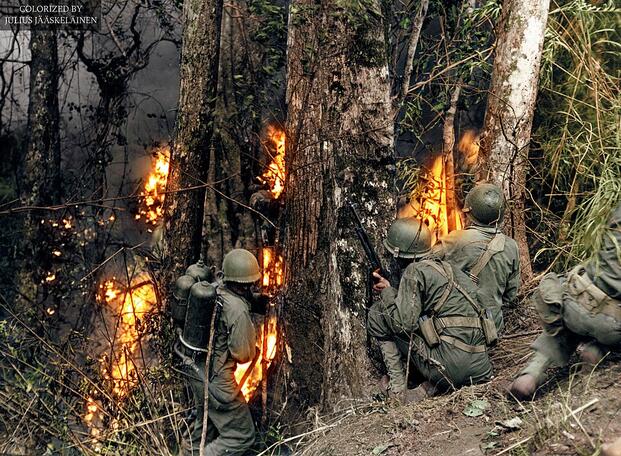
    <p>In July 1943, after Guadalcanal, the division aimed to capture Munda airfield on New Georgia. Led by Col. James Dalton, the division endured nine days of difficult terrain and hostile forces. The 27th Infantry's arduous march to Bairoko Harbor highlighted the challenges faced in these operations.</p><br />
    <br />
    <p>By October, the division had cleared Arundel Island and Kolombangara, contributing to the campaign's success. After a year of combat, the division moved to New Zealand for recuperation and training.</p><br />
<br />
    <h2><strong>The Liberation of the Philippines</strong></h2><br />
    <p>Landing at Lingayen Gulf on January 11, 1945, the division, now under Maj. Gen. Charles Mullins Jr., engaged Japanese forces across Luzon. The 161st Infantry faced entrenched Japanese defenses, while soldiers like Tech. 4th Grade Laverne Parrish and Master Sgt. Charles L. McGaha earned Medals of Honor for their bravery.</p><br />
    <br />
    <p>The division's operations in the Caraballo Mountains and the protracted battle for Balete Pass demonstrated their resilience. The loss of Brig. Gen. Dalton to a sniper highlighted the campaign's cost, which was the highest among Sixth Army divisions.</p><br />
<br />
    <h2><strong>Operation Downfall: Planning for Japan's Invasion</strong></h2><br />
    <p>As Operation Downfall loomed, the division prepared to land in Kyushu. However, the use of atomic bombs and the Soviet Union's entry into the war ended these plans. Instead, the division arrived in Japan on September 20, 1945, as part of the occupation forces.</p><br />
<br />
    <h2><strong>Turning Foes into Friends</strong></h2><br />
    <p>Stationed in Japan, the division played a key role in rebuilding efforts. They helped the Holy Family orphanage in Osaka, forming a lasting bond. This relationship continues today, with the division hosting children from the orphanage in Hawaii.</p><br />
    <br />
    <p>The division's efforts in Japan transformed former adversaries into allies, marking a significant chapter in their history before the outbreak of the Korean War necessitated their deployment from Japan.</p><br />
<br />
    <h2><strong>The Enduring Legacy of Tropic Lightning</strong></h2><br />
    <p>Through four WWII campaigns, the 25th Infantry Division earned its "Tropic Lightning" nickname for swift, decisive action. The division's story is immortalized in literature and film, with James Jones's novels offering a glimpse into their experiences.</p><br />
    <br />
    <p>Today, the division's patch—a lightning bolt on a Taro leaf—symbolizes its Hawaiian roots and combat achievements. From the Pearl Harbor attack to post-war Japan, the 25th Infantry Division remains a storied unit within the U.S. Army.</p><br />
</div><br />