In the late summer of 1921, the hills of Blair Mountain in West Virginia became the backdrop for the largest armed uprising in the United States since the Civil War. Thousands of coal miners, disillusioned by oppressive working conditions and determined to fight for union rights, took a stand against the coal companies. This confrontation would lead to a significant government intervention that set a precedent for future handling of domestic unrest.
President Warren Harding, faced with escalating violence, ultimately decided to intervene by deploying the U.S. Army. The Battle of Blair Mountain, as it came to be known, marked a turning point in the West Virginia Coal Wars, involving a massive military response to quell the miners’ insurrection.
Life in an Industrial Police State
The coal miners of West Virginia lived under harsh conditions often described as an industrial police state. They were bound to company-owned facilities for their work, shelter, and shopping, paid in scrip that was only useful within these confines. This system kept miners perpetually in debt as they rented tools and purchased overpriced goods, unable to escape their financial chains.
Mine safety was a secondary concern to production, leading to the highest death rates in the nation. In 1918 alone, 404 miners lost their lives to gas explosions, roof collapses, and mechanical failures. Attempts to organize unions were met with violence from the Baldwin-Felts Detective Agency, who enforced company rule through intimidation and brutality.
The Matewan Massacre
The tension reached a boiling point on May 19, 1920, when Baldwin-Felts agents attempted to evict unionizing miners in Matewan. Confronted by Police Chief Sid Hatfield and Mayor Cabell Testerman, a gunfight ensued, resulting in ten deaths, including the mayor and several agents. Hatfield emerged as a hero to the miners, symbolizing resistance against corporate oppression.
However, violence escalated as state forces, at the behest of coal operators, cracked down on union activities, resulting in the declaration of martial law in Mingo County and the imprisonment of numerous union activists.
The March on Blair Mountain
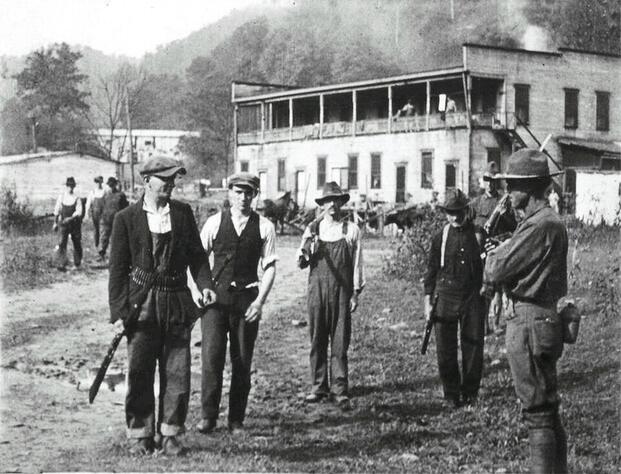
In August 1921, after the assassination of Hatfield by Baldwin-Felts agents, miners gathered en masse, prepared to march to Mingo County to free imprisoned union members. They faced Logan County Sheriff Don Chafin and his privately funded armed force. The miners, many of whom were veterans, were determined to make a stand.
“No armed mob will cross the Logan County line,” Chafin warned.
Federal Intervention
President Harding, upon learning of the escalating conflict, sent Brigadier General Henry Bandholtz to assess the situation. Bandholtz, known for his experience in suppressing uprisings, was tasked with restoring order, either through negotiation or military force.
Despite initial miner agreements to disperse, continued violence led Bandholtz to call for federal intervention. President Harding responded by mobilizing 2,500 troops, marking the largest domestic military deployment in decades, supported by reconnaissance planes and bombers for surveillance.
Clash and Resolution
The battle that ensued lasted four days, with miners and deputies exchanging heavy fire. Despite the miners’ efforts and tactical knowledge from World War I, they were unable to overcome Chafin’s defenses. The federal troops’ arrival marked the conflict’s end, as miners laid down arms, unwilling to fight against the U.S. military.
Federal troops ensured a swift occupation, and the miners’ insurrection was quelled. The aftermath saw many miners indicted, but most were acquitted, while some served prison sentences. The intervention effectively crushed union activities in the region for years to come, with significant implications for future labor disputes.