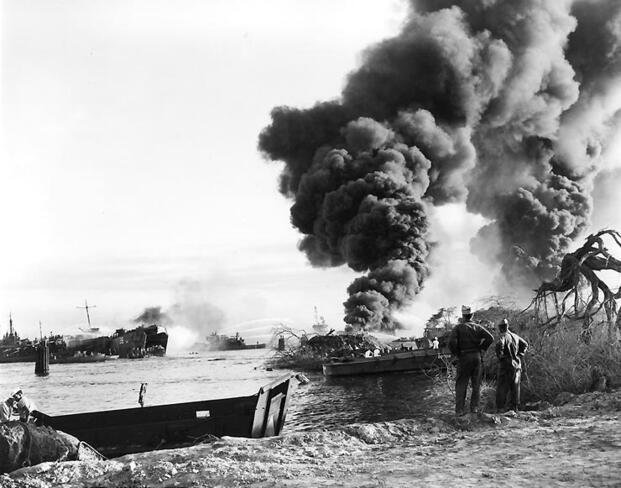
On a fateful afternoon on May 21, 1944, a series of explosions at West Loch, Pearl Harbor, led to one of the most catastrophic incidents during World War II, which remained shrouded in secrecy for years. The disaster, largely overshadowed by the infamous attack on Pearl Harbor, was a significant event with far-reaching consequences.
The Tragic Incident at West Loch
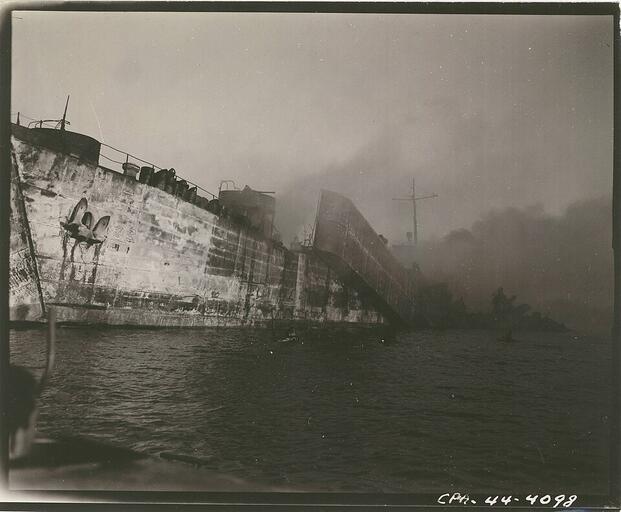
At precisely 3:08 p.m., Army personnel from the 29th Chemical Decontamination Company began transferring 4.2-inch mortar ammunition onto the LST-353. The soldiers, inexperienced in handling explosives, were unaware of the looming disaster. A sudden explosion near the ship’s bow killed all nearby, leaving no witnesses to pinpoint the cause. The blast triggered a massive fireball, igniting gasoline drums on adjacent ships within minutes.
Casualty records officially list 163 dead and 396 injured, but some estimates suggest fatalities exceeded 1,000. The Navy’s decision to keep the incident classified contributed to its relative obscurity even today.
Operation Forager and the Strategic Importance
The urgency of Operation Forager, aimed at capturing the Mariana Islands, demanded a rapid loading schedule at Pearl Harbor. With Saipan strategically located 1,500 miles from Tokyo, its capture was vital for launching B-29 Superfortress bombers against Japanese cities. Over 300 ships and 300,000 personnel prepared for the invasion, stopping at Pearl Harbor en route to the Pacific.
The staging area at West Loch was cramped with 34 LSTs, each carrying high-octane gasoline and a variety of ammunition. Amidst these preparations, approximately 100 enlisted men from the 29th Chemical Decontamination Company were aboard LST-353, unloading mortar rounds when disaster struck.
Chain Reaction and Devastation
Just three minutes after the initial explosion, a second blast occurred as gasoline drums on multiple ships detonated, engulfing the area in flames. The subsequent explosion sent debris over a vast radius, shaking windows miles away and causing chaos at the harbor. Boatswain’s Mate 2nd Class Owen Francis Patrick Hammerberg’s heroic efforts during salvage operations post-disaster highlighted the bravery amidst tragedy.
Investigations and Findings
A Naval Board of Inquiry, led by Rear Admiral John F. Shafroth Jr., investigated the causes of the explosions. Theories of a Japanese submarine attack were dismissed due to the harbor’s anti-submarine defenses. Testimonies revealed that untrained Army stevedores were handling mortar ammunition near gasoline drums, likely leading to the disaster. However, the exact cause remained undetermined due to the death of all nearby witnesses.
Admiral Chester W. Nimitz ordered a press blackout, with a brief statement acknowledging some loss of life and damage. The Navy classified the details as Top Secret until 1960, keeping the disaster largely forgotten.
Impact and Reforms
The West Loch disaster, along with the subsequent Port Chicago explosion, prompted significant military reforms. The Navy implemented comprehensive training for handling explosives and enforced strict safety protocols. Design changes for equipment and facilities ensured safer operations, preventing similar incidents in the future.
Moreover, the disasters accelerated the desegregation of military units, addressing the disproportionate casualties among Black service members and highlighting the need for equality in training and assignments.

Remembering the Fallen
Despite the official toll, the true number of casualties at West Loch remains uncertain. Efforts to identify unknown service members buried at the National Memorial Cemetery of the Pacific continue, with modern forensic techniques offering hope of returning names to the fallen.
Today, annual memorial ceremonies at West Loch honor those who perished, and the lessons learned from the disaster continue to shape military practices.