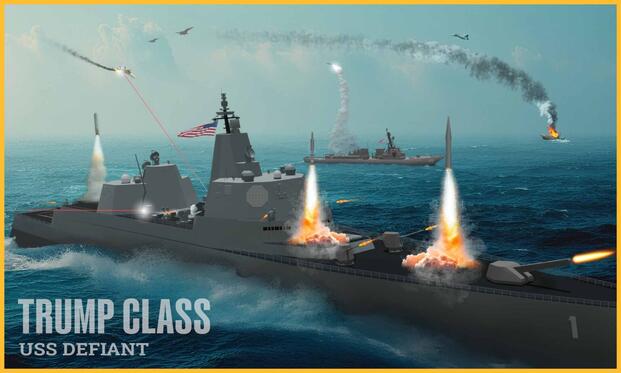
In a surprising move, President Donald Trump has declared the U.S. Navy will commence construction on a new line of battleships, dubbed the Trump class. The first vessel in this series, the USS Defiant (BBG-1), will lead the fleet, marking a significant shift in naval strategy.
The New Era of Battleships
According to the Navy, the Trump-class battleships will weigh over 35,000 tons and have speeds surpassing 30 knots. These vessels will be equipped with nuclear-armed sea-launched cruise missiles, hypersonic weapons, electromagnetic railguns, and directed energy weapons. Navy Secretary John Phelan mentioned plans to start with two ships, potentially expanding to a fleet of 20 to 25 battleships.
This announcement represents the first U.S. battleship construction effort since the USS Missouri in 1944, the last active battleship before its decommissioning in 1992.
Challenges and Historical Context
President Trump has claimed these new ships will be unparalleled in speed and power, stating they’re “the fastest, the biggest, and by far 100 times more powerful than any battleship ever built.” However, this statement is factually inaccurate, as the Iowa-class battleships from World War II were significantly larger.
Despite their impressive specifications, the historical record shows battleships have been vulnerable to air attacks since as early as 1921. This was demonstrated through tests led by Army Brig. Gen. Billy Mitchell, who showed that aircraft could sink battleships. Subsequent events during World War II reinforced the vulnerability of battleships, which were overshadowed by the versatility and reach of aircraft carriers.
Lessons from History
Historical examples such as the Japanese attack on Pearl Harbor and the fate of Japan’s Yamato highlight the limitations of battleships. The Yamato, the largest battleship ever built, was sunk by American aircraft long before reaching its target, illustrating the supremacy of air power.
Furthermore, the proposed Trump-class vessels are considerably smaller than the Yamato, indicating they would face similar challenges in modern warfare. The concept of large warships has been deemed obsolete, a view supported by a series of historical events where battleships were either sunk or severely damaged by air and submarine attacks.
Modern Naval Warfare
Current naval strategies focus on smaller, more versatile ships like destroyers that are equipped with advanced technology and require fewer resources to operate. The U.S. Navy’s current fleet of Arleigh Burke-class destroyers reflects this approach, emphasizing flexibility and cost-effectiveness over sheer size and firepower.
Moreover, today’s advanced missile technologies, such as the Chinese DF-21D and Russian Zircon, represent significant threats to large surface ships, reaffirming the strategic shift away from battleships. The proposed revival of battleships raises questions about resource allocation, especially when the Navy faces shortages in essential munitions and modern equipment.
The decision to build a new line of battleships is seen as a controversial step back to a bygone era. Critics argue that the focus should instead be on enhancing current naval capabilities and addressing modern threats.