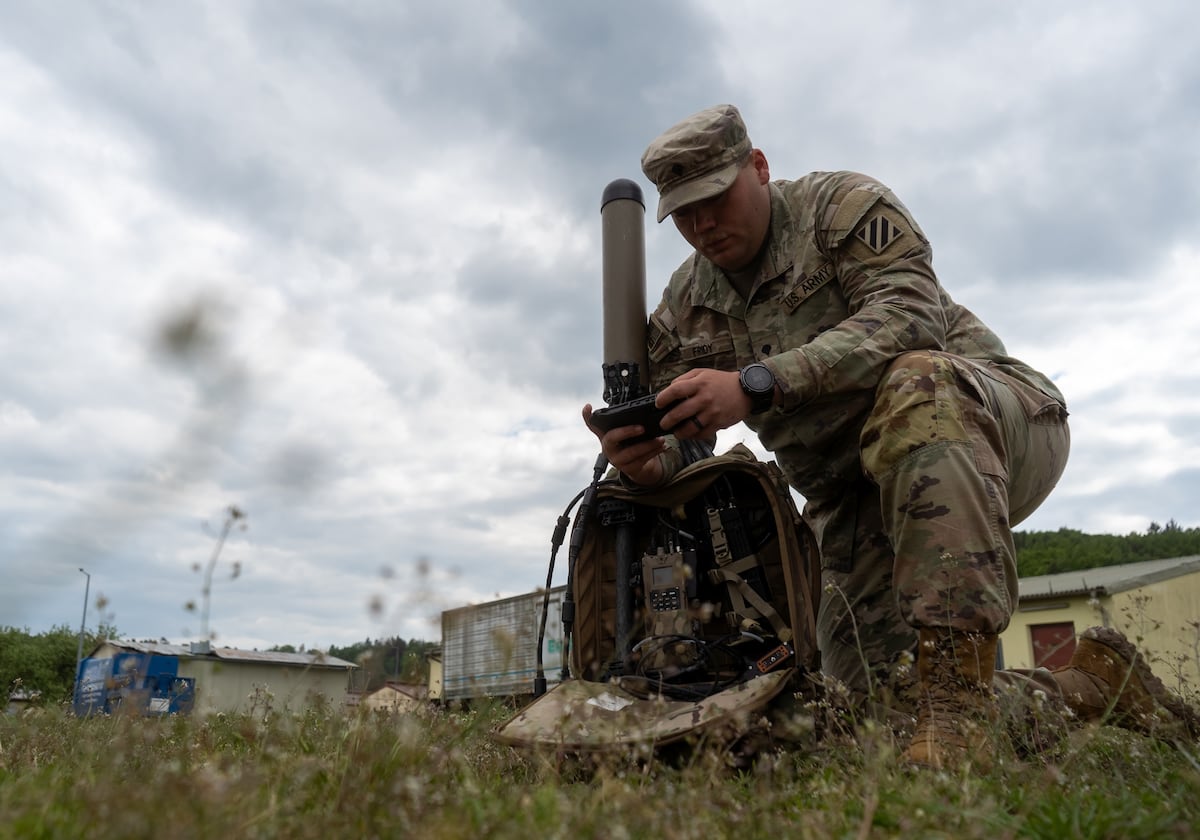
In a sweeping overhaul of its acquisition processes, the U.S. Army is redefining how it procures electronic warfare (EW) and signals intelligence (SIGINT) systems. This initiative comes in response to the Army’s current challenges in effectively operating across the electromagnetic spectrum.
Gen. David Hodne, leading the Transformation and Training Command, highlighted a significant shortcoming: “the Army lacks the ability to sense, locate, attack, and protect” within this critical domain.
The Army’s acquisition system for electromagnetic spectrum operations (EMSO) has been identified as too fragmented, hindering its efficacy. “Currently, EMSO capabilities are spread across different warfighting functions and not fully designed as cohesive technologies that are modular, scalable, and adaptable enough to mitigate modern threats,” Hodne emphasized in a January memo outlining the new EMSO operations concept.
The disjointed nature of these capabilities has prevented the Army from harnessing the full potential of Artificial Intelligence and Machine Learning (AI/ML) for swift decision-making across competitive environments.
To address these challenges, the Army is actively seeking input from industry players regarding its new EMSO concept and an upcoming Indefinite Delivery/Indefinite Quantity contract for acquiring EW and SIGINT equipment.
The Program Manager Electronic Warfare & Cyber is evaluating an acquisition strategy aimed at delivering comprehensive, lifecycle management products for its EW and SIGINT systems, according to the Army’s Request for Information. The deadline for feedback is March 13.
One of the questions posed to industry is about their willingness to invest financially to expedite solution delivery. The RFI inquires, “If the Government were to leverage multi-year procurement contracts, would vendors pay facilitation costs to increase production quantities or significantly improve production schedules for EW/SIGINT Equipment?”
Moreover, the Army is interested in systems tailored to diverse user needs. The RFI points out that using a “common basis of issue (BOI) across varied formations (e.g., heavy, light, airborne) has proven to be neither cost-effective nor optimal for ensuring battlefield lethality against modern, technologically advanced adversaries.”
Feedback on the EMSO concept itself, including potential “industry partnerships,” is also being solicited. The RFI asks, “What partnership models would be most effective for the rapid development and fielding of EMSO capabilities?”
The memo from Hodne envisions accelerating the deployment of new systems by having T2COM program managers collaborate with the Command and Control/Counter C2 Portfolio Acquisition Executive. “This approach enables continuous integration and delivery of EMSO capabilities for operations in austere and DDIL [denied, disrupted, intermittent and limited-bandwidth] environments,” the memo states.
Additional calls have been made for a variety of offensive and defensive electromagnetic capabilities. These include effects targeting specific communications protocols, identifying and locating multiple adversary emitters, and obscuring friendly signals from enemy detection. EMSO systems are expected to feature open architecture for integration with the Next-Generation Command-and-Control framework.