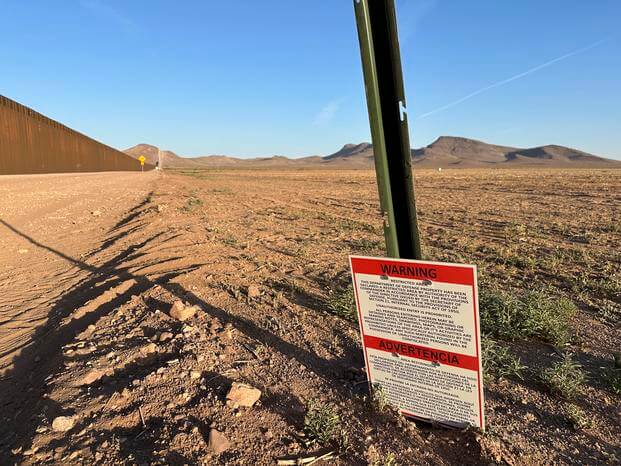
The arid landscape of New Mexico is now dotted with orange signs warning of restricted areas. These signs mark a significant shift as the U.S. military takes an unprecedented role in enforcing the border with Mexico. This initiative, which stretches across New Mexico and western Texas, places military oversight on large segments of the border, allowing troops to detain individuals entering illegally.
This military involvement stems from a national emergency declaration regarding border security by former President Donald Trump, aiming to strengthen border enforcement and curb illegal activities such as human smuggling and drug trafficking. The introduction of these militarized zones has sparked controversy and legal challenges from civil rights and humanitarian organizations.
In an effort to cover gaps in border security, the Defense Department has established two extensive militarized zones along the border. These zones, which span 230 miles from Fort Hancock, Texas through New Mexico, and cover an additional 250 miles in Texas’ Rio Grande Valley, will soon see further expansion near Yuma, Arizona. In total, these efforts will encompass nearly a third of the U.S.-Mexico border, with a deployment of about 7,600 troops.
The reaction among local communities, particularly in New Mexico’s Luna County, has been varied. While some residents support the increased security to combat illegal activities, others express concerns over restricted access to public lands. James Johnson, a local farmer, expressed support for the mission, stating, “We as a family have always been very supportive of the mission, and very supportive of border security.”
However, there are concerns about the impacts on outdoor activities. Ray Trejo, a Luna County commissioner, worries about potential conflicts with hunters or hikers entering these zones unknowingly. He said, “I don’t want to go down there with my hunting rifle and all of a sudden somebody rolls up on me and says that I’m in a military zone.”
In terms of legal consequences, more than 1,400 migrants have been charged with trespassing on military land, facing significant penalties. Despite these charges, most face deportation after serving time for illegal entry. Nicole Wieman, an Army spokesperson, indicated that the Army is negotiating to allow limited public access for recreational purposes.
As border crossings decline, with a reported 30% decrease in arrests in June, the militarized zones cover regions with historical and cultural significance. The Columbus, New Mexico area, once a site of conflict during the 1916 raid by Pancho Villa, now sees children crossing daily for school without apparent disruption.
Oversight of these zones is managed by U.S. Army commands in Texas and Arizona, navigating around the Posse Comitatus Act, which limits military involvement in civilian law enforcement. Rancher Russell Johnson, who leases borderland, noted, “We have seen absolutely almost everything imaginable that can happen on the border, and most of it’s bad.” He observed minimal military presence, aside from increased signage.
The implementation of these zones has faced legal scrutiny, with federal public defenders contesting the military’s role in border enforcement. Some court cases have seen mixed outcomes regarding trespassing charges. Prosecutor Ryan Ellison emphasized the clarity of military zone boundaries, stating, “There’s not going to be an issue as to whether or not they were on notice.”
Concerns persist about the potential expansion of military enforcement along the border. ACLU attorney Rebecca Sheff warned of a more punitive approach, describing it as a vehicle for potentially establishing a more hostile border presence.