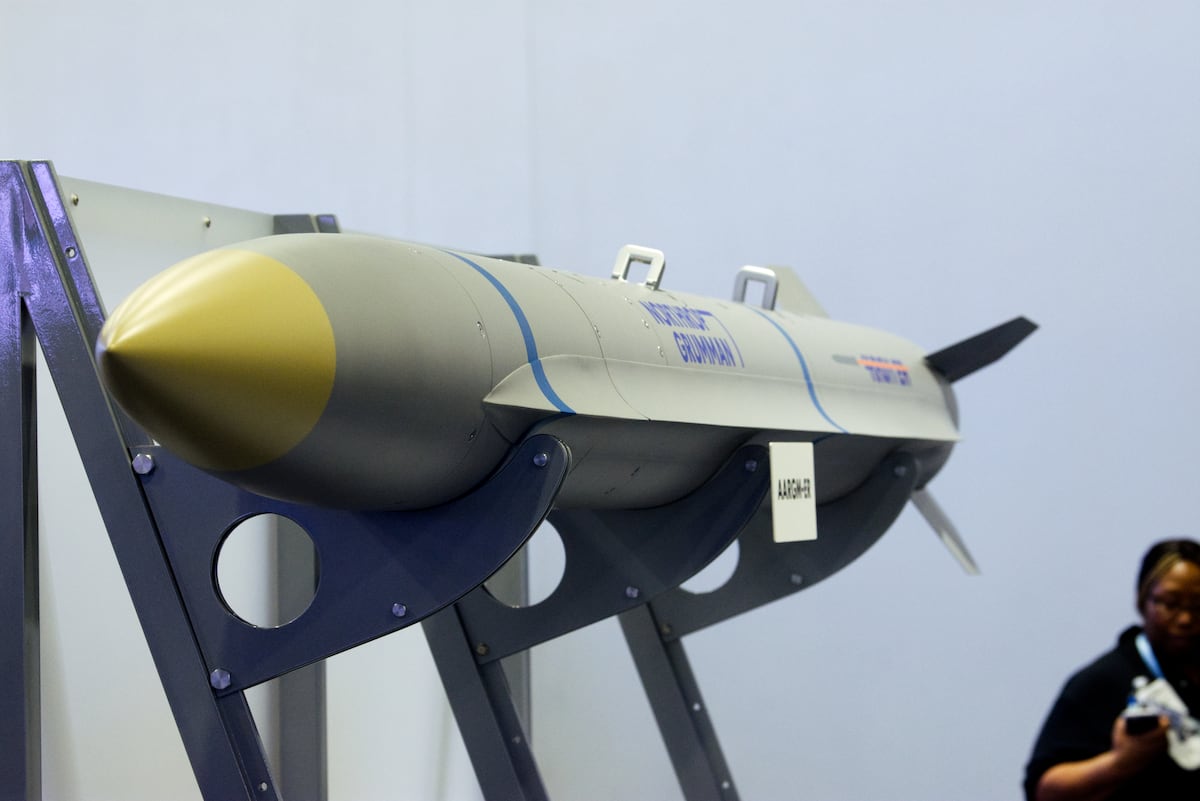
The U.S. Navy is setting its sights on a new anti-radiation missile capable of outperforming current options in range. This initiative, known as the Advanced Emission Suppression Missile (AESM), is detailed in a Sources Sought notice, which specifies compatibility with existing aircraft like the F-18 and F-35.
According to the announcement, the Navy plans to acquire up to 300 missiles annually, with an operational target set for two years post-contract award. This development does not explicitly replace the aging AGM-88 High-Speed Anti-Radiation Missile (HARM), currently utilized by Ukraine, nor does it mention the AGM-88G Advanced Anti-Radiation Guided Missile Extended Range (AARGM-ER), which is undergoing live-fire testing.
The Navy’s notice emphasizes the need for a missile with a longer reach than current offerings. The HARM boasts a range of up to 80 miles, depending on the altitude of the launch aircraft, while the AARRGM-ER is anticipated to offer a greater range.
The focus is on ensuring the new missile can effectively target advanced radar systems that have been engineered to resist anti-radiation attacks. The AESM is expected to feature a seeker with extensive frequency coverage, GPS and INS guidance, alternative navigation that can counteract jamming, and the capability to engage both airborne and ground targets.
Furthermore, the AESM should offer “potential for pre-emptive targeting capabilities,” as highlighted in the notice. It is intended for use on current aircraft models such as the F/A-18E/F, EA-18G, and F-35. Its open architecture design will also allow deployment from future aircraft.
The Navy requires the AESM to reach at least Technology Readiness Level 7, indicating a prototype ready for operational testing. The deadline for submissions is set for March 18, 2026.