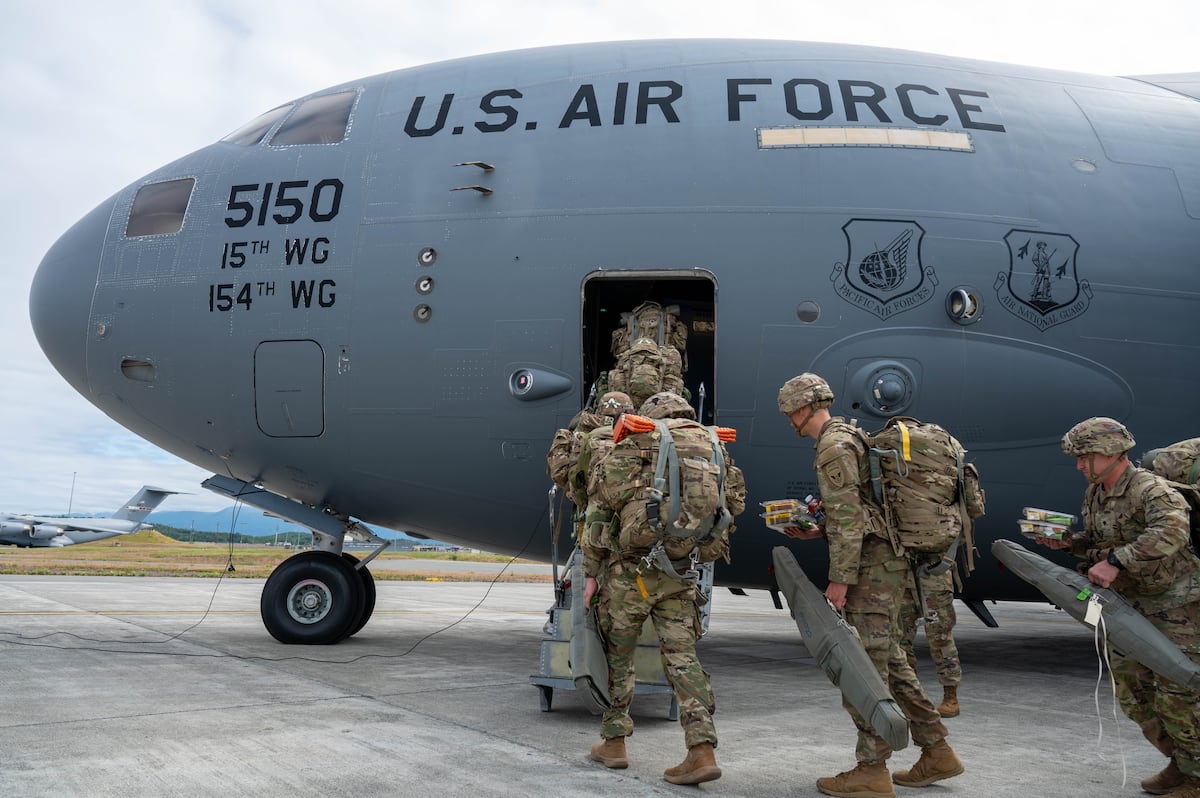
TOWNSVILLE, Australia — In a striking display of military prowess, U.S. paratroopers took part in Exercise Talisman Sabre 2025, making a dramatic entry into Australia. The paratroopers completed a 14.5-hour nonstop flight from Joint Base Elmendorf-Richardson in Alaska, descending into the Australian countryside under the cover of darkness on July 14.
Col. Brian Weightman, leading the 2nd Infantry Brigade Combat Team (Airborne) of the U.S. Army’s 11th Airborne Division, shared insights with Defense News in Townsville. “We landed right on the X,” he stated, having been the first to jump onto the drop zone. In such operations, expectations are set for up to 10% casualties, but fortunately, only three minor injuries occurred, one resulting from a midair parachute entanglement.
The paratroopers from the 3rd Battalion, 509th Parachute Regiment, known as “Three Geronimo,” embarked on a mission extending beyond their initial drop. After landing, they traversed over 30 miles to secure an urban target near Townsville in northern Queensland. “To be able to do that with real violence and at speed is really impressive, and I think it should scare adversaries,” Weightman remarked.
Using six C-17A Globemaster III aircraft, including four from the U.S. Air Force and two from Australia, 323 American and 12 German paratroopers were airlifted across continents. Upon arrival in Australia, they were joined by French troops. The aircraft also delivered heavy equipment, such as HMMWVs.
Technological Advances
The exercise highlighted technological strides, as Weightman enjoyed continuous communication with headquarters, utilizing voice, data, and video from the aircraft. This capability significantly enhances situational awareness, allowing for a comprehensive understanding of enemy positions. “You’re able to really paint a much better picture of the enemy,” he emphasized.
Nighttime operations, often perceived as more challenging, are perceived differently by Weightman. “For us it’s not much more. You know, we own the night,” he stated, asserting an asymmetric advantage once on the ground. The exercise demonstrated high proficiency in interoperability, a concept described as “easy to talk about but hard to do.”
Following their refit in Townsville, over 400 American paratroopers, along with 100 German and 36 French soldiers, were set to execute another night jump on July 21 at Shoalwater Bay in central Queensland. Weightman described the operation as a classic airborne infantry maneuver, essential to their capabilities.
The 11th Airborne Division, part of the U.S. Army’s five airborne brigades, includes the 1st Brigade, a mobile combat unit, and the 2nd Brigade, which is airborne. Weightman highlighted the division’s ability to operate anywhere in the Indo-Pacific and its unique capability to conduct operations in arctic conditions, making them versatile across diverse climates.
In addressing the relevance of airborne units in modern warfare, Weightman argued for their continued importance, despite past failures such as Russia’s operation at Hostomel Airport in Ukraine. “What we’re able to do would absolutely scare me if I was the enemy of our country,” he commented.
The Indo-Pacific region faces various tensions involving China, Taiwan, and the Korean Peninsula. Weightman emphasized the division’s readiness to undertake offensive, defensive, stability, or expeditionary missions. Regarding potential threats from China, he stated, “We’re not training against a specific adversary. What we’re training to do is to be interoperable with our allies and partners in the Indo-Pacific.”
The exercise, the eleventh of its kind, involved over 40,000 troops from 19 nations, underscoring the scale and international cooperation involved in Talisman Sabre.