The USS Mississippi (BB-41) is a storied name in naval history, having navigated the waters of the Pacific during World War II with resilience and might. With a legacy that includes surviving kamikaze attacks and firing the first guided missile from an American surface ship, her journey is marked by pivotal moments in maritime warfare.
Yet, it was the Battle of Surigao Strait in October 1944 that truly defined her place in history, as she fired the last shot by any battleship at another in combat.
From Construction to Combat
The USS Mississippi began her journey at Newport News Shipbuilding, with her keel laid on April 5, 1915, and launching on January 25, 1917. Sponsored by Miss Camelle McBeath, she was officially commissioned on December 18, 1917, under Capt. Joseph Lee Jayne. As the third U.S. Navy ship to bear the state’s name, she was part of the New Mexico-class battleships, measuring 624 feet and weighing 32,000 tons at full load.
Initially joining the Atlantic Fleet during World War I, she engaged in training exercises along the East Coast without seeing combat. By July 1919, she had transitioned to the Pacific Fleet, operating out of San Pedro, California, for over a decade.
Notably, Capt. William A. Moffett, a future chief of the Bureau of Aeronautics, commanded her between 1919 and 1921.
The Catastrophic Turret Explosions
On June 12, 1924, during a gunnery practice near San Pedro, a disaster struck as the center gun of No. 2 turret exploded during reloading. A burning ember ignited 470 pounds of propellant, sealing the fate of 44 crew members who asphyxiated inside until rescuers could cut through.
Tragedy struck again when residual powder detonated upon reaching port, killing four more men. This incident became the deadliest peacetime disaster in Navy history at the time.
The Bureau of Ordnance’s investigation revealed insufficient air purging of the center barrel, yet the issue persisted, as demonstrated by a similar explosion in 1943.
World War II and the USS Mississippi
In May 1941, the USS Mississippi was reassigned to the Atlantic Fleet amidst rising U-boat threats. She spent months escorting convoys to Iceland before heading to the Pacific after the Pearl Harbor attack. Operational by January 22, 1942, she trained and escorted along the West Coast while other battleships underwent salvage.
Her wartime efforts extended to the Aleutians in 1943, where she bombarded Kiska Island. Despite a successful evacuation by Japanese forces, she continued to play a crucial role in subsequent operations.
Engagement at Surigao Strait
Vice Adm. Shoji Nishimura’s fleet, including the battleships Yamashiro and Fuso, attempted to break through U.S. lines during the night of October 24-25, 1944. However, American forces, under Rear Adm. Jesse Oldendorf, awaited with a strategic advantage.
Three U.S. battleships with advanced radar opened fire, severely damaging the Yamashiro. The USS Mississippi, equipped with older technology, joined the fray late but fired a historic 12-gun salvo, marking the end of battleship-to-battleship combat.
Post-War Innovations and Legacy
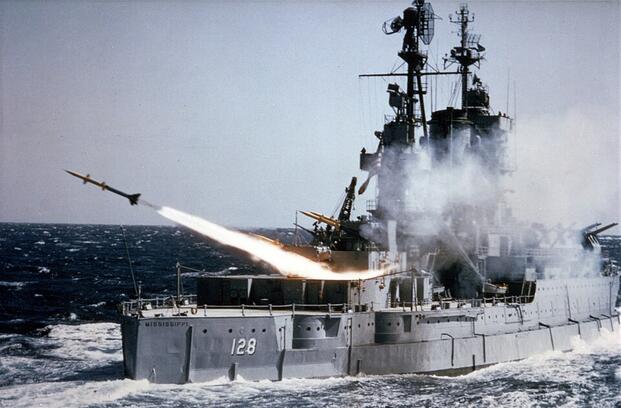
After World War II, the USS Mississippi transitioned to a test platform, contributing to innovations in naval warfare. She launched the first guided missile from a surface ship in 1953, demonstrating the shift to modern naval tactics.
Decommissioned on September 17, 1956, and sold for scrap, she left behind a legacy of eight battle stars and memorable service. Her role in naval history is a testament to the evolution of maritime warfare.