When the U.S. Army activates a new 2,100-soldier unit, the headlines focus on military strategy — but behind every soldier in formation stands a family navigating housing waitlists, school enrollment deadlines, and the ever-present question of healthcare access on and around the base. The activation of the Army’s 4th Multi-Domain Task Force at Fort Carson, Colorado this week is a significant strategic move, but it also sets in motion a cascade of real-world consequences for the military families who will follow these soldiers to their new assignments.
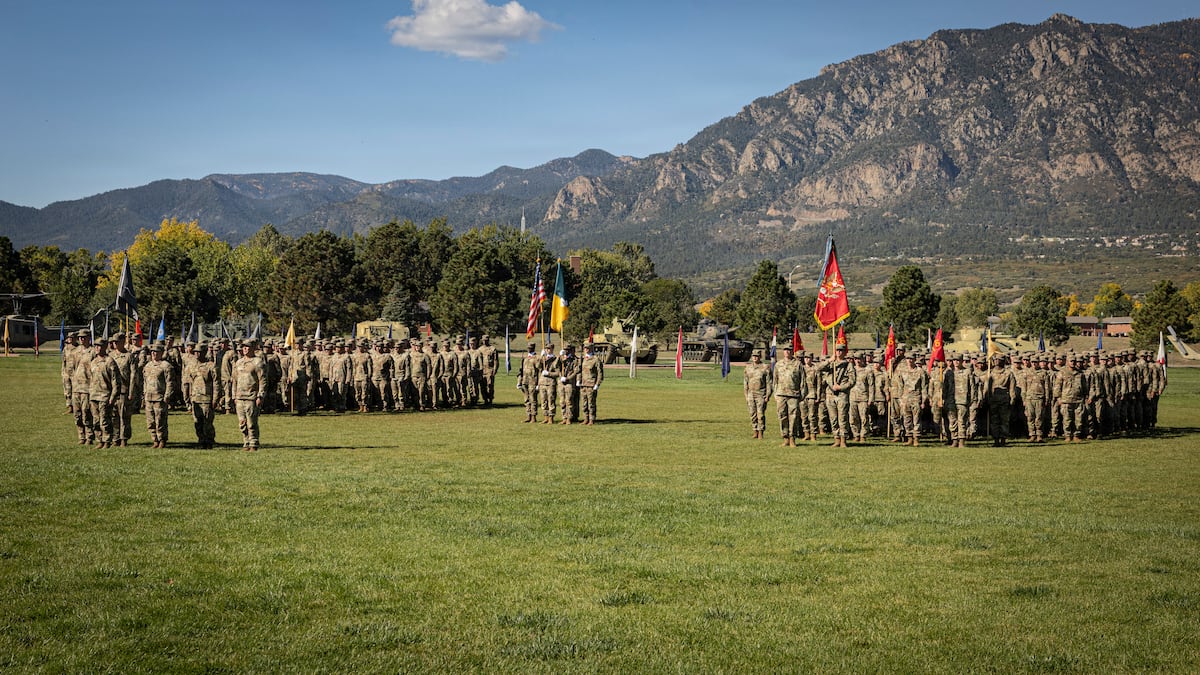
The ceremony took place October 8, 2026, at Founder’s Field on Fort Carson. The new task force is designed to synchronize long-range precision fires across the Indo-Pacific region, with the mission to “deny, disrupt and disaggregate adversary capabilities” and give joint force units a tactical edge against near-peer adversaries.
Col. Hugh W.A. Jones, who previously commanded the 2nd Stryker Brigade, 4th Infantry Division — and led that brigade when it deployed to the U.S.-Mexico border — assumed command of the 4th MDTF at the ceremony.
“While we build this formation to deter aggression and preserve peace, if war comes, we must be prepared to fight and win. We owe those in harm’s way every advantage we can give them, while leaving our enemy nowhere to run and nowhere to hide.”
Jones added a reminder that technology alone doesn’t win wars:
“As we build this formation, we must never forget that technology earns its value in the hands of well-trained and disciplined soldiers. A soldier who solves a difficult problem here may make the difference for an American fighting far beyond the horizon.”
What a 2,100-Soldier Expansion Means for Families on the Ground
A unit of this scale — four battalions, with plans to grow to 2,100 soldiers — doesn’t materialize in a vacuum. Fort Carson, already one of the Army’s largest installations, will absorb this force growth along with the thousands of family members who arrive alongside service members. That means pressure on base housing — where waitlists can stretch months — on local schools already serving military-connected children, and critically, on TRICARE-covered healthcare services in the region.
Military families enrolled in TRICARE rely on a network of military treatment facilities and civilian providers. When large units stand up rapidly, base clinics can face appointment backlogs, and families — especially those with children, pregnant spouses, or members managing chronic conditions — can find themselves scrambling to establish care with off-post providers. In communities surrounding Fort Carson, that influx strains the civilian healthcare infrastructure that military families depend on when base capacity is exceeded.
For families relocating to Colorado Springs, understanding what TRICARE covers, which providers are in-network, and how to navigate the system in a new location is not a minor administrative task. It is a healthcare access challenge with real consequences — delayed prenatal appointments, gaps in mental health care for children adjusting to new schools, and prescription continuity issues that can affect patients managing serious conditions.
The Broader Strategic Picture
The 4th MDTF reports to the 7th Infantry Division (Multi-Domain Command-Pacific) at Joint Base Lewis-McChord, Washington. That headquarters, established in June 2026, integrates maneuver, fires, air defense, cyber, space, electronic warfare, intelligence, unmanned systems, sustainment, and command-and-control across the Pacific theater.
Maj. Gen. Bernard Harrington, commander of the 7th Infantry Division, attended the Fort Carson ceremony and addressed the newly formed unit directly.
“You are driving the change our nation demands today, to meet the changing character of war, to prevent conflict, and to maintain a free and open Pacific alongside our allies and partners.”
This activation is part of a broader transformation initiative aimed at countering near-peer adversaries in an increasingly complex global environment. According to a Congressional Research Service report, the Army plans to establish five multi-domain task forces by 2028. The 2nd MDTF was activated in 2021 at Clay Kaserne in Germany, the 3rd stood up in Hawaii in 2022, and a 5th is planned for Fort Bragg, North Carolina. Each unit is designed to operate across all domains — land, air, sea, space, cyberspace, and information — giving combatant commanders a wider range of strategic options.
For the soldiers assigned to the 4th MDTF and their families, the mission is abstract until the orders arrive and the moving trucks pull up. At that point, the questions that matter most are immediate and personal: Will there be a doctor available on post? How long is the waitlist for a pediatrician? Is mental health care accessible for a spouse managing anxiety during a long training cycle or deployment? These are the ground-level realities that accompany every major force structure decision — and they deserve as much attention as the strategic rationale behind them.