Alabama’s Execution Method Under Scrutiny: Court Demands Further Examination
In a significant legal development, the use of nitrogen gas as a method for execution in Alabama is facing fresh scrutiny. A federal appeals court has called for a deeper investigation into whether the method contravenes the constitutional prohibition against cruel and unusual punishment. This decision, made public on Monday, casts uncertainty over Alabama’s upcoming execution scheduled for Thursday.
Alabama’s application of nitrogen for capital punishment, first initiated in 2024, involves attaching a respirator to the inmate’s face and substituting breathable air with pure nitrogen, leading to death by oxygen deprivation. The appeals court reversed a previous ruling from May, which had determined that nitrogen hypoxia did not breach constitutional protections. The case, initiated by death row inmate Jeffery Lee, who is set to be executed using this method, has been sent back for further examination.
Although the panel did not stay Lee’s pending execution, it instructed the lower court to explore the viability of his suggested alternative: a firing squad. The U.S. Supreme Court mandates a dual test for evaluating the legality of execution methods. The challenge must prove that the method poses a substantial risk of excessive pain and that a feasible alternative is available. The court acknowledged that Lee satisfied the first criterion and directed the trial court to assess the second.
The panel expressed reservations about the nitrogen method, particularly the duration it takes for the individual to lose consciousness. “In our view, the overall suffering described by the district court, which lasts for one to three minutes, presents a substantial risk of serious harm over and above death itself,” the judges wrote. “Counting to 60 or 180 seconds is not a quick exercise, and constitutionally speaking, that timeframe is intolerable given the suffering that would likely take place under Alabama’s nitrogen hypoxia protocol.”
The Alabama Attorney General’s Office has yet to comment on the ruling, although the state continues to assert the constitutionality of the method. Opponents of nitrogen executions welcomed the court’s decision. “For the first time a court has acknowledged what I and so many others have seen with our own eyes. Nitrogen executions are a unique form of horror,” stated the Rev. Jeff Hood, a spiritual adviser during two nitrogen executions.
Nationally, nitrogen has been employed in eight executions, with seven occurring in Alabama and one in Louisiana. Critics argue that the method inflicts excessive suffering, citing that Alabama’s most recent nitrogen execution exceeded 30 minutes.
Lee’s conviction stems from a 1998 robbery of Jimmy’s Pawnshop in which he killed Jimmy Ellis, the owner, and Elaine Thompson, an employee. Despite a jury’s 7-5 vote for life imprisonment, a judge imposed a death sentence. Alabama abolished judicial override in 2017, prohibiting judges from overruling jury sentencing in death penalty cases.
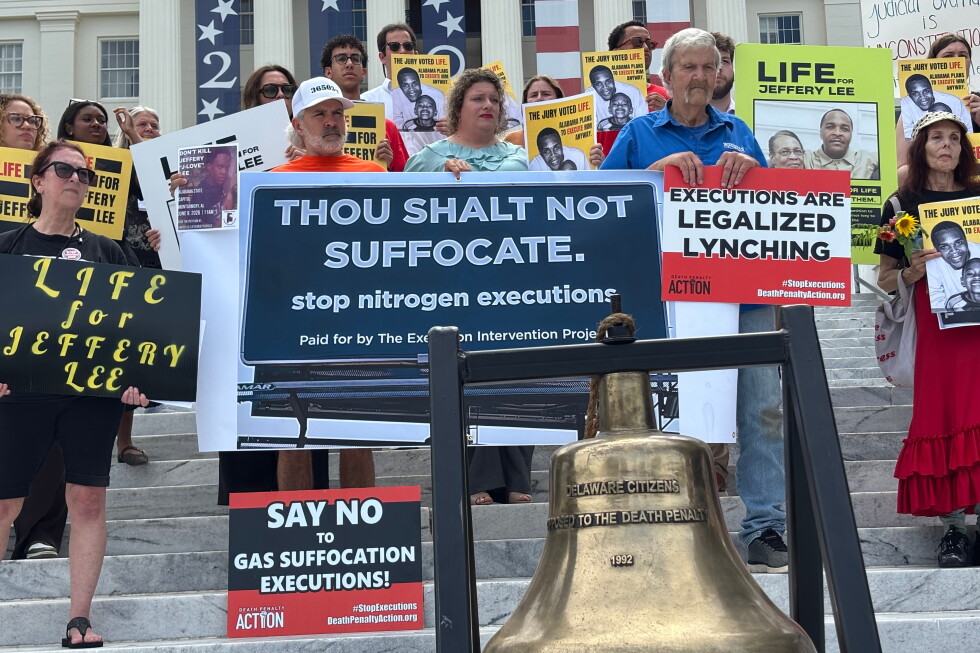
The court’s ruling coincided with a vigil at the Alabama Capitol advocating for Lee’s sentence to be commuted to life imprisonment. Alabama Attorney General Steve Marshall opposed the clemency plea, stating, “The people of Alabama have not forgotten Jimmy and Elaine. I have not forgotten them. Anything short of carrying out the sentence imposed by the court falls short of justice for the victims, and that is not what victims of this state deserve.”