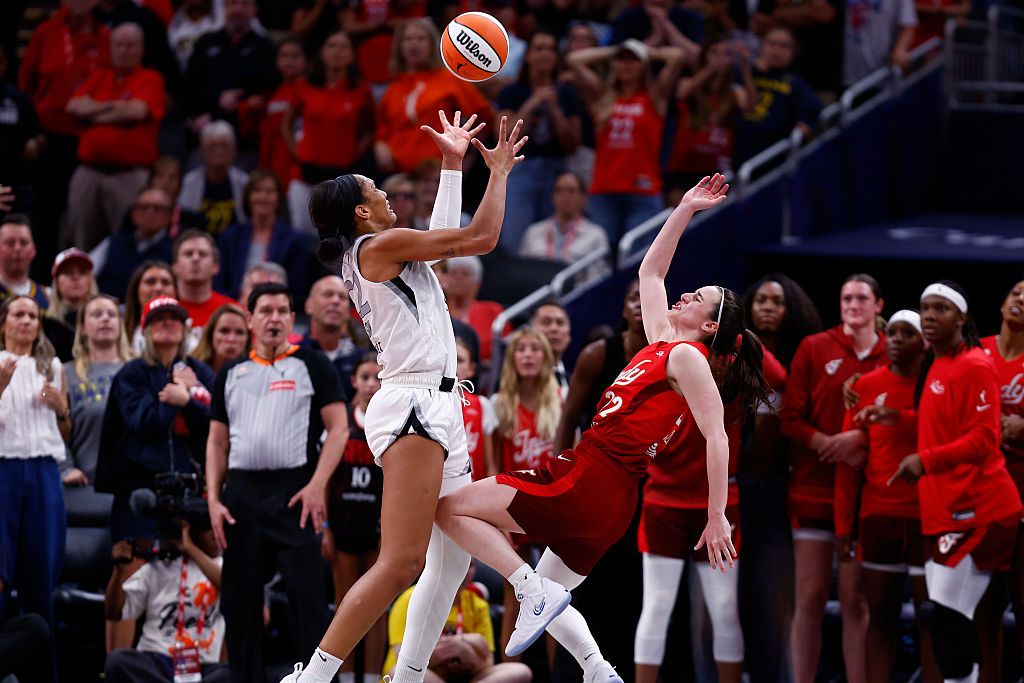
Unraveling the Media Frenzy: Caitlin Clark’s Spotlight and A’ja Wilson’s Absence

The FIBA Women’s Basketball World Cup is a celebrated event where WNBA stars showcase their skills on an international platform, transcending domestic competition to unite athletes globally. For fans in the United States, the tournament promises a showcase of national talent and pride.
Yet, the spotlight has been disrupted by the focus on Indiana Fever’s Caitlin Clark, whose inclusion on Team USA has sparked controversy. Critics argue that media attention has disproportionately favored her over more accomplished athletes sharing the court.
Retired ESPN anchor Linda Cohn has been at the center of this discourse, questioning the motives of four-time WNBA MVP A’ja Wilson for opting out of the World Cup due to health concerns. Cohn speculated, “So is there any part of A’ja that didn’t want to spend the next couple of weeks watching the World Cup become the Caitlin Clark show?” This commentary has been criticized for perpetuating racial stereotypes that Black women face in professional settings.
Despite Wilson’s proven excellence, media narratives have suggested insecurity and jealousy as reasons for her absence. This reflects broader societal biases where Black women’s achievements are often undermined by unfounded claims of envy when they assert their prowess.
The timing of these narratives appears to coincide with the impending MVP vote, with some suggesting that discrediting Wilson could influence the outcome. Data indicates that Black women in professional arenas are often more ambitious and focused on their goals than their peers, challenging the notion that Wilson would feel threatened by Clark.
Comparatively, Kelsey Mitchell’s decision to skip the World Cup to train independently has not attracted similar scrutiny. Her proximity to Clark seems to afford her a degree of protection from the same media biases.
The debate extends to the MVP race, where media campaigns have emerged advocating for co-MVP awards between Clark and Mitchell, despite Wilson’s clear statistical superiority. This reflects an ongoing struggle to reconcile media-driven narratives with on-court realities.
As the World Cup unfolds, Clark’s performance has been put under the microscope. In a recent match against Italy, she was largely ineffective, scoring only from the free-throw line, highlighting the disparity between media hype and performance.
Meanwhile, other players like Paige Bueckers and Angel Reese have captured the public’s attention with their performances and charisma, suggesting they may be the true future of women’s basketball. The ongoing media discourse underscores the complex dynamics at play in sports narratives and the broader implications for recognition and representation.
SEE ALSO:
The WNBA Has An Obvious Choice For MVP In 2026: A’ja Wilson [Op-Ed]
How History Should Remember This Era Of The WNBA [Op-Ed]