When American voters go to the polls, they’re choosing leaders who will make decisions about where U.S. troops are deployed, what alliances are built, and how tax dollars are spent abroad. The quiet but rapidly expanding U.S. military presence in Panama is exactly the kind of policy decision that flows directly from those electoral choices — and it’s one that most Americans know almost nothing about.
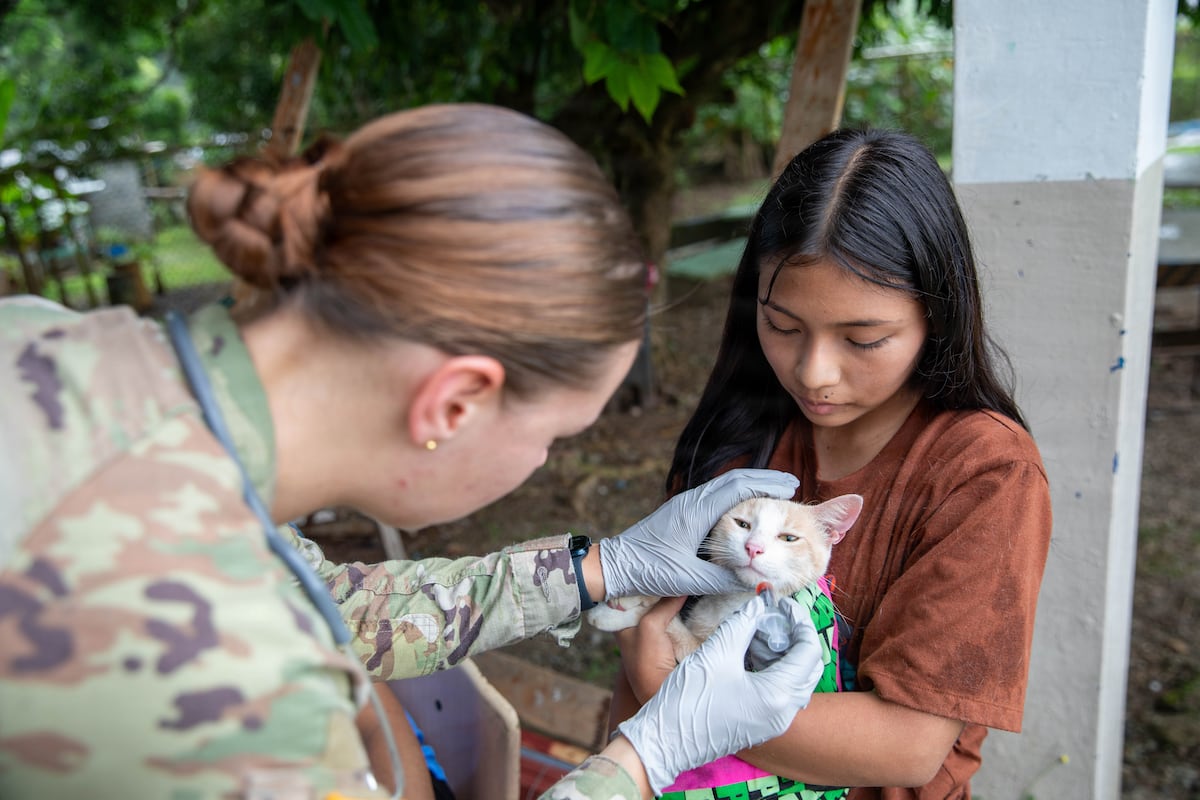
More than two decades after handing over its military bases to Panama, the United States has rebuilt a substantial and multifaceted partnership with the Central American nation. From veterinarians treating cats in rural villages to salvage dive teams training near the Panama Canal, American service members are embedded across the country — operating under policies shaped by the executive branch and, ultimately, accountable to the American electorate.
Understanding what the U.S. military is doing in Panama — and why — is part of what informed democratic participation requires. Here’s what the public record shows.
A Strategic Shift, Driven by Elected Policy
The expansion of U.S. military activity in Panama didn’t happen in a vacuum. It is the direct result of deliberate policy choices made by the Trump administration, which elevated “defense of the U.S. Homeland” to the highest national security priority and shifted focus toward the Western Hemisphere. These are governing decisions made by officials chosen — or appointed by those chosen — through the democratic process.
Col. Jacob White, deputy commander of Joint Security Cooperation Group-Panama, described the shift in stark terms from the unit’s Panamanian headquarters:
“The Western Hemisphere is now the priority hemisphere. We want to move faster and be more present down in this hemisphere.”
In April 2025, the U.S. and Panama formally announced an agreement to counter Chinese influence in the region and secure the Panama Canal — laying the groundwork for the broader joint activities now underway. The agreement reflects a strategic calculation that Panama sits at the intersection of some of the administration’s top priorities: canal security, migration, and drug trafficking.
Henry Ziemer, a fellow with the Americas Program at the Center for Strategic and International Studies, notes that Panama has always held strategic value — but its importance has grown. Over the past year, he said, disruptions at other critical global waterways like the Strait of Hormuz have made the Panama Canal even more central to U.S. economic interests. Roughly 5% to 6% of all global trade passes through it, with about 70% of that traffic moving to or from the United States.
Kevin Marino Cabrera, the U.S. Ambassador to Panama, framed the relationship in terms that voters in every American city and town can recognize:
“For many subsequent administrations and decades, I think the United States took [its] eye off this neighborhood, off the Western Hemisphere.”
He emphasized that what happens in Panama has direct consequences for Americans at home — from the goods that move through the canal to the migration flows through the treacherous Darién Gap, which at its peak saw more than half a million crossings per year.
“You can’t talk about migration without talking about Panama,”
Cabrera said.
Ziemer echoed that point, arguing that from the U.S. perspective,
“the border begins in Panama — it’s a lot easier to secure the Isthmus of Panama than it is to secure the whole Southwest land border, right?”
What U.S. Troops Are Actually Doing
The scope of American military activity in Panama is broader than a single mission or base. The centerpiece most visible to the public is a revitalized jungle warfare school, but that is only one thread in a much larger fabric.
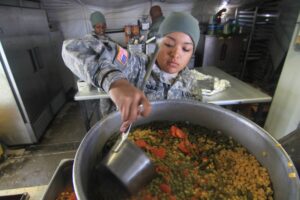
Medical teams — doctors, dentists, optometrists, and even veterinarians — rotate through remote regions of the country, working alongside Panamanian professionals to serve local civilian populations. Surgeries ranging from colonoscopies to cataract procedures are performed as part of these rotations, including in the remote Darién Province. Military engineers cycle through to build infrastructure for training programs. U.S. salvage and dive teams operate near the Panama Canal, cross-training with Panamanian counterparts.
Perhaps most telling is the scale of the Civil Affairs presence. While a typical U.S. partner nation might host one or two Civil Affairs teams — the Army’s special operations forces that connect military operations with civilian communities — Panama hosts an entire U.S. Civil Affairs company, working across virtually every district in the country. Those teams identify gaps in civilian infrastructure: deteriorating school buildings, unsafe bridges, communities with unmet needs.
Col. White described the philosophy behind all of it in terms that go beyond military tactics. One of the lessons absorbed from the long wars in Iraq and Afghanistan, he said, was about the limits of rapid action:
“In a crisis, you simply can’t surge trust. And so, being here — present — doing things on the regular with SENAFRONT and SENAN, with the government of Panama — and with their permission to do it — it helps build that trust.”
SENAFRONT and SENAN are two branches of the Panamanian Public Forces; Panama does not maintain a standing army.
On the training side, Panamanian instructors at the jungle school note that joint exercises give them confidence that, in an emergency, U.S. soldiers would understand the extreme difficulty of operating in that environment. Panama’s terrain also replicates jungle biomes found elsewhere in the Western Hemisphere — regions where U.S. forces may need to operate.
The Sovereignty Question — and the Democratic Stakes
Expanded U.S. military activity in any foreign country inevitably raises questions about sovereignty — and those questions carry weight in Panama, where the legacy of a deeply controversial 1989 U.S. invasion to remove dictator Manuel Noriega still shapes public memory. The decaying remnants of former U.S. military quarters still line roads in and out of Aeronaval Base Cristóbal Colón — once known as Fort Sherman when American forces occupied it.
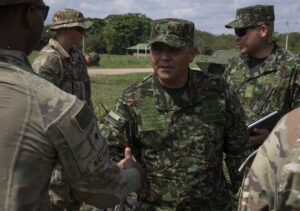
U.S. officials have been direct on one point: permanent military basing is not on the table. Col. White said the U.S. contingent is committed to upholding the Neutrality Treaty of 1977, which guarantees that the Panama Canal remains open and neutral for ships of all nations. The approach, he said, is to operate
“by, with and through the Panamanians.”
Ambassador Cabrera described the partnership as genuinely mutual. Panama, too, faces the pressures of cartels, drug trafficking, and migration:
“Our plan is to defeat the cartels, to maintain the Darién closed, so that we can secure the U.S. Southern border and keep our communities safe. We’re working together with Panama because they have many of the same goals.”
For American voters, the broader point is this: the decisions that put U.S. troops in Panamanian jungles, funded civil affairs teams, and structured this international partnership were made by elected and appointed officials. The policies reflect specific priorities — on immigration, trade security, and great-power competition with China — that were debated during elections and enacted by administrations answerable to the public. Staying informed about where those decisions lead, and what they cost and accomplish, is one of the most direct ways citizens can engage with the democratic process between elections. For service members and military families with a direct stake in these deployments, that civic engagement takes on particular urgency.