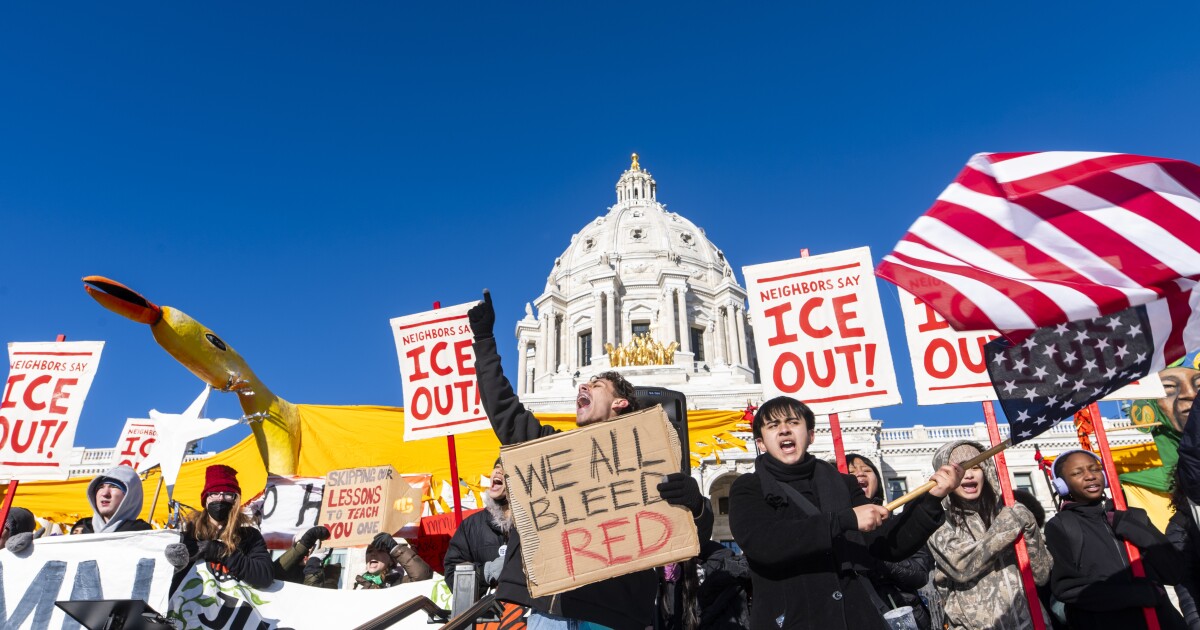
States Respond Differently to Immigration Crackdowns
The deaths of Renee Macklin Good and Alex Pretti have ignited debates on how states should handle immigration enforcement. Some Democratic leaders are exploring the possibility of holding federal Immigration and Customs Enforcement (ICE) officers accountable by pursuing criminal charges against them.
Following an ICE operation in Chicago last year, Illinois established the Illinois Accountability Commission to investigate ICE’s actions and leadership, with the aim of making accountability recommendations. Rubén Castillo, the chair of the commission and a former federal judge, stated that they are in talks with local law enforcement to identify possible prosecutions.
State Prosecution of Federal Agents
Despite the White House suggesting immunity for federal agents on duty, legal experts argue that states can bring criminal charges against federal officials if state laws are violated. Harrison Stark, an attorney affiliated with the University of Wisconsin Law School’s State Democracy Research Initiative, emphasized that states possess the authority to investigate and prosecute federal officials under state laws.
Moreover, Illinois allows individuals to sue federal agents in civil court, a provision that has sparked legal challenges from the Trump administration. Similarly, Democratic lawmakers in various states are contemplating enacting laws that mirror this provision.
Contrasting Approaches Between States
Republican-led states like Tennessee and Kentucky have actively supported federal immigration enforcement efforts, offering grants to law enforcement agencies collaborating with ICE. Tennessee is piloting legislation in collaboration with the White House to restrict benefits for individuals lacking legal status.
Conversely, Democratic-led states such as California, Illinois, and New York are exploring measures to limit police cooperation with ICE, including mask bans for federal agents and establishing tip lines to report ICE activity and abuses. Some states are considering creating safe zones where immigration arrests are prohibited.
With differing responses and legislative proposals, states are navigating the complex terrain of immigration enforcement amidst heightened scrutiny and evolving policies.
Original News Article:
Article Title: World Health Organization Issues Warning About Spread of New Strain of Coronavirus
The World Health Organization (WHO) has recently issued a warning about the spread of a new strain of coronavirus that has been identified in several countries. This new variant, known as B.1.1.529, is said to be highly transmissible and may evade immunity provided by vaccines. While the full extent of its impact is still being studied, health officials are urging caution and increased vigilance to prevent further spread.
According to WHO officials, the new variant was first detected in South Africa and has since been found in several other countries, including Botswana and Hong Kong. Preliminary data suggests that this strain may have mutations that could affect how well vaccines and treatments work against it. As a result, there is concern about its potential to cause a surge in cases and put additional strain on healthcare systems worldwide.
Governments and health authorities are being urged to enhance surveillance and sequencing efforts to track the spread of this variant and implement measures to contain it. Travel restrictions and quarantine requirements may be necessary to prevent the rapid spread of the virus. Additionally, WHO is working closely with scientists and researchers to better understand the new variant and develop strategies to combat its impact.
New Article:
Article Title: WHO Calls for Heightened Vigilance Against New Coronavirus Variant
Amid growing concerns over a new strain of coronavirus, the World Health Organization (WHO) has issued a warning urging countries to be on high alert. The variant, identified as B.1.1.529, is raising alarms due to its reported high transmissibility and potential ability to evade vaccine immunity. This development has sparked global efforts to prevent the spread of the virus and protect public health.
Initially discovered in South Africa, the new variant has quickly spread to other countries such as Botswana and Hong Kong. Early data suggests that mutations in this strain could impact the effectiveness of existing vaccines and treatments, posing a significant challenge to ongoing pandemic control measures. Health experts are closely monitoring the situation to assess the risks and determine the best course of action.
In response to the threat posed by the new variant, governments and health authorities are being called upon to strengthen surveillance and sequencing capabilities. By closely tracking the spread of the virus, countries can implement targeted measures to contain outbreaks and prevent further transmission. Travel restrictions and quarantine protocols may be essential in curbing the potential impact of the variant on global health systems.
The WHO is collaborating with scientists and researchers to enhance understanding of the new strain and develop strategies to combat its effects. By working together to address this emerging challenge, the international community aims to safeguard public health and mitigate the risks associated with the spread of the new coronavirus variant.