A Hero’s Journey Through Iwo Jima’s Minefields
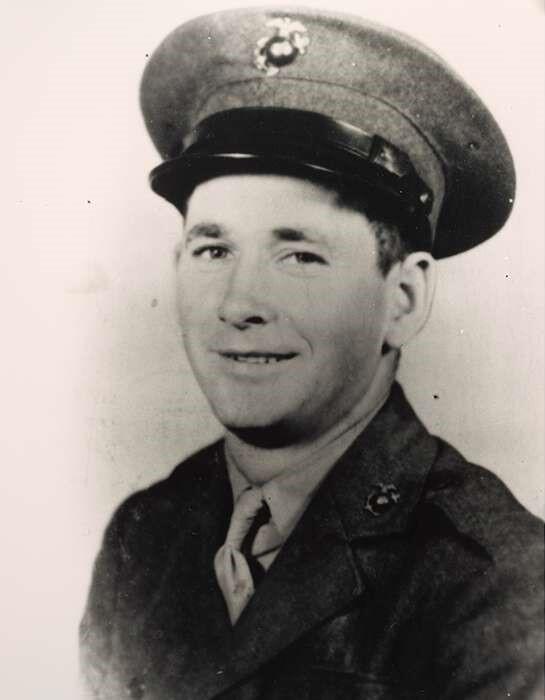
Amidst the chaos and intense combat of Iwo Jima, one Marine’s extraordinary courage became legendary. Sgt. Ross F. Gray, known for his unwavering faith and unyielding bravery, undertook a daring mission that would etch his name into the annals of history.
Carrying a 24-pound satchel charge, Gray navigated a minefield under relentless Japanese fire without the protection of a rifle. Supported by three Marines providing cover, Gray advanced toward a fortified Japanese bunker on February 21, 1945, during the fierce battle of Iwo Jima. He meticulously mapped the minefield without triggering a single device, a feat that would soon culminate in a display of unparalleled valor.
The Deacon’s Early Years
Born on August 1, 1920, in Marvel Valley, Alabama, Ross Franklin Gray was raised in a family of faith and hard work. Leaving Centerville High School in 1939, he joined his father in carpentry while engaging in sports and enjoying the rural Alabama life. Gray’s religious devotion earned him the nickname “The Deacon” among his fellow Marines, who often turned to him for spiritual guidance.
Gray enlisted in the Marine Corps Reserve in 1942, training at Parris Island and New River, North Carolina. By September, he joined the 23rd Marines, 4th Marine Division, and embarked on a series of amphibious assaults, ultimately leading to the battle of Iwo Jima.
The Front Lines of the Pacific War
Gray initially served in non-combat engineering roles, but the brutality of the Pacific War soon propelled him to the front lines. Following the devastating campaign at Saipan, where he lost a close friend, Gray took up a Browning Automatic Rifle, signifying his shift to direct combat roles.
As the 4th Marine Division faced the formidable defenses of Iwo Jima in February 1945, Gray’s leadership and training in mine and booby trap warfare became crucial. The division’s assault on the island met fierce resistance from a well-fortified Japanese defense system.
Confronting Kuribayashi’s Defenses
Lt. Gen. Tadamichi Kuribayashi’s intricate network of tunnels and bunkers posed a formidable challenge to the advancing Marines. On February 21, Gray’s platoon was halted by a minefield and entrenched positions. Assuming command, Gray embarked on a solo reconnaissance mission to assess the threat.
His discovery revealed a complex of interconnected bunkers protected by a minefield. Gray volunteered to neutralize the threat, securing 12 satchel charges and plotting a safe path through the minefield. With covering fire from fellow Marines, Gray executed a series of daring assaults on the bunkers, each time returning unscathed.
Twelve Courageous Crossings
Gray’s repeated crossings through the minefield allowed him to systematically destroy six enemy emplacements, eliminating over 25 Japanese soldiers and clearing the way for his platoon. His actions not only disarmed the minefield but also enabled his unit to advance without further casualties.
Despite the relentless enemy fire, Gray’s determination and selflessness transformed the battlefield dynamics, earning him the Medal of Honor posthumously. Sadly, he was fatally wounded six days after his heroic actions, leaving a legacy of bravery and sacrifice.
Remembering a Hero
Gray’s valor on Iwo Jima is commemorated through various honors, including the USS Gray (FF-1054) and his Medal of Honor, now housed at the Cahaba Lily Foundation. As one of 27 Medal of Honor recipients from the Iwo Jima campaign, Gray’s story continues to inspire future generations.
His extraordinary courage and leadership in the face of overwhelming odds exemplify the highest ideals of the Marine Corps, ensuring that Sgt. Ross F. Gray’s legacy endures as a testament to the sacrifices made during World War II.