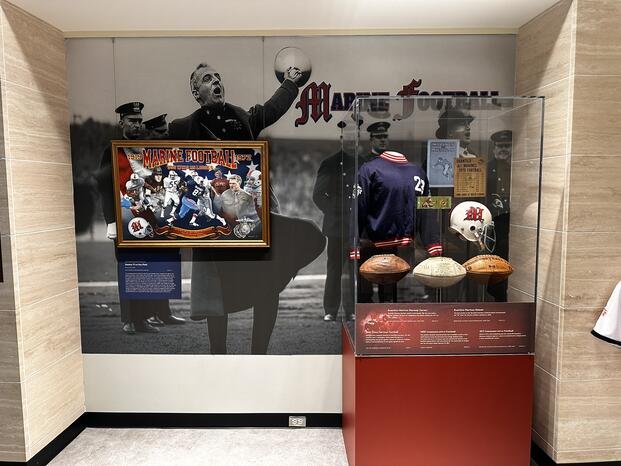
A New Chapter Unveiled: Marine Corps Football Legacy at National Museum
In an event that married nostalgia with history, the National Museum of the Marine Corps on January 28, 2026, opened a new exhibit dedicated to the enduring legacy of Marine Corps football. The ceremony featured retired Lieutenant Colonel Ron Eckert, the last coach of the Quantico Marines, who shared the spotlight with Brigadier General Matthew Tracy, President of Marine Corps University, as they paid tribute to this unique aspect of Marine culture.
The exhibit seeks to highlight a lesser-known chapter of the Marines’ history, aptly described by former Major General Joseph C. Fegan in 1923: “Fine Young Americans… will go where athletics are encouraged – they, too, like to be on the winning side.”
A Gathering of Stories and Memories
The display’s unveiling brought together a dedicated crowd of former Marines, veterans, and families. With the help of his wife Cathy, Eckert cut the ribbon, officially opening the display. Museum Director Keil Gentry emphasized the exhibit’s significance, stating, “This display celebrates teamwork, discipline, and the Marine spirit beyond the battlefield … It reminds us that competition, resilience, and camaraderie are as much a part of Marine identity as service in combat.”
Attendees exchanged stories and memories, including a tale from Eckert about the Quantico Marines’ final game against Xavier University. He recounted how a FedEx plane crew, passing en route to Memphis, paid homage by singing the Marines’ Hymn over the radio.
Honoring a Legacy: LtCol Ron Eckert’s Contributions
LtCol Ron Eckert played a pivotal role in Marine football as both a player and coach. Following two tours in Vietnam, he became the head coach in 1971, leading the team to a victorious end in 1972 with a 34-0 win over Xavier. He reflected on the program’s closure, noting, “Our world changed dramatically; the penchant for service football dried up.” Eckert’s personal artifacts and memorabilia enrich the exhibit, providing an authentic glimpse into that era.
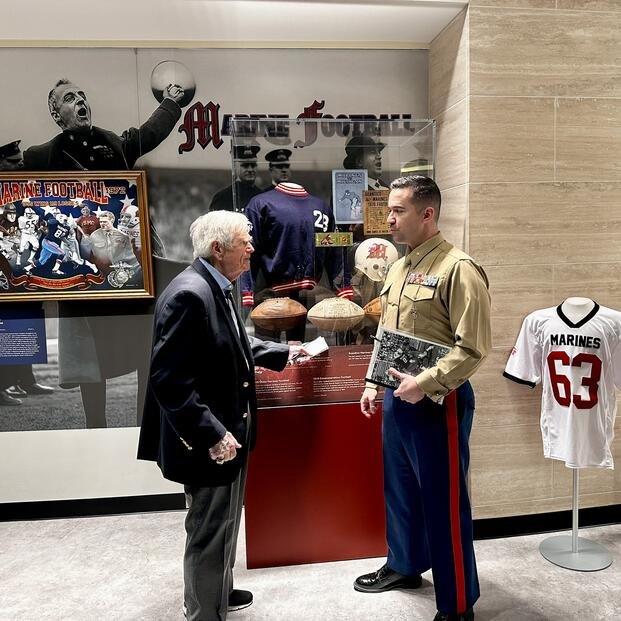
Artifacts and Memories: A Journey Through Marine Football
The exhibit showcases a rich collection of artifacts, including a 1935 football signed by the 4th Marines team in Shanghai and the final Quantico Marines helmet. A highlight is the painting “Semper Fi on the Field” by Jason Breidenbach, capturing the essence of the Marines in action. These items collectively reflect the indomitable spirit of the Marine Corps on the field.
The Historical Roots of Marine Football
The legacy of Marine football began in 1917 at Mare Island, California, where the team triumphed in the 1918 Rose Bowl before heading to World War I. By 1919, the program had moved to Quantico, Virginia, under General Smedley Butler’s guidance, amassing 355 wins across 51 seasons against prominent colleges and military squads. The team produced 21 All-Pro athletes, including NFL stars Eddie LeBaron and Jim Mora.
Impact Beyond the Field
Marine football wasn’t just about the game. It instilled values that translated into leadership and combat readiness. Captain Mike Pitts once highlighted in the base newspaper how the team embodied the “toughness of the Corps” and promoted teamwork and dedication. Today, the exhibit inspires reflection on the role such programs play in modern recruitment, emphasizing the celebrated virtues of strength and victory.
The National Museum of the Marine Corps, located at 1775 Semper Fidelis Way in Triangle, Virginia, welcomes visitors daily from 9 a.m. to 5 p.m., except on Thanksgiving and Christmas. Admission and parking are free. For more information, visit www.usmcmuseum.com.