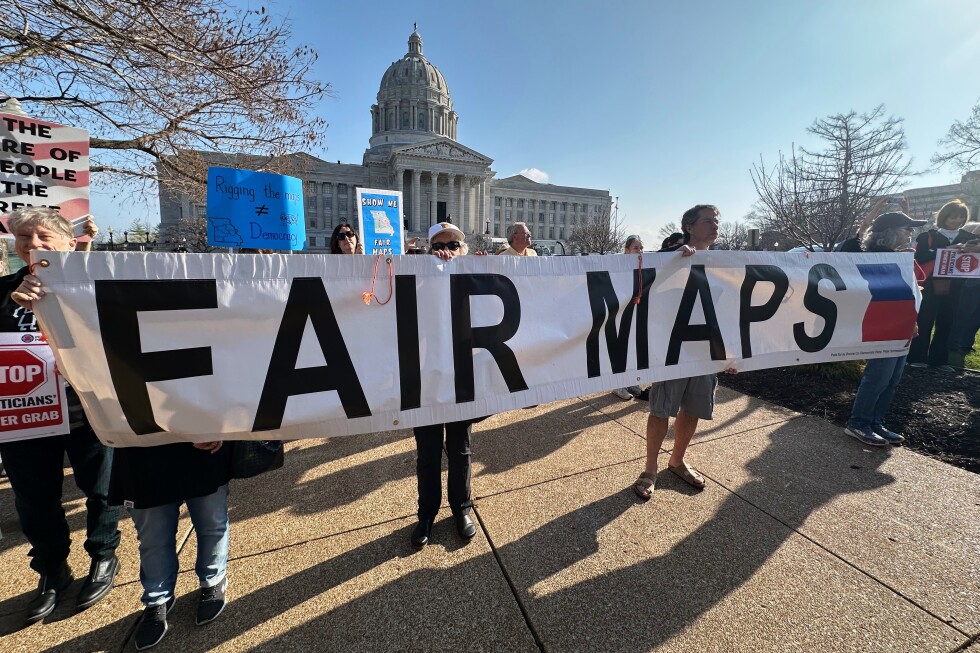
The political landscape in Missouri is shifting as a court ruling has upheld new congressional districts, crafted with the aim of bolstering Republican representation. This decision comes amidst broader national efforts influenced by President Donald Trump to reshape electoral boundaries to favor the GOP in the upcoming midterms.
Legal challenges against the newly drawn districts argued that they violated Missouri’s constitutional requirement for compactness. However, Jackson County Circuit Judge Adam Caine dismissed these claims, ruling in favor of the Republicans on Thursday.
While this court decision marks a triumph for the GOP, another legal battle continues in the Missouri Supreme Court, questioning the constitutionality of mid-decade redistricting. In addition, efforts to challenge the map include a petition with over 300,000 signatures seeking a statewide referendum.
Missouri’s current congressional delegation consists of six Republicans and two Democrats, established under a 2022 map following the latest census. Previously, Republican lawmakers resisted pushing for a map that could secure seven Republican seats, wary of overextending and potentially losing ground if Democrats gained momentum in elections.
Despite these concerns, Republicans proceeded with revising the districts, responding to pressure from the White House. The newly approved map from a September legislative session aims to capture a Kansas City-area seat held by Democratic U.S. Rep. Emanuel Cleaver. It does so by redistributing parts of Kansas City into adjacent Republican-represented districts and extending the 5th Congressional District into rural Republican strongholds.
Voter lawsuits claimed that the changes “radically depart” from historical norms by fragmenting the 5th District, traditionally centered in Kansas City. However, legal representatives for Republican Attorney General Catherine Hanaway argued that the overall map offers greater compactness and minimizes the division of local governments across districts, a view supported by Judge Caine.
Judge Caine noted that the underlying argument against the map seemed to suggest rural and urban voters should not be grouped together, countering this by pointing to previous instances where such combinations existed, including maps from 2012 to 2020.
“The decision of what municipalities to split is a political and policy determination that is properly left in the hands of the General Assembly and Missouri’s political processes,” Judge Caine stated.
Organizations representing the plaintiffs criticized the ruling but have not yet indicated if they will appeal. “If allowed to stand, it would represent a significant setback for fair representation in Missouri,” expressed the American Civil Liberties Union and the Campaign Legal Center in a joint statement.
Conversely, Hanaway described the ruling as “a complete victory for Missouri and for the people’s elected representatives.”