The U.S. Air Force is quietly repositioning itself across two of America’s most remote island chains — one stretching toward Russia in the icy North Pacific, the other scattered across the contested waters of the central Pacific near China. What’s driving this push, and what does it mean for American security?
In late October, the Air Force carried out a rare deployment to Shemya Island, a wind-swept outpost in Alaska’s Aleutian Islands that sits closer to Russia than to mainland Alaska. At the same time, the service released a proposal outlining its plans for operations on islands near Guam in the Pacific. Taken together, the two developments reveal an Air Force focused on expanding the number of places from which it can operate — and complicating the calculations of potential adversaries.
Waking Up a Cold War Outpost
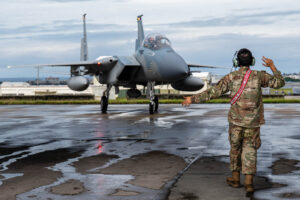
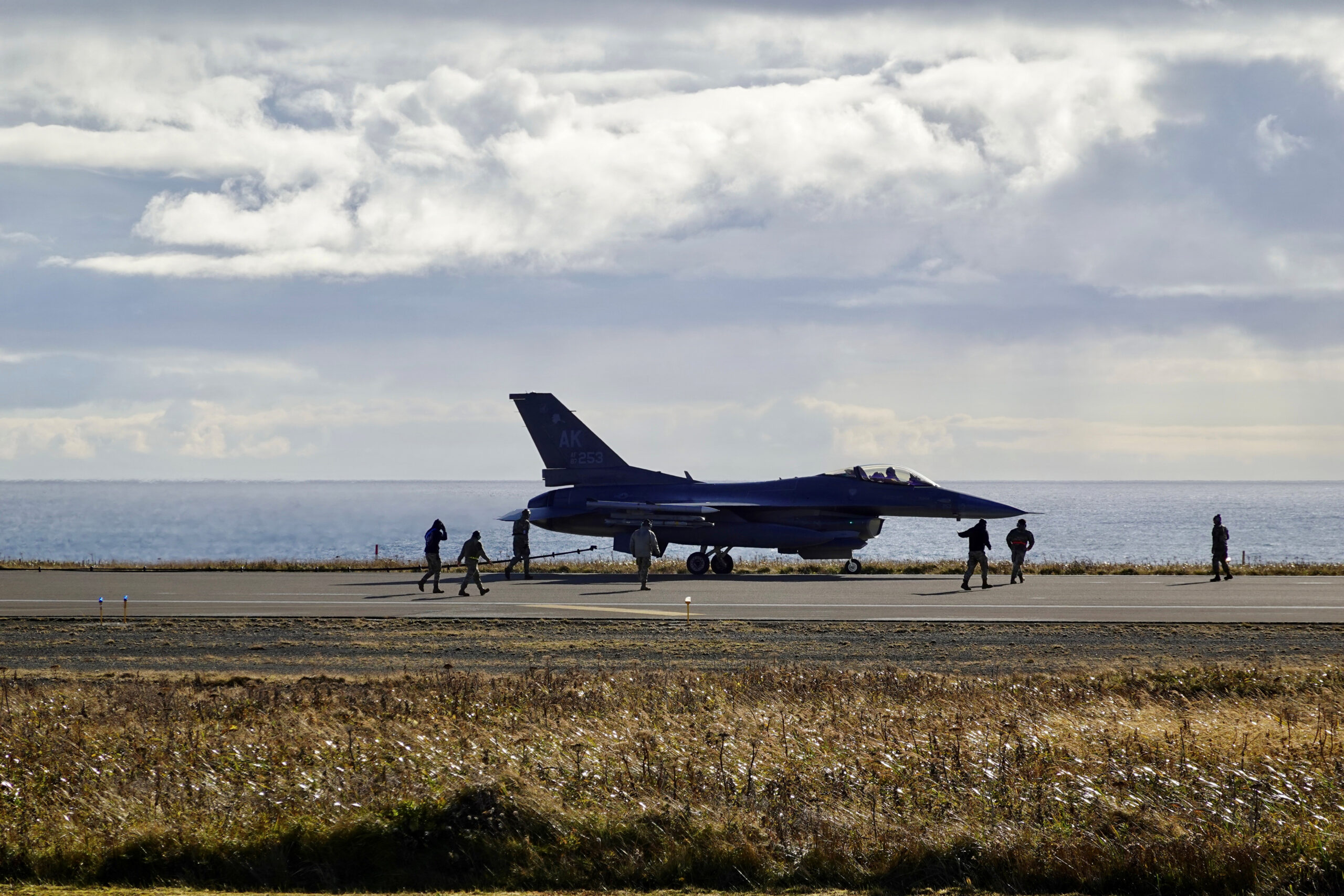
From October 18 to October 26, F-16 fighter jets, tankers, and cargo aircraft deployed to Eareckson Air Station on Shemya Island — and they didn’t just land and wait. The jets “sat alert,” meaning crews were positioned and ready to launch on short notice. It was a posture that hasn’t been seen there in a long time.
Capt. Kitsana Dounglomchan, spokesperson for the Alaskan NORAD Region, put it plainly:
“While it was commonplace for aircraft to sit alert in the 1980s, this deployment marks the first time in decades that aircraft have sat alert at Eareckson.”
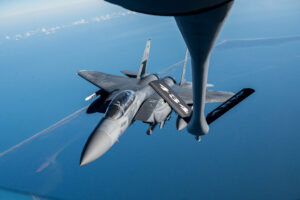
The exercise concluded with a joint U.S.-Canada homeland-defense operation. As F-16s launched from Eareckson to cover the southern portion of the Alaska theater, F-35s and F-16s at Eielson Air Force Base — 1,600 miles to the west — took off to cover the northwest. Canadian CF-18s flew 2,600 miles from their base at Cold Lake to handle the northern sector.
Air Force Lt. Gen. Robert Davis, commander of the Alaskan NORAD region, said the exercise demonstrated real operational value:
“Operating from Eareckson proved we can deploy to an austere location, maintain alert, launch on short notice, and seamlessly integrate U.S. and Canadian forces to defend the northern approaches.”
Shemya’s history stretches back to World War II, and during the Cold War it hosted refueling and surveillance aircraft along with radars tracking Soviet missile activity. The massive Cobra Dane radar, built in the 1970s, still monitors missile launches today. Recent activity at the island has picked up in response to a flurry of Russian and Chinese activity in the region, including the first-ever Sino-Russian bomber patrol near Alaska. In September 2024, U.S. soldiers conducted a “force projection operation” with HIMARS rocket launchers there, and other recent exercises have focused on defending the island from seaborne and aerial threats.
The Aleutian Islands stretch across strategically important waters linking the Pacific and Arctic oceans — a fact that keeps Shemya relevant despite its remoteness. During the October deployment, airmen also certified Eareckson’s aircraft-arresting system to handle F-16s, “further validating Eareckson Air Station as a viable location for future fighter operations from an austere airfield,” according to a press release. Dounglomchan declined to preview future plans but said NORAD maintains “the operational capability” to move forces around Alaska and the Arctic “at a time and place of our choosing” and “oftentimes to remote locations like Eareckson.”
Rebuilding Pacific Runways
As the Shemya drills were wrapping up, the Air Force published a proposal to study the impact of conducting up to 1,500 — and potentially more than 1,800 — aircraft operations annually at airfields on Rota, Saipan, and Tinian in the Commonwealth of the Northern Mariana Islands, a U.S. territory in the central Pacific. The planned operations would include small, medium, and large exercises held several times a year, involving up to 550,000 gallons of fuel, up to 1,000 personnel, munitions, and temporary infrastructure at each airfield. The formal study assessing the social, economic, and environmental effects won’t be complete until mid-2028.
Tinian has drawn particular attention. The Air Force has been refurbishing North Field there — described as one of the U.S.’s largest and most important World War II airbases — which had been abandoned and overgrown since the war ended. Airmen have been clearing vegetation, removing debris, and rehabilitating runways since late 2023. That work is ongoing, but had advanced enough by mid-2025 for North Field to be deemed “a semi-permanent [contingency] location” for the Air Force’s main base on Guam, roughly 100 miles to the south.
The Northern Marianas sit in the Second Island Chain, which runs from Japan through the central Pacific to Indonesia. The Air Force has been scouting airfields throughout that chain and conducting renovations and upgrades as part of its Agile Combat Employment concept — a strategy built on dispersing aircraft across many locations to make them harder to destroy in a single strike.
Kelly Greico, a senior fellow at the Stimson Center whose research focuses on airpower strategy, explained the logic clearly:
“China’s missile force is large, but it’s not unlimited. Every additional airfield from where the Air Force can operate is another target China has to cover. That’s the logic behind Agile Combat Employment.”
Greico draws a distinction between what the two island groups offer strategically. Shemya, he said,
“is primarily about homeland defense. Its location in the North Pacific makes it useful mainly as a forward operating location for NORAD. The value of the remote airfield lies less in its ability to generate sorties under contested conditions than in its geographic position in intercepting Russian aircraft forward.”
Investments in Rota, Tinian, and Saipan, by contrast,
“are primarily about expanding the number of locations from which the Air Force could operate, reducing its dependence on Andersen Air Base at Guam,”
Greico added.
Both island groups carry one significant advantage over U.S. bases in Japan or the Philippines: they are American territory. That gives the Pentagon more freedom to operate without needing a foreign government’s approval. Bases closer to China in the Philippines and Japan may offer geographic advantages, but those host nations may limit their access during a crisis.
Geography, however, imposes its own limits. Drawing on the Stimson Center’s modeling, Greico noted that dispersal had “the biggest effect of any countermeasure we tested” — but cautioned that
“the effect is much smaller in the Second Island Chain than in Japan, because there just aren’t many runways out there.”
The numbers back that up.
“Chinese missile strikes could keep U.S. runways in Guam and other Pacific islands closed to tankers and bombers for about four days. Adding civilian airfields in Guam, the Northern Marianas, and Palau only reduced those times by a matter of hours,”
Greico said.
“Geography matters here. There’s a lot of water out there, but not much land.”