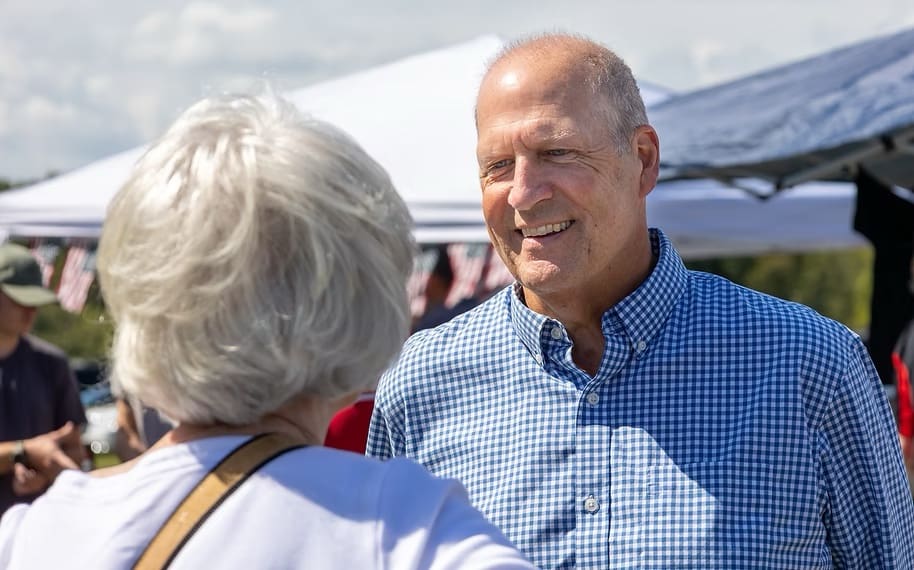
Amid escalating conflicts in Iran and Venezuela, financial disclosures suggest that Republican John Sununu’s investments are reaping significant benefits. Sununu, who is vying for a U.S. Senate seat in New Hampshire, appears to profit from rising oil and gas company stocks, a situation that aligns with his vocal support for these wars, despite their widespread unpopularity.
Sununu, who served in the U.S. Senate from 2003 to 2009, has seen substantial gains from his oil and gas investments. The ongoing wars have driven up gas prices, subsequently boosting the profitability and stock values of these companies.
“The first quarter is going to be phenomenal for these companies,” Leo Mariani, an analyst at Roth Capital Partners, remarked to Reuters. “I don’t think there’s any way around that.”
In the previous year, Sununu and his wife disclosed ownership of oil and gas stocks valued between $77,000 and $280,000, including up to $50,000 in ExxonMobil and $65,000 in Shell. These holdings have surged by 24% since November 2025, with notable increases following the January incursion into Venezuela and the February bombing of Iran.
The U.S. administration has offered various reasons for its actions in Iran, citing regime change, the protection of Israeli security, and the prevention of nuclear armament. Joe Kent, who resigned as director of the National Counterterrorism Center, has publicly criticized the war, labeling it as unnecessary and perilous.
“I cannot in good conscience support the ongoing war in Iran,” Kent stated in his resignation letter. “Iran posed no imminent threat to our nation.”
Sununu, however, has echoed the administration’s stance. In a February radio interview on New Hampshire Today, he defended the war as essential for national security and expressed support for a prolonged military presence until the perceived threat is neutralized.
“The real issue is that Iran cannot be allowed to have a nuclear weapon,” he explained. “For the last 40 years, they have been the largest state sponsor of terrorism, global terrorism, so I think that the effort to eliminate their nuclear program … is the right focus for the administration to have.”
Addressing concerns about rising gas prices due to the conflict, Sununu stated, “the mission is important and critical.”
Similarly, the White House’s justification for its actions in Venezuela has been vague, but Sununu sees potential for oil and gas development. On New Hampshire Today, he described the situation as an opportunity for U.S. intervention in rebuilding Venezuela’s economy, particularly in the oil sector.
“I think there is an opportunity for the U.S. to provide technical assistance, advice, even financing to help rebuild [Venezuela’s] economy broadly and in the oil industry in particular,” he noted.
Polling indicates that Sununu’s perspective diverges from public sentiment. An Ipsos poll revealed that only 33% of Americans support military intervention in Venezuela, while a Pew Research Center survey showed 61% disapprove of the Iran conflict.
Since departing the Senate, Sununu has been associated with Akin, a lobbying firm serving several sectors, including energy and defense. Between 2010 and 2019, Akin reported over $5 million in earnings from oil and gas entities, such as Shell.
During his Senate tenure, Sununu supported the 2003 Iraq invasion.
Sununu is set to compete against former New Zealand ambassador Scott Brown in the September 8 primary. The victor will likely contend with Democratic Rep. Chris Pappas in the general election.