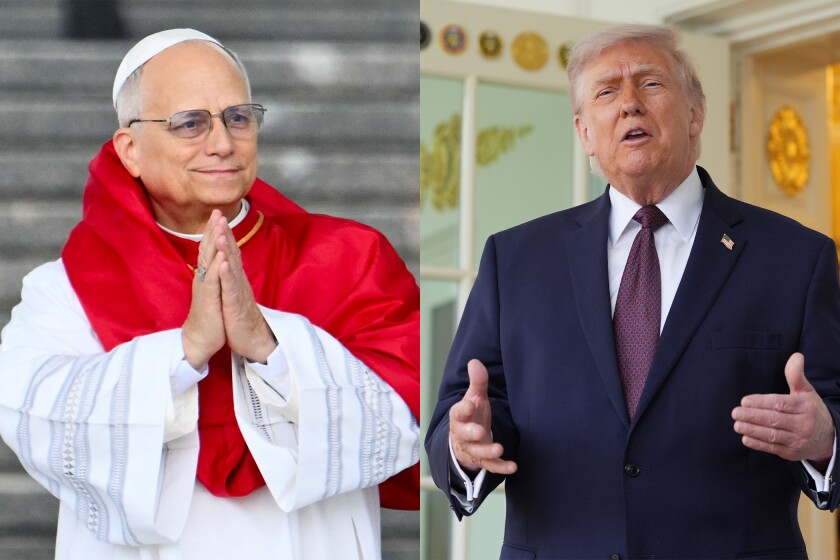
In an unexpected quarrel between two major global figures, Pope Leo XIV and former President Donald Trump have clashed over divergent views on Iran’s war. Each brings contrasting perspectives on leadership, religion, and international conflict, marking their stark differences.
Social Media Sparks Debate
Trump turned to social media to criticize Pope Leo XIV as “Weak” and under the sway of the “Radical Left,” implying without evidence that Trump played a role in Leo’s elevation to the papacy. In response, the pope dismissed these remarks as “truly unacceptable,” focusing instead on Scripture and ecclesiastical teachings rather than engaging in personal political battles.
Pope Leo, while traveling to Africa, stated, “I’m not afraid of the Trump administration,” emphasizing the Church’s commitment to spreading the Gospel’s message.
It’s the first time these two Americans have used their influential platforms for a public dispute.
Prevost’s Stance on Global Policies Before the Papacy
Before becoming pope, Robert Prevost, then a Peruvian bishop, condemned Russia’s actions in Ukraine during a 2022 TV interview on “Weekly Expression,” describing it as an “imperialist invasion” with power motives. This segment resurfaced in the media after his papal appointment on May 8, 2025.
Prevost also critiqued U.S. Vice President JD Vance on social media, sharing a headline that read, “JD Vance is wrong: Jesus doesn’t ask us to rank our love for others.” Such outspoken engagement showcases his willingness to address global issues directly.
Trump’s Nationalistic Interpretation of Leo’s Election
Trump celebrated Prevost’s election as Pope Leo XIV on May 8, 2025, via Truth Social, expressing honor and excitement at having an American pope. He mentioned looking forward to a “very meaningful moment” with Leo. Later, he attributed Leo’s papacy to a strategic choice by the Church to handle Trump, reflecting a nationalistic viewpoint that overlooks the Vatican’s broader diplomatic ties.
Papal Addresses Emphasize Peace
Leo XIV used his first appearance from St. Peter’s balcony to embrace peace, stating, “Peace with you all … the first greeting of the risen Christ.” In his first Sunday blessing, he condemned the conflicts in Ukraine and Gaza, referring to them as fragments of a “third world war.” He reiterated the Sermon on the Mount’s message by saying, “Blessed are the peacemakers.”
These addresses reflect a papacy deeply committed to advocating for peace through Gospel teachings.
The Global Orientation of Pope Leo XIV
Leo’s papacy is marked by a rejection of U.S.-centric perspectives, favoring a multilingual approach. He delivered his papal announcement in Italian and switched to Spanish to greet Peruvians. His preference for Italian and Spanish signals his identity as a global leader rather than solely an American figure.
The Growing Rift During Holy Week
During Palm Sunday, Pope Leo described Jesus as the “King of Peace,” warning that God disregards the prayers of those waging war. Concurrently, Trump hosted conservative religious leaders at the White House, where advisor Paula White compared him to a persecuted savior. On Easter, Trump’s aggressive stance on Iran prompted Leo to denounce such rhetoric as “truly unacceptable.”
Ongoing Exchanges Between Trump and Pope Leo
In a new message, Trump labeled Leo as “weak” and a tool of the “Radical Left,” asserting, “I don’t want a Pope who criticizes the President of the United States,” and imploring Leo to “focus on being a Great Pope, not a Politician.” (Trump’s 2024 victory was far from a landslide.)
During his flight to Algeria, Leo expressed to The Associated Press his commitment to the Church’s mission, saying, “To put my message on the same plane as what the president has attempted to do here, I think is not understanding what the message of the Gospel is.” He stressed his dedication to his vision for the Church in current world affairs.
This uncommonly public dispute highlights the pope’s resistance to political classification and Trump’s framing of Leo as a rival rather than a religious leader.