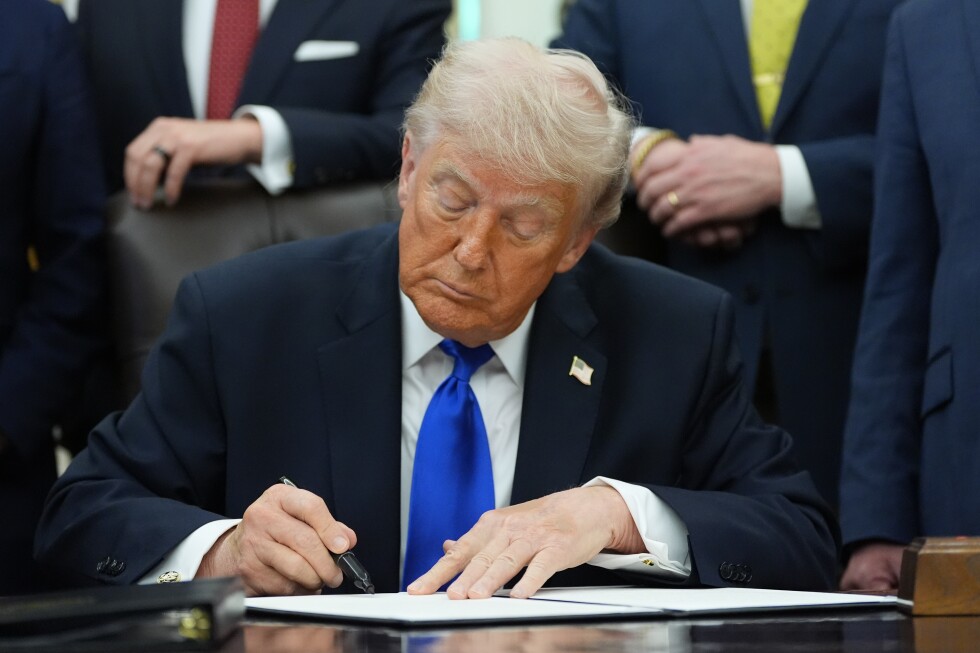
In a move that could have significant implications for the global economy, President Donald Trump announced plans to raise tariffs on European Union car and truck imports to 25% by next week. This decision comes amid rising tensions over what Trump describes as the EU’s failure to adhere to a previously negotiated trade agreement.
Trump took to social media to express his dissatisfaction, stating that the EU “is not complying with our fully agreed to Trade Deal.” However, he provided no additional details on his specific grievances. When questioned by reporters about the tariff increase, he reiterated that the EU was not following the trade framework established last year and suggested that higher tariffs would expedite the relocation of production to the U.S.
The trade deal, agreed upon last July between Trump and European Commission President Ursula von der Leyen, had initially set a tariff ceiling of 15% on most goods. However, a Supreme Court ruling against Trump’s legal authority to impose such tariffs has led his administration to explore alternative measures, including a current 10% tax while assessing trade imbalances and national security concerns.
Potential Global Economic Impact Amidst Other Challenges
The timing of these tariffs is critical, as the ongoing Iran conflict has already strained the global economy. The closure of the Strait of Hormuz has resulted in increased oil and natural gas prices, exacerbating inflation and slowing economic growth worldwide.
Domestically, Trump is under pressure to manage escalating inflation rates ahead of the November midterm elections. Though he campaigned on a promise to control prices post-pandemic, energy costs have driven inflation higher than anticipated, reaching 3.3% in March. An Associated Press-NORC Center for Public Affairs Research poll indicates that only 30% of U.S. adults approve of Trump’s economic management.
European Response and Concerns
The European Parliament is progressing slowly with the trade deal ratification, expected to be completed next month. The EU has warned that it will consider protective measures if the U.S. takes actions inconsistent with the agreement. Bernd Lange, chair of the European Parliament trade committee, criticized the tariff hike, calling it “unacceptable,” and accused the Trump administration of breaking commitments.
Jennifer Safavian, CEO of Autos Drive America, voiced concerns that the tariff increase could undermine progress in opening EU markets and bolstering the U.S. auto industry. Both the U.S. and the EU remain committed to the Turnberry Agreement, named after Trump’s Scottish golf course, to maintain the trade framework.
Legal and Trade Developments
Earlier this year, the Supreme Court decision cast doubt on the 2025 trade deal’s future by declaring the president’s lack of authority to impose tariffs based on economic emergencies. In response, the Trump administration has initiated trade investigations under Section 301 of the Trade Act of 1974 to address issues such as forced labor and overproduction.
These investigations could jeopardize the agreement with the EU, though European Commissioner for Trade and Economic Security Maroš Šefčovič expressed optimism about improving U.S.-EU relations over the past year. The potential tariff increase may involve Section 232 of the Trade Expansion Act of 1962, which permits tariffs on national security grounds.
Scott Lincicome from the Cato Institute noted the instability in trade agreements, highlighting that they rely on “handshakes and winks” and are vulnerable to shifts in Trump’s stance. The EU had anticipated the bilateral deal to save European automakers between 500 to 600 million euros monthly, with the total EU-U.S. trade in goods and services valued at 1.7 trillion euros in 2024.