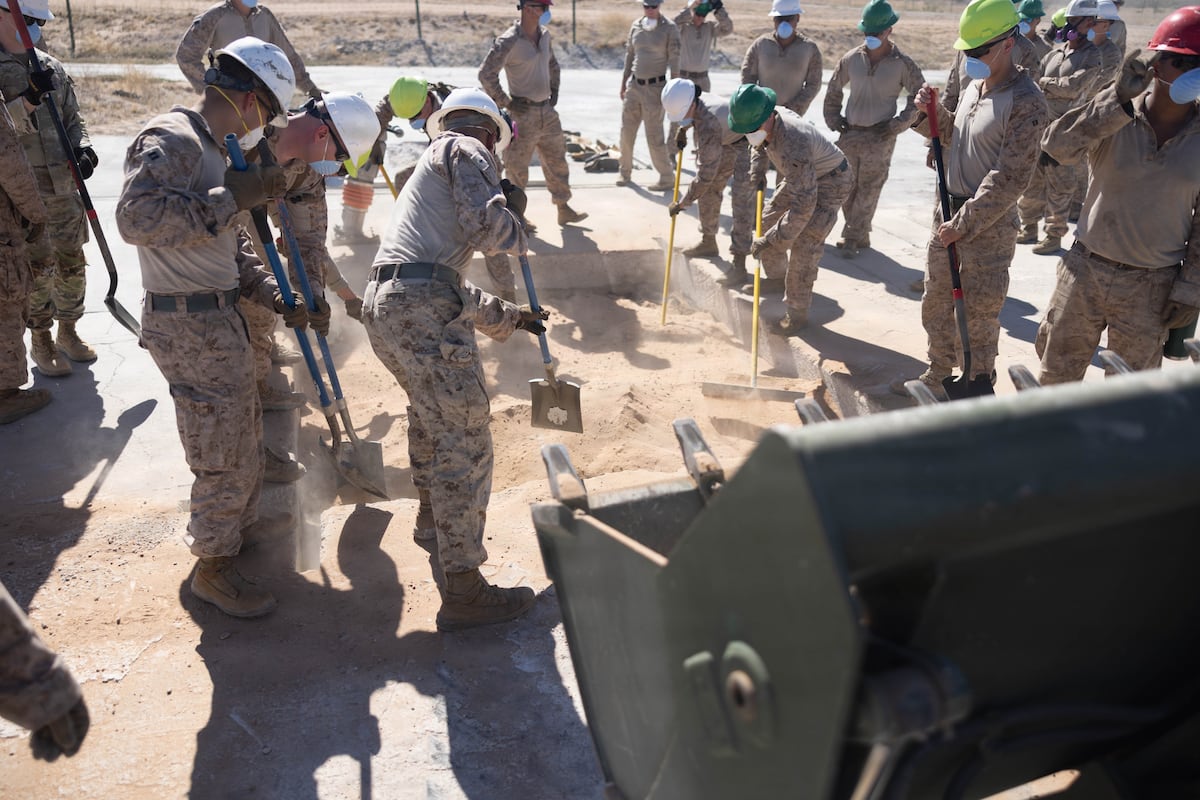
In a move to reduce the physical demands on Marines in remote areas, the Marine Corps is exploring cutting-edge robotics to automate the construction of temporary airfields. This initiative aims to replace the manual labor traditionally required for laying down expeditionary airfield (EAF) matting with advanced robotic systems.
The Marines’ current method of assembling EAF matting is labor-intensive and hazardous, according to a Small Business Innovation Research (SBIR) proposal, which is seeking submissions until June 3. The project, titled “Automated Expeditionary Airfield Assembly,” outlines the need for robots that can operate on challenging terrains and precisely position heavy mat sections under tough conditions.
As per the SBIR proposal, the envisioned robots should be capable of autonomous navigation and control, featuring abilities such as obstacle avoidance and path planning without human intervention. The proposal also encourages contractors to explore diverse robotic configurations, including mobile manipulators and assistive technologies, to enhance the efficiency of EAF mat handling across various terrains.
Phase I of the SBIR project will focus on establishing the technical viability of a robotic system that can automate or support the assembly of EAF prefabricated surfaced aluminum (PSA) Flat Top-Nested (Top-N) Trackway mats. Key evaluation criteria include payload capacity, manipulation precision, and operational endurance.
Following this, Phase II will aim to develop a functional prototype with automated or semi-automated capabilities. “The robot shall be able to handle the PSA mats in some manner to aid in the assemble of the airfield, be a closed system and able be able to operate in a realistic environment,” the SBIR states. The system’s feasibility, assembly time, user-friendliness, and overall size will be critical factors.
Phase III will transition to a deployable system ready for field testing. The SBIR emphasizes that the robot must withstand electrical, environmental, and cyber threats, demonstrating its ability to reduce staffing needs, operational costs, and deployment times significantly.
Efforts to simplify the construction of expeditionary airfields are not new to the Marine Corps, which has already begun adopting commercial lightweight matting. Meanwhile, the robotics industry is advancing technologies for construction work, including four-legged and two-legged humanoid robots.
Additionally, Japan Airlines is experimenting with humanoid robots for baggage handling, showcasing the broader potential of robotics in various operational contexts.