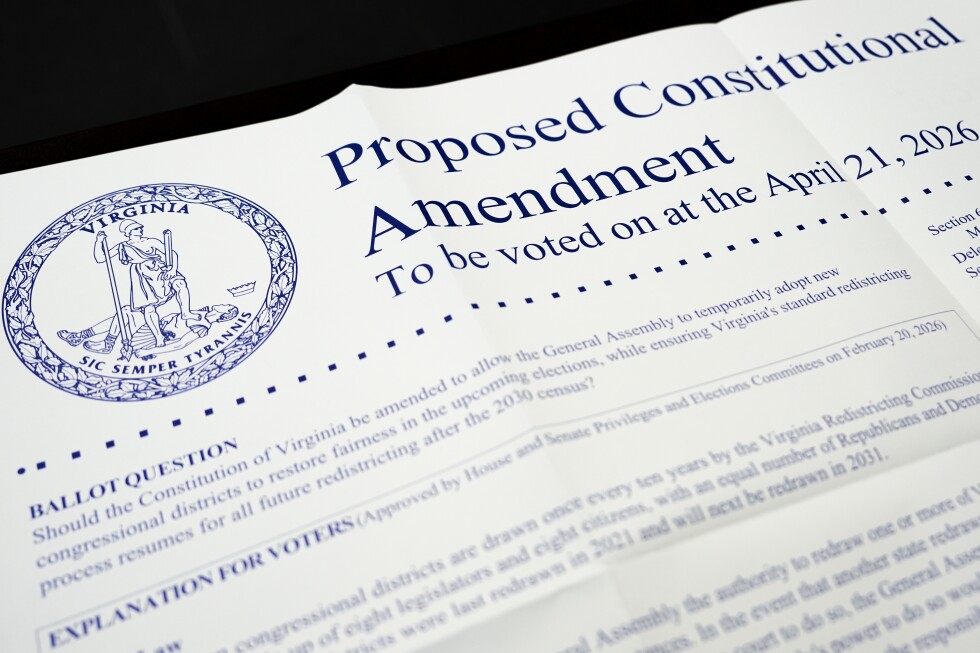
In an unexpected twist in the political landscape, Democrats have turned to the U.S. Supreme Court with an urgent appeal, aiming to reverse a Virginia court decision that has hindered their chances of securing additional seats in the House of Representatives. This legal maneuver comes as the latest chapter in the ongoing saga of redistricting battles across the nation.
The Virginia Supreme Court recently nullified a constitutional amendment, narrowly approved by voters, which could have provided the Democratic Party with four additional viable congressional districts. The court’s 4-3 decision stated that the process of placing the amendment on the ballot was improperly initiated after early voting commenced in last fall’s general election in Virginia.
Democrats contend that the U.S. Supreme Court has previously ruled that an election is not concluded until Election Day itself, regardless of early voting activities. Despite their arguments, the Virginia court’s decision prevailed, prompting the Democrats’ emergency appeal.
This appeal is part of a larger nationwide redistricting struggle, fueled by President Donald Trump’s call for Republican-led states to redraw their electoral maps. A recent Supreme Court decision further complicated the situation by significantly weakening the Voting Rights Act, impacting how districts can be shaped.
The Democrats’ legal team, including Virginia’s Democratic Attorney General Jay Jones, argued, “The Court overrode the will of the people who ratified the amendment by ordering the Commonwealth to conduct its election with the congressional districts that the people rejected.” They emphasized the profound and immediate harm resulting from the Virginia Supreme Court’s ruling.
For Democrats, the Virginia court decision represents a significant setback in the mid-decade redistricting race. Although they remain optimistic about reclaiming the House, their Republican counterparts have reportedly gained over a dozen seats through redistricting efforts. The voter-approved Virginia map could have counterbalanced these gains.
Despite the legal hurdles, the Democrats’ appeal to the Supreme Court is considered a long shot, given the justices’ general reluctance to overturn state court interpretations of their constitutions. This stance is evidenced by the Court’s recent refusal to overrule a North Carolina Supreme Court decision blocking a GOP-favored congressional map.
Politically, this appeal might serve as a strategic tool for Democrats, providing them with material for election-year narratives about a perceived partisan bias in the Supreme Court. This aligns with recent court actions allowing Louisiana Republicans to proceed with redistricting, despite rulings against majority Black districts as unconstitutional racial gerrymanders.
The Virginia amendment was originally designed to counter Republican advances in states like Texas, Missouri, North Carolina, and Ohio, and to challenge a new map in Florida. Its passage momentarily balanced the national redistricting battle between Democrats and Republicans.
However, the Virginia Supreme Court’s decision, with justices appointed by a legislature that has shifted between parties over the years, has disrupted this balance. Although the court does not have a clear ideological bias, its ruling has tilted the redistricting scales.