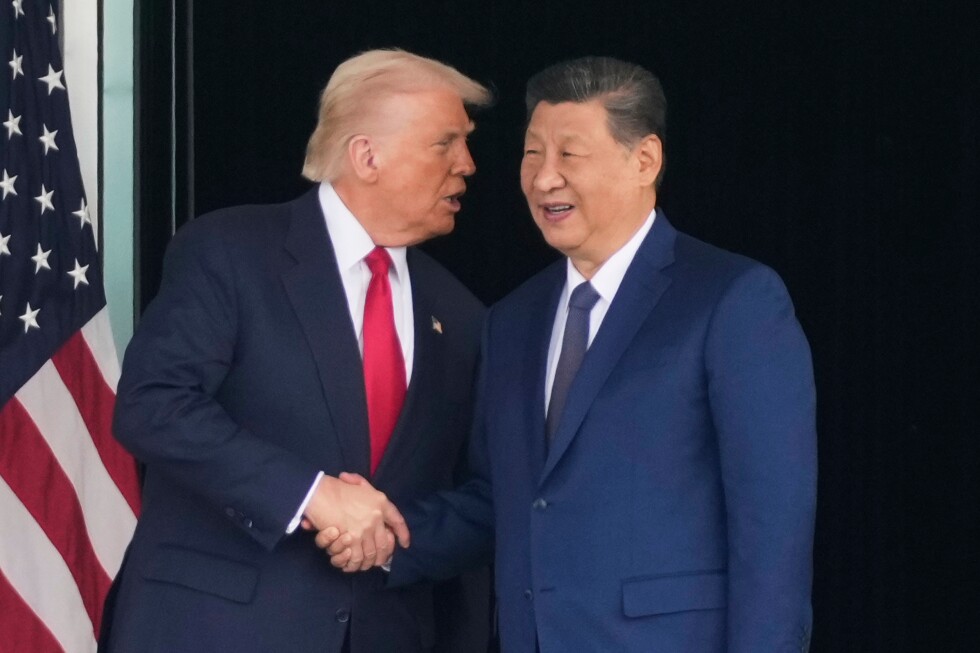
The intricate dance of diplomacy and commerce continues as President Donald Trump prepares for a significant summit in Beijing with Chinese President Xi Jinping. This meeting comes amid ongoing challenges in trade relations, encompassing rare earth minerals, tariffs, and advancements in technologies like artificial intelligence.
In anticipation of the four potential meetings this year, Trump has emphasized the positive financial outcomes from trade with China. “We’re doing a lot of business with China and making a lot of money,” Trump stated, underscoring the evolving nature of economic ties between the two nations.
The summit aims to maintain stability in the economic relationship, with expectations set for only minor policy shifts. The trade truce established last October might be prolonged, and China could announce purchases of American agricultural products and Boeing airplanes. Additionally, U.S. officials are considering the establishment of a Board of Trade to facilitate ongoing economic discussions.
Brett Fetterly, a managing principal at The Asia Group, noted that some in the Trump administration prioritize stability and engagement over immediate deliverables to foster future negotiations. However, addressing deeper competition issues between the U.S. and China will require more than just engagement, as tariffs and technology races remain contentious.
China and the US are Buying Less from Each Other
Despite Trump’s optimistic remarks, U.S. Census Bureau data reveals a $50 billion decline in American product purchases by China compared to 2022. This reduction partly stems from Beijing’s halt in soybean purchases during the previous year’s trade war. The Trump administration aims to rectify this by encouraging more Chinese imports of U.S. goods to address the $202 billion trade imbalance recorded last year.
Interestingly, the U.S. now imports more from Taiwan than China, influenced by the AI sector’s demand for Taiwanese computer chips and servers. Since Trump’s first term, China has redirected some U.S.-bound products through other Asian countries, while American companies have shifted supply chains for electronics to Vietnam and India. Chad Bown of the Peterson Institute for International Economics highlighted that China’s share of U.S. imports has decreased significantly since 2017.
The US Proposes a Trade Board with China
U.S. Trade Representative Jamieson Greer has advocated for a “new government-to-government Board of Trade” to facilitate trade in non-sensitive goods like agricultural products. This initiative could streamline dispute resolution and enhance American exports to China, potentially preventing tariff hikes like those imposed last year.
While the Trump administration seeks domestic approval for the board, there is also interest in forming an investment forum to discuss bilateral financing. Accompanying Trump to China will be notable CEOs, including Tesla’s Elon Musk and Apple’s Tim Cook.
Washington and Beijing’s Divergent Objectives
The differing priorities of the U.S. and China underscore their complex relationship. While Trump focuses on trade imbalances and AI supremacy, Xi considers global disruptions like climate change and the Iran conflict as opportunities for Chinese technological advancements. Michael Sobolik of the Hudson Institute noted, “Washington and Beijing are competing at different levels and different domains.”
The energy landscape is also shifting due to the U.S.-Israel conflict with Iran, with the Trump administration betting on continued reliance on fossil fuels. In contrast, China views the energy disruptions as a catalyst for a green transition. Ali Wyne from the International Crisis Group commented on the growing structural frictions between the two nations.
Underlying Tensions Despite Positive Rhetoric
Despite optimistic overtures, several underlying tensions could hinder significant progress at the summit, including:
- China’s control over rare earth minerals, vital for electronics, and the U.S.’s efforts to develop its own production capabilities.
- The U.S. initiative to limit China’s access to advanced computer chips essential for AI.
- China’s rise as a leading automaker with competitive EV exports.
- Ongoing tariff disputes following legal challenges to Trump’s previous tariffs.
- U.S. sanctions on Chinese entities involved in Iranian oil transportation, prompting Beijing to reject U.S. penalties.