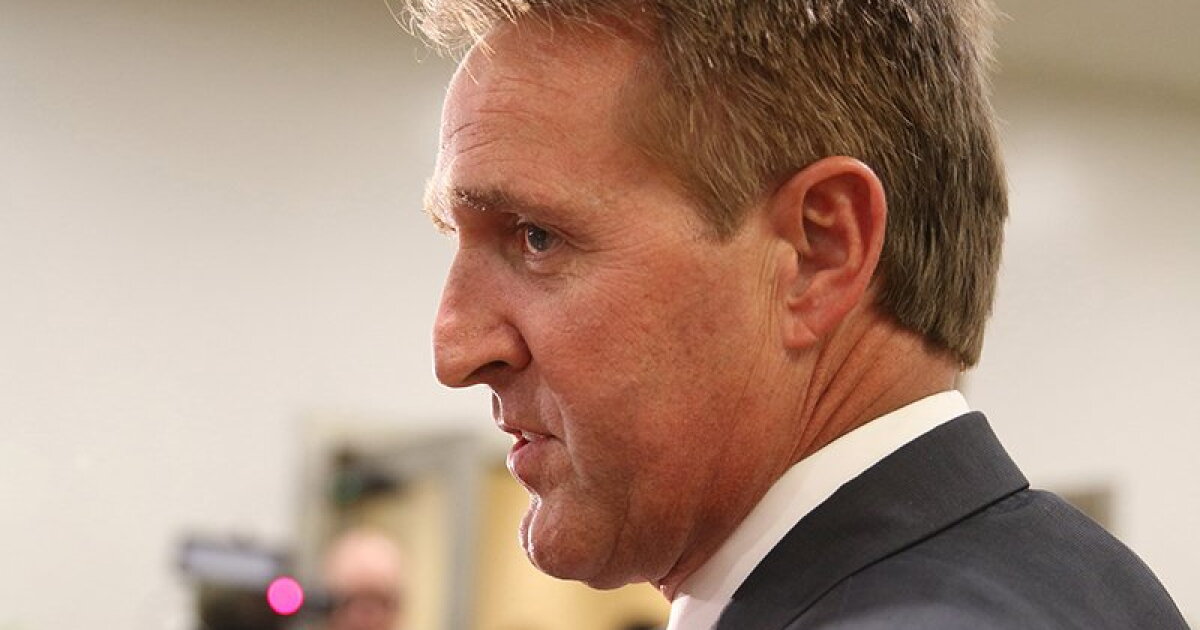
The morning of September 11, 2001, began routinely for Jeff Flake, who was then a freshman Republican representative. He had just dropped his wife, Cheryl, at the airport for her trip back to Arizona and proceeded to a congressional hearing at the Capitol. However, the day quickly unraveled into chaos.
Flake and his colleagues were informed of a plane crashing into the North Tower of the World Trade Center. Initially, the incident was perceived as an accident. However, when another plane hit the South Tower minutes later, it became clear that America was under attack.
“I just remember leaving the hearing room and just seeing pandemonium in the Capitol,” Flake recounted years later. Flake, who would later serve as the U.S. ambassador to Turkey under President Biden, was advised to evacuate the Capitol immediately.
On September 11, four planes were hijacked by terrorists. Two targeted the Twin Towers, one struck the Pentagon, and the fourth crashed in Pennsylvania, likely thwarted by passengers from reaching its intended target, the Capitol or the White House, as per the 9/11 Commission Report.
Amidst the chaos, Flake’s primary concern was ensuring the safety of his wife. Her flight was grounded in Wichita, Kansas, due to the nationwide airspace closure ordered by the Federal Aviation Administration. This decision was unprecedented, affecting more than 4,000 flights. It took Cheryl Flake three days to reach Arizona.
Later that day, as the immediate threat receded, around 150 lawmakers gathered at the Capitol steps. In a moment of unity, they sang “God Bless America.” Flake recalled, “Republicans, Democrats, didn’t matter — singing that song.”
The attacks on September 11 resulted in the deaths of 2,977 people, marking it as the deadliest terrorist act in history according to the FBI. In response, support poured in from over 130 countries, including Iran and Cuba.
Three days post-attacks, the U.S. House of Representatives and Senate approved the 2001 Authorization for Use of Military Force, empowering President George W. Bush to pursue those responsible. Flake supported this measure, as well as the subsequent USA PATRIOT Act, which expanded surveillance powers.
The pursuit of Osama bin Laden spanned nearly a decade, with U.S. military presence in Afghanistan lasting almost 20 years. Reflecting on the extended involvement, Flake expressed reservations about the prolonged conflict, noting, “That was not what was envisioned in the beginning.”
Additionally, Flake reflected on the 2002 Iraq War resolution, which he later viewed as a mistake. The Iraq war, based on “errant information” about weapons of mass destruction, lasted nine years and led to the fall of Saddam Hussein.
Looking back 25 years, Flake emphasized the unity exhibited globally and domestically in the wake of the tragedy. He noted the solidarity shown by allies and the heroic actions on Flight 93. “Remember how unified a country can be, and should be,” he said.