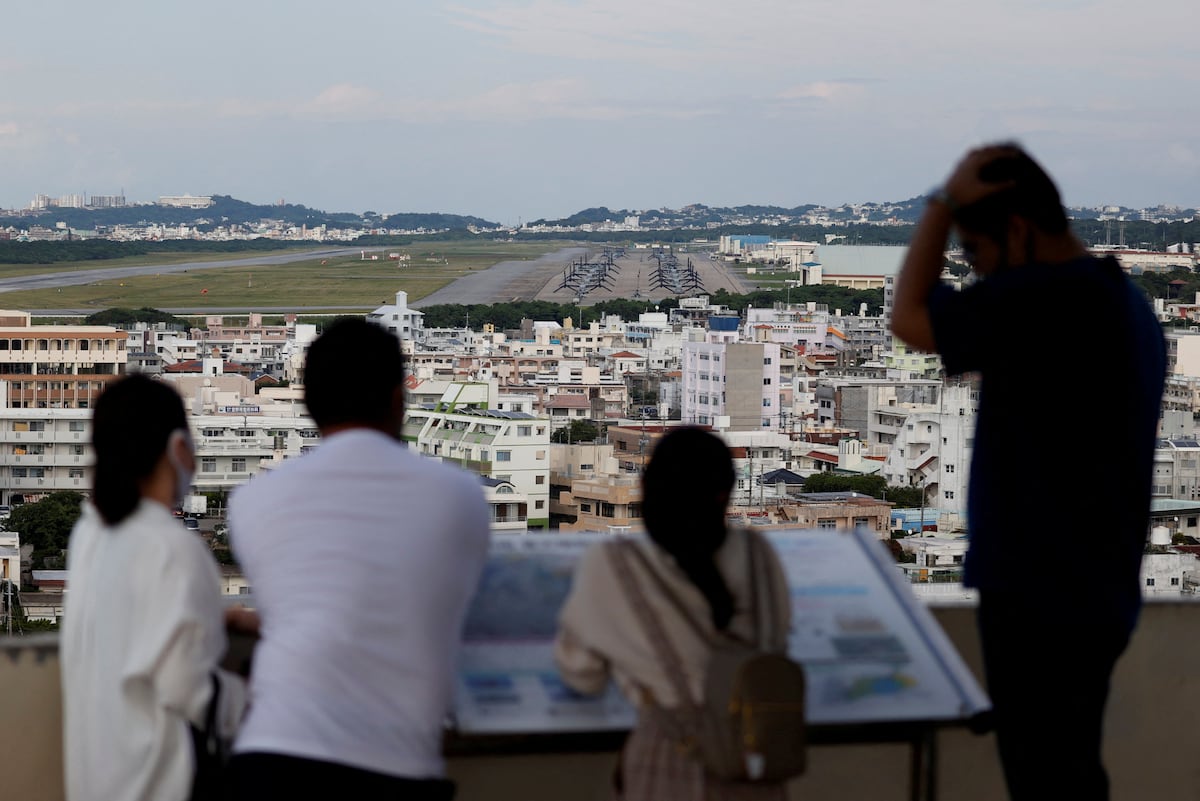
A Marine stationed in Okinawa, Japan, has been arrested on suspicion of murder, triggering an immediate military-wide response that has halted normal operations across the island and reignited a decades-long debate over the U.S. military presence there. The case has drawn sharp protests from the Japanese government and placed renewed pressure on the alliance between the two nations.
Marine Corps Lance Cpl. Devin Jacob Ballard, assigned to the III Marine Expeditionary Force headquartered at Camp Courtney, was arrested by local Okinawan police in connection with the suspected robbery and murder of Anna Yagi, a 39-year-old resident of Naha. The arrest set off a swift institutional response from U.S. military leadership.
In the days following Ballard’s arrest, U.S. officials directed all military personnel stationed on Okinawa to stand down from normal operations for a 48-hour window — from noon Wednesday to noon Friday — for mandatory standards training. The directive, issued as a U.S. Forces Japan statement posted by III MEF, also imposed a complete ban on off-base activity, including alcohol consumption both on and off base during that period.
What the Training Covers
During the two-day operational pause, commanders and senior enlisted leaders are required to conduct training sessions covering standards of conduct, discipline, liberty policy, alcohol awareness, Okinawan culture, and the broader responsibilities service members carry as guests in the community. Lt. Gen. Benjamin T. Watson, Okinawa Area Coordinator and commanding general of III MEF, signed the directive and made the expectations clear.
“Every member of this force must understand that individual conduct has consequences,”
Watson wrote in the message.
Following the training window, all personnel will enter a 30-day Period of Reflection beginning Friday. During this phase, liberty restrictions will remain in place, alongside a midnight curfew requiring all service members to return to their assigned quarters — whether on or off base — between midnight and 5 a.m. Enhanced supervision at installation gates across Okinawa will also be enforced throughout the reflection period.
Watson was direct about what is at stake beyond the immediate case.
“Serving on Okinawa comes with responsibility. We live, work, and socialize alongside the people of Okinawa; their home is our home.”
He continued:
“Every interaction with our neighbors either builds or undermines the trust that is essential to our team. When that trust is damaged, it affects the strength of our alliance and the security of this region. Accordingly, we will take time to think hard about discipline, standards and our alliance responsibilities.”
U.S. Forces Japan will use the reflection period to review its liberty policies and procedures and submit recommendations to the Okinawa Area Coordinating Committee. The statement did not specify what disciplinary actions would follow if service members violate the curfew.
A Pattern of Tension
The Ballard case is not an isolated incident. In 2024, two American service members were charged with sexual assault in separate cases, prompting protests from the Japanese government and leading Marine Corps bases to begin conducting sobriety checks at their installations in Japan.
Those incidents themselves drew comparisons to the high-profile 1995 case in which three U.S. service members raped a 12-year-old Okinawan girl — a crime that sparked mass protests across the island and ultimately led to a 1996 agreement between the U.S. and Japan to close a key American air station.
Following Ballard’s arrest, the Japanese government lodged what it described as “strong” protests against the United States, demanded cooperation with the Okinawa Prefectural Police investigation, and called for concrete steps to prevent similar crimes from occurring. III MEF has stated that it is cooperating with local authorities.
The broader community friction over the U.S. military footprint in Okinawa has persisted for decades, and incidents like this one consistently renew those grievances among local residents. Military leadership appears to recognize the weight of that history, framing the current pause and reflection period not just as a disciplinary response, but as a reaffirmation of the alliance itself.
For more on related military and veterans news, visit Army Times, including recent coverage on topics such as veterans’ claims processing disputes, life insurance premium relief for nearly 500,000 veterans, and a new commission targeting quality of life for military spouses.