When a soldier loses their security clearance, the consequences ripple far beyond their career — they can lose the income that pays for their family’s health insurance, their children’s doctor visits, and the prescriptions that keep a household running. Now, the Pentagon’s push to use artificial intelligence to assess whether military and intelligence personnel are trustworthy enough to hold those clearances is raising serious alarms — not just about civil liberties, but about the real-world fallout for families who depend on the financial stability a clearance provides.
The Pentagon has been developing artificial intelligence tools designed to scan text, voices, and faces in order to judge whether a person is being truthful. But after Defense News sought responses to expert criticisms of the program, the Defense Counterintelligence and Security Agency (DCSA) — the body responsible for vetting security clearance holders — quietly walked back significant portions of what it had previously described.
What the Pentagon Said — Then and Now
As recently as July, Pentagon officials and Air Force researchers were actively discussing AI-driven tools capable of analyzing sentiment, vocal patterns, and even micro-facial expressions during security clearance interviews. A Pentagon official speaking anonymously told reporters:
“AI processes data in real time and enables standardized, objective data analysis. AI-based analysis is a force multiplier for our human investigators, not a replacement.”
By October, DCSA’s official position had shifted considerably. The agency stated in an emailed statement that its “Modernizing Polygraph” effort
“does not incorporate generative super intelligence, also known as artificial intelligence”
that generates new content, nor does it include large language models, facial action coding, micro-expression analysis, or vocal analyses. What the agency did not address was whether AI models trained to detect “deceptive speech” patterns remain part of the program.
This marks a meaningful contrast with earlier documents, budget filings for 2027, and DCSA slides obtained through public records requests. Those materials described a multi-year “Credibility Assessment Modernization” initiative — also referred to as Polygraph+ — that had been underway since at least 2019, involving the Air Force, DCSA, and university research labs. The project’s price tag: $31 million, covering AI scoring algorithms, decision-support tools, and thermal imaging sensors designed to detect physiological stress responses.
Among the tools in development: an early AI model trained on text scraped from Twitter, Reddit, and vocabulary databases like WordNet, as described in declassified slides. The goal, according to Farakh Zaman of the Air Force Office of Scientific Research, was for these systems to help investigators identify areas that
“may help establish a more objective baseline for investigators and pinpoint specific areas requiring further human-led clarification.”
A separate slide dated May 2025 depicted a computer-generated avatar interviewer asking questions of a clearance applicant while camera and microphone feeds routed audio, video, and speech into multiple AI models. According to another undated slide, DoD set a goal for this technology to correctly read an interviewee’s emotional state with 75% accuracy.
What a Lost Clearance Really Costs a Family
For military families and federal workers, a security clearance is more than a professional credential — it is the financial foundation that makes employer-sponsored health insurance, stable housing, and access to medical care possible. When a clearance is suspended or revoked, even temporarily, those foundations can crack.
National security attorney Mark Zaid, whose own clearance was revoked after he represented a whistleblower central to President Trump’s first impeachment, described a troubling pattern for service members who fail a polygraph. When officers who have previously passed exams suddenly fail their latest test, DoD typically puts them
“in a corner with a dunce cap on for a year before officials will re-administer another exam.”
During that period, Zaid explained,
“You can’t get promoted. You can’t get certain assignments. And you can’t go overseas, which, to case officers, is death careerwise.”
A year without advancement or deployment eligibility can mean a year without the income bump that allows a family to afford out-of-pocket medical costs, mental health appointments, or specialist visits not fully covered by their plan. And because the Supreme Court ruled nearly 40 years ago that civil courts have no authority over national security clearance decisions, workers who believe an inaccurate polygraph cost them their job have almost no legal recourse — and thus no path to recovering the health benefits tied to that employment.
Zaid, who has represented workers on all sides of the polygraph table, drew a sharp analogy to the film Minority Report, which imagines a government reliant on psychic children to detain people accused of crimes they haven’t yet committed. He warned that introducing AI into the clearance process — in a domain where deception means not just lying, but doing so knowingly and willfully — carries similar risks. He said he appreciates efforts to modernize polygraph testing but wants proof the planned approach actually works. “The first thing that jumps out at me with AI is how often it is wrong…I’ve caught AI lying to me,” Zaid said.
The Science Doesn’t Support It — And That Has Health Consequences
The scientific community has long challenged the premise that any system — human or algorithmic — can reliably detect deception by reading faces, voices, or speech cadence. Decades of peer-reviewed work have discredited the popular theories behind shows like Lie to Me that micro-expressions or vocal stress can reliably reveal deception. Current research puts the odds of AI-based voice, speech, or face analysis correctly identifying a lie at roughly 50:50 — the same as a coin flip.
David Markowitz, a Michigan State University professor who studies AI and human communication, put it plainly:
“There are no – reliable – diagnostic cues for deception detection, and I have yet to see any evidence, whether it is with artificial intelligence, that goes against that trend.”
Markowitz tested a Google Gemini AI model by having it watch mock interrogations of people accused of cheating in a trivia game — the same interrogations that had previously been shown to human observers in research studies. The results were striking: Gemini performed no better than chance at distinguishing liars from truth-tellers, matching humans in its inaccuracy. Worse, the AI was more likely than humans to wrongly flag an innocent person as deceptive. Markowitz’s explanation: the AI
“is assuming that someone must have done something wrong because why else would they be questioned. Anytime that someone is in an interview setting where they might be accused of something, a large language model is assuming dishonesty.”
Worth noting: DoD has entered into agreements to run Gemini on both unclassified and classified networks.
That built-in suspicion matters enormously for clearance holders — and by extension, for their families’ health and financial security. A wrongful determination doesn’t just stall a career; it can trigger the loss of employer-sponsored insurance at exactly the moment a service member or federal employee most needs to contest an erroneous finding.
Algorithmic Bias Hits Hardest for Workers With Disabilities
One of the most troubling dimensions of AI-assisted screening — whether in a security clearance interview or a corporate pre-employment evaluation — is its well-documented bias against people with disabilities. This isn’t a hypothetical risk. The Justice Department has warned that emotion-recognition algorithms can discriminate against high performers with intellectual or developmental disabilities, misreading their communication styles as signs of deception or low competency.
Jo Ann Oravec, a University of Wisconsin professor who authored the 2024 article “From Polygraphs to Truth Machines: Artificial Intelligence in Lie Detection,” explained that AI video screening tends to misinterpret the involuntary movements or vocal patterns of skilled workers with certain disabilities — effectively screening out qualified people.
“Facial expression analysis is heaviest in terms of biases against individuals with disabilities,”
she said.
The same pattern has surfaced in private-sector hiring technology. Similar tools used for pre-employment screening have faced allegations of bias and error. Workers with disabilities who are misclassified by these systems don’t just lose a job — they may lose access to the employer-based health coverage that manages their condition, the income that covers their medications, and the professional standing that keeps their household financially stable.
Pentagon officials have long stressed that one motivation for AI-assisted screening is to reduce the gender and cultural biases that human investigators may carry into an interview room. But as Ryan Carrier, founder of ForHumanity, a global nonprofit that audits AI systems, explained, the Pentagon’s ethical guidelines are a skeleton compared to those required under the European Union’s AI Act. That law demands that users of high-risk AI systems receive training to overcome “automation bias” — the reflexive tendency to accept an algorithm’s output without questioning it. The EU has gone further, labeling AI-aided polygraph tools as “high risk” and citing power imbalances and due process concerns in placing strict limits on law enforcement’s use of them.
Carrier further warned that multimodal AI systems — those simultaneously analyzing a subject’s voice, face, and speech transcript — are prone to data misalignment that can produce analyses completely disconnected from what actually occurred in an interview. The system
“could be making determinations that a person is lying or trying to deceive me that are outside of the tool’s specifications,”
he said. The practical result: a service member or federal employee could lose their clearance, their job, and their family’s insurance coverage based on a technical mismatch no human reviewer caught.
Due Process — And the Right to Challenge a Machine
The Supreme Court declared in 1998 that
“[t]here is simply no consensus that polygraph evidence is reliable”
and banned polygraph results from military courts. Justice Clarence Thomas wrote plainly that
“A fundamental premise of our criminal trial system is that the jury is the lie detector.“
Now Zaid is pushing for equivalent protections in administrative proceedings, where clearance disputes play out and where the stakes for families are just as high. Drawing on successful legal challenges to speeding tickets issued by miscalibrated cameras, he asked whether workers would be granted access to evidence and an explanation of the AI’s training if they sought to contest a clearance revocation triggered by faulty algorithms. The answer, under current rules, is far from guaranteed — and without those protections, there is no meaningful way for a family to fight back against a system that may have cost them their livelihood and their health coverage.
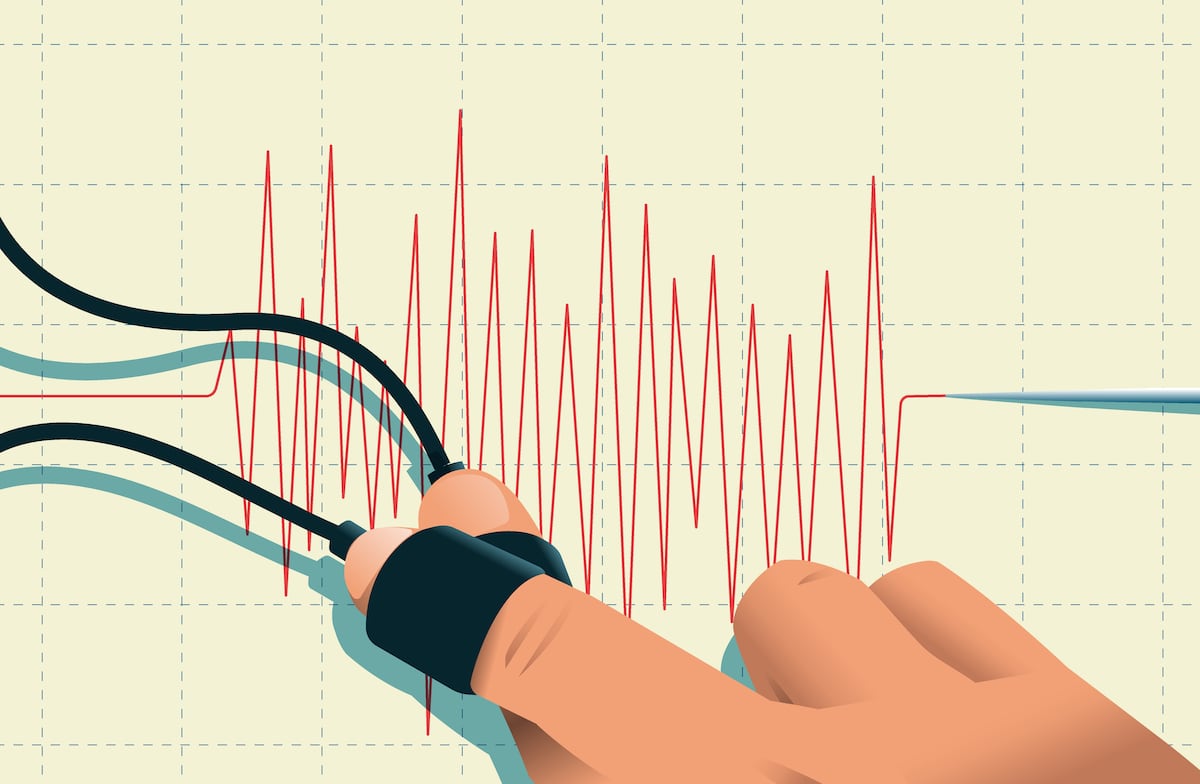
Former Army JAG officer Greg Rinckey, now a security clearance attorney, acknowledged that the existing polygraph technology is outdated —
“where they’re using tubes around people’s chests and blood pressure and sweat”
— and that any improvement in reliability would be welcome. But he, too, pressed the critical question:
“What is the research saying on how accurate it is?”
When the Pentagon administered a wave of polygraph exams in August to probe leaks about the Iran conflict’s toll on U.S. military stockpiles, some observers suspected the goal was less about finding leakers and more about enforcing loyalty and deterring dissent. Jay Stanley, a senior policy analyst with the ACLU’s Speech, Privacy and Technology Project, offered a frank assessment of what AI-based trustworthiness screening might be best suited for in that context:
“If it’s purely an intimidation technique, it may not be utterly useless from the point of view of large bureaucracies.”
Jake Laperruque, deputy director of the Center for Democracy and Technology’s Security and Surveillance Project, drew a direct historical parallel. Polygraph devices were celebrated as a breakthrough when they were first introduced roughly 100 years ago — seen as a tool that could finally peel back the curtain on human deception. Over time, it became clear the machines were merely tracking physical signals like heart rate, signals that correlate with stress but don’t prove lying. AI sentiment tools, Laperruque argued, are at risk of repeating that error:
“Thinking that AI sentiment analysis tools are actually making an assessment or engaged in reasoning — that’s not what those machines are actually able to do.”
For American military families and federal workers, the stakes of getting this wrong extend well beyond a career setback. A flawed algorithmic determination can set off a chain reaction — job loss, benefit loss, insurance loss — that leaves families scrambling to cover the medical costs that employer coverage once absorbed. The question of whether the Pentagon’s AI can reliably tell truth from deception is, in the end, also a question about who bears the cost when it can’t.