On a Sunday morning commute along Interstate 5 near DuPont, Washington, what began as a roadside emergency turned into something far more dangerous — and three U.S. Army soldiers, each traveling separately, found themselves at the center of it. Two children are alive today in part because those soldiers didn’t just drive past.
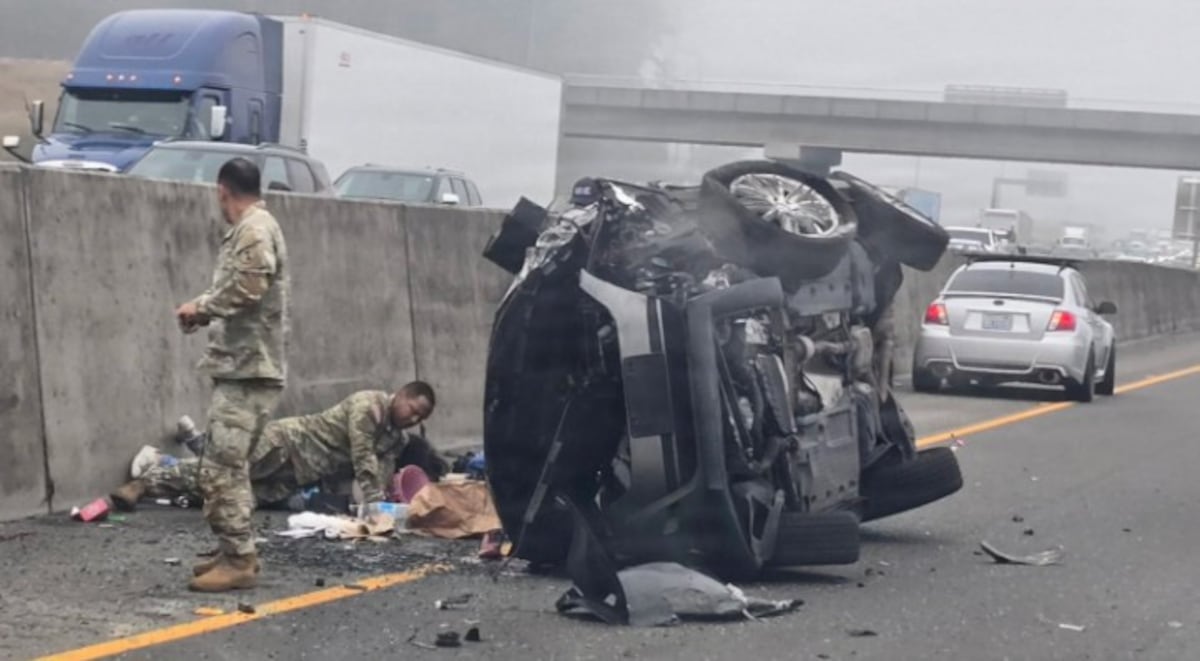
According to an Army release published Wednesday, Sgt. 1st Class Jeff Hytower was making his Monday morning commute to Joint Base Lewis-McChord when he spotted an overturned vehicle on the interstate and pulled over to help. What he encountered was not a simple crash scene. A woman near the vehicle was wielding a knife and attacking her two children.
Hytower, a practical nursing specialist instructor, acted immediately.
“I just jumped up, it was just instinct,”
he said.
“That’s when the training kicks in.”
Sgt. Ricardo A. Nunez, a soldier with the 7th Infantry Division (Multi-Domain Command-Pacific), arrived moments later and joined Hytower in disarming and restraining the woman. A third soldier, Sgt. Alex McKay — a Washington National Guard medic — focused her attention on the children, pulling one child to safety and beginning medical care.
McKay described one of the children as
“very afraid, but also very, very brave.”
For McKay, the response was exactly what she had prepared for.
“As a medic, my number one priority was pulling the child a safe distance away from the immediate threat, where she would be safe and not have to see the aftermath,”
she said in the Army release.
She also spoke to what it means to serve alongside fellow soldiers in moments like these.
“Also knowing that I can trust the service men and women to my right and left with my life and my safety,”
McKay said.
“If it weren’t for the quick reaction of Soldiers, this would have ended in tragedy. It makes me proud to wear the uniform.”
Hytower echoed that sentiment, pointing to the role military training plays in split-second decision-making.
“With both my Soldier and medical training, you’re taught to quickly figure out what needs to be done and prioritize what’s most important,”
he said.
“When the situation suddenly changed, we were able to react quickly and make sure everyone was safe. A lot of that comes from the training we’ve received and being able to fall back on it without really having to think about it.”
A Mother in Crisis — and the Mental Health Questions That Follow
Both children were hospitalized following the October 5 incident but are expected to recover from their injuries. Investigators say their mother, Janieka Ellington, 35, intentionally drove the car into a concrete barrier while heading southbound on I-5. Court records indicate she may have been experiencing suicidal thoughts and was under the influence at the time of the crash. A judge has ordered a mental health evaluation, and Ellington is currently being held without bail.
The case is a stark reminder of how mental health crises can erupt without warning — and of the devastating consequences for families when someone in distress does not receive timely care. Mental health professionals and family advocates have long pointed to gaps in access to psychiatric services as a driver of exactly these kinds of tragic moments, where a parent in severe psychological distress reaches a breaking point with no intervention in sight.
For the children involved, the road ahead will likely involve not just physical recovery, but emotional and psychological healing as well — the kind that requires sustained access to mental health support, which remains out of reach for too many American families due to cost, insurance gaps, and a shortage of providers.
That three soldiers happened to be in the right place at the right time on that October morning is something McKay clearly does not take for granted. Their combined instincts, skills, and training turned what could have been an irreversible tragedy into a story of survival — a reminder that community, preparation, and the willingness to act can make all the difference for a family in crisis.
For more military and veteran news, visit Army Times. You can also read about nearly 500,000 veterans receiving a three-month break from life insurance premiums, a planned DEERS outage that could affect Tricare beneficiaries, and two veterans battling in court over for-profit claims processing. Recent coverage also highlights century-old homes being renovated at Fort Bragg and the legacy of the outgoing AAFES director who expanded benefits for veterans and military families.