Revamping Economic Development Strategies: A Call for Interstate Cooperation
Amidst the ongoing debate over the use of public funds to attract businesses, Representative Bryan Posthumus (R-Rockford) has proposed a novel idea – a formal agreement between states to refrain from engaging in this practice. According to Posthumus, the current scenario where states compete by offering incentives to poach companies from each other has turned into a detrimental “race to the bottom.”
During an appearance on Michigan Public Television’s show “Off the Record,” Posthumus expressed his concerns, stating, “We’re essentially buying jobs from other states to come here. Other states are trying to buy jobs to take from Michigan to go there and they’re using tax dollars to do it. It just doesn’t make sense.”
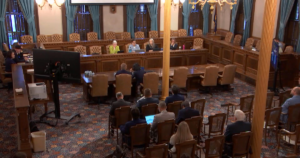
Recently, the Michigan Legislature decided not to renew funding for Governor Gretchen Whitmer’s primary economic development program in the new state budget. Both Republican and Democratic leaders criticized the excessive spending on incentives, leading to bipartisan opposition. As a result, discussions are underway to formulate a new economic development strategy that aligns with the state’s interests.
A Longstanding Idea with Challenges
State Senator Jeff Irwin (D-Ann Arbor) shed light on the concept of a formal interstate compact, indicating that the idea has been circulating for approximately two decades. While acknowledging its appeal, Irwin highlighted the reluctance of states heavily reliant on business subsidies, citing Texas as an example.
Irwin shared his insights, stating, “I think that one of the reasons why it’s a struggle to get states to kind of lay down their arms, so to speak, with respect to cash on the table for companies is because there are some states that have just leaned so heavily into the strategy and don’t seem willing to walk away from it.”
Although Posthumus acknowledged the ambitious nature of the proposal, he emphasized his stance against what he referred to as “corporate welfare.” Despite recognizing the challenges ahead, he expressed his aspiration for a shift away from this practice, emphasizing the need for a more sustainable economic development approach.