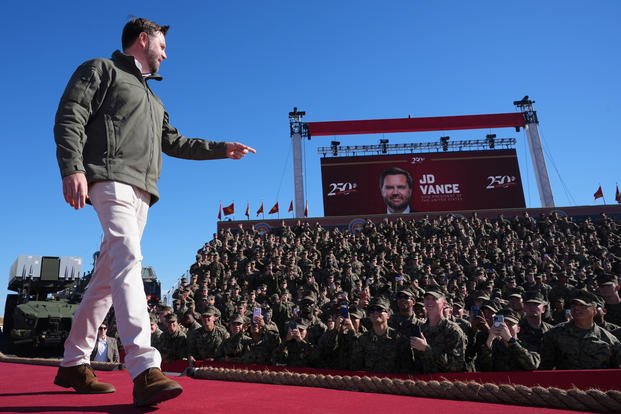
In a celebration to commemorate the 250th anniversary of the United States Marine Corps, an event at Camp Pendleton underscored both the strength and challenges faced by the nation’s military forces. The planned highlight, a simulated beach assault, turned unexpectedly when an artillery round exploded midair, showering debris onto a California Highway Patrol vehicle on a nearby on-ramp of Interstate 5.
Fortunately, no injuries were reported, but experts questioned the choice to use live munitions over a busy freeway during the demonstration. The incident has brought to light the complexities of conducting such exercises at Camp Pendleton, a base covering 125,000 acres between Orange and San Diego counties, yet with limited space for dynamic artillery firing. Traditionally, these exercises are carried out at other facilities like the Marine Corps Air Ground Combat Center in Twentynine Palms and the Chocolate Mountain Aerial Gunnery Range.
A retired senior Marine officer, speaking anonymously, commented on the constraints: “It’s so canned as we would call it, or preplanned, that there’s not a lot of training value in it.” According to base maps, artillery pieces such as the M777 howitzers used in the demonstration are rarely fired on the base, and never over the freeway, as none of Pendleton’s artillery zones are situated west of Interstate 5. The main impact zones, Whiskey and Zulu, are located well inland for live-fire practice.
Pendleton’s “Range and Training Area Standing Operating Procedures” mandates that any non-standard artillery firing areas require a 30-day prior request and an environmental assessment, further highlighting the unusual nature of this incident.
A spokesperson for the Marine Corps mentioned that data is still being compiled regarding past instances of artillery being fired over Interstate 5. Here’s a breakdown of the recent events:
What transpired during the event?
According to a CHP incident report, at 1:46 p.m., a round from an M777 howitzer launched from White’s Beach exploded prematurely in midair. The report detailed, “an artillery round failed to clear the roadway and detonated midflight. … The explosion sent shrapnel toward” the CHP protective services detail.
The shrapnel left a minor dent on an unoccupied CHP vehicle, and a motorcycle officer nearby noted debris landing around him, though no damage occurred. The Marine Corps managed to fire only one volley of five shells, ceasing firing after the incident.
Understanding the M777 howitzer
The M777 howitzer, an indirect fire weapon, is designed to launch explosive shells in an arc over friendly troops. Each shell, about 2 feet in length, has a fuse that determines how it detonates. Impact fuses explode upon hitting the ground, whereas proximity fuses detonate at a predetermined distance from the target.
Although the type of fuse used during the exercise is not confirmed, a malfunction is suspected. The M777 has been a crucial part of military operations since 2005, including recent uses in Ukraine, making it a fitting choice for the celebration.
The confusion over freeway closures
In a statement on X, the Marine Corps announced the “live-fire” demonstration, ensuring no public roads would close. However, Gov. Gavin Newsom’s office later received confirmation that exercises would not involve firing over Interstate 5, leading to initial plans for a freeway closure being shelved.
Despite these assurances, state officials observed howitzers firing over the freeway during a rehearsal, prompting a late request to inform drivers with electronic signs. By Saturday morning, authorities announced a 17-mile closure of Interstate 5 due to safety concerns. Newsom’s office criticized the federal government on X for misleading the public about the exercises and called for an apology to all Americans.
___
©2025 Los Angeles Times. Visit at latimes.com. Distributed by Tribune Content Agency, LLC.
© Copyright 2025 Los Angeles Times. All rights reserved. This material may not be published, broadcast, rewritten or redistributed.