Redistricting Battle Heats Up Ahead of 2026 Election Year
As the 2026 election year approaches, the redistricting fight intensifies following a recent Supreme Court ruling favoring Texas lawmakers and Republicans. The decision grants approval for the GOP’s new congressional map despite allegations of racial gerrymandering by a lower court.
The approved map could potentially provide Republicans with five additional seats, shaping the political landscape leading up to the upcoming elections. This development marks a significant milestone in the nationwide redistricting race initiated by former President Trump to secure Republican dominance in the House of Representatives.
With the House currently evenly split, Republicans holding 220 seats and Democrats 213, the outcome of the redistricting battle could sway the balance of power in Congress. Historically, the president’s party tends to lose seats in midterm elections, adding further complexity to the upcoming electoral dynamics.
While projections suggest a possible gain of 12-14 seats for Republicans and 9 seats for Democrats through redistricting efforts, the final outcome hinges on pending court challenges and state legislative decisions. The uncertainty surrounding these factors underscores the fluidity of the political landscape.
State-Level Developments and Legislative Responses
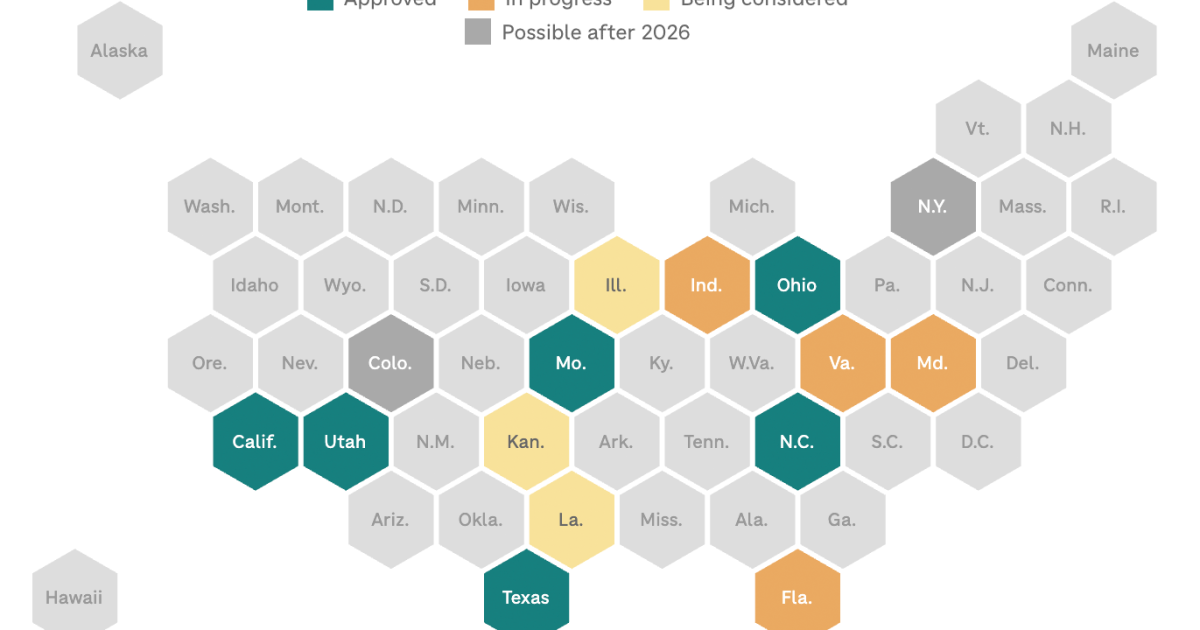
This week, Indiana lawmakers are convening to address redistricting issues, reflecting the broader state-level responses to the redistricting race. In Missouri, petitioners face a deadline for signature collections that could delay redistricting pending a public vote.
California, in response to Texas’ redistricting moves, has approved a map that could potentially flip five Republican-held seats. Similarly, Republicans in Missouri and North Carolina have targeted Democratic seats, illustrating the strategic maneuvering taking place across various states.
Notably, the Indiana state House recently passed a GOP-backed map aimed at securing two additional seats for Republicans. However, divisions within the state Senate, particularly among Republicans, pose challenges to the map’s final approval.
Amidst these developments, some Indiana Republicans have faced internal resistance to aligning with Trump’s redistricting goals, leading to threats of primary challenges and anonymous intimidation tactics. The complexities within the Republican Party underscore the nuanced dynamics at play in the redistricting process.
Political Landscape and Partisan Dynamics
Republicans currently hold a strategic advantage in the redistricting process compared to Democrats, primarily due to their control over a greater number of state legislatures. This asymmetry in redistricting capabilities highlights the broader partisan disparities shaping the electoral landscape.
As the redistricting battle unfolds across states, the intricate interplay of legal, political, and demographic factors will ultimately determine the distribution of power in Congress. The upcoming 2026 election year stands as a pivotal moment in American politics, marked by heightened tensions and strategic maneuvering on both sides of the aisle.
In a political landscape where redistricting can significantly sway the balance of power, several states are making moves to potentially alter the electoral map. Virginia’s Democratic-led legislature has taken a pivotal step by voting to hold a special election that could amend the state constitution to allow redistricting. If this proposal passes, it could potentially shift two to three seats in favor of Democrats.
Similarly, Maryland’s Democratic governor has established a commission to provide recommendations on redistricting. However, given that Maryland already has predominantly Democratic representation, the focus may primarily be on one Republican-held House seat.
Conversely, in Florida, Republican Governor Ron DeSantis is actively pushing for redistricting efforts to be carried out by the Republican-controlled legislature. The aim is to potentially flip as many as five seats to favor the GOP. A recent Florida House committee meeting marked the initial steps taken towards redistricting in the state.
Despite the intentions of Florida Republicans, the state faces legal barriers such as laws prohibiting partisan gerrymandering. Additionally, federal regulations like the Voting Rights Act (VRA) restrict racial gerrymandering. However, the Supreme Court’s current review of the VRA could potentially weaken these constraints, opening the door for more redistricting efforts that might benefit Republicans.
The VRA serves as a crucial safeguard against diluting the voting influence of minority communities by tactics like “cracking” or “packing” them into specific districts. As states navigate the intricate process of redistricting, the outcomes could significantly impact future elections and political representation.
Overall, the evolving landscape of redistricting in various states underscores the complex interplay between legal frameworks, political maneuvering, and the quest for electoral advantage. As these processes unfold, the potential implications for democratic principles and fair representation remain at the forefront of public scrutiny.
Copyright 2025 NPR