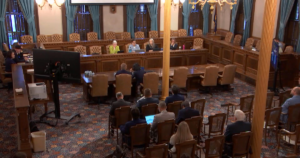
Michigan House Considers Crackdown on Unlicensed Cannabis Products
In a move to regulate unlicensed cannabis-derived products, a set of bills is making its way to the Michigan House of Representatives. These bills specifically target delta-8 and other cannabinoids that exploit loopholes in federal laws to be sold in various stores.
The proposed legislation aims to restrict products based on their THC content, the main psychoactive component in marijuana. Items containing more than 1.75 milligrams of THC per container or equivalent cannabinoid would be subject to the same regulations as traditional marijuana under Michigan’s laws for recreational and medicinal use, potentially limiting their availability outside of licensed dispensaries.
State Senator Dayna Polehanki, one of the sponsors, emphasized the importance of safeguarding children. She expressed concerns about these products, sometimes designed to appeal to minors, being easily accessible in gas stations and convenience stores.
Under the bills, low-dosage THC products would fall under the oversight of the Michigan Cannabis Regulatory Agency and could be sold as hemp. However, stakeholders in the hemp industry argue that the proposed THC limit is too restrictive.
Blain Becktold, president of iHemp Michigan, highlighted that the 1.75 mg limit could hinder access to CBD products, widely used for pain management and stress relief. He suggested that a higher limit of 5 mg would be more beneficial for consumers seeking these products.
Controversy Surrounding THC Content Limits
The legislation faced modifications before passing the Senate, including a change from limiting THC content per serving instead of per container. This adjustment was made to address safety concerns and find a middle ground among lawmakers.
Despite these changes, the bills may face challenges due to evolving federal regulations. The recent reclassification of legal hemp standards and the reclassification of marijuana as a Schedule III drug by President Trump could introduce complexities into the regulatory landscape.
As the bills move to the Michigan House of Representatives, discussions are ongoing about how to navigate the changing regulatory environment. Lawmakers are deliberating on the appropriate THC limits and considering the implications for the hemp-derived beverage industry and other marijuana alternatives available in the market.
State Representative Joseph Aragona emphasized the need for comprehensive regulation in light of these developments. The House Regulatory Reform Committee is expected to review and potentially vote on related legislation in the upcoming months.
While the future of unlicensed cannabis products in Michigan remains uncertain, the ongoing dialogue between legislators and industry stakeholders will shape the regulatory framework for these products moving forward.
Original News Article:
Headline: Study Finds Link Between Social Media Use and Mental Health Issues
A recent study conducted by researchers at a leading university has found a significant link between excessive social media use and mental health issues. The study, which surveyed over 1,000 participants, revealed that individuals who spent more than two hours a day on social media platforms were more likely to experience symptoms of depression and anxiety.
According to Dr. Smith, the lead researcher on the study, the findings suggest that the constant exposure to curated and often unrealistic representations of others’ lives on social media can have a negative impact on individuals’ mental well-being. Dr. Smith emphasized the importance of setting boundaries for social media use and taking breaks to engage in offline activities.
The study also highlighted the role of comparison and social isolation in contributing to mental health issues among heavy social media users. Participants who reported feeling inadequate or left out after viewing others’ posts were more likely to experience feelings of depression and anxiety.
In light of these findings, mental health professionals are urging individuals to be mindful of their social media consumption and prioritize activities that promote positive mental health. Seeking support from friends, family, or mental health professionals can also help mitigate the negative effects of excessive social media use.
Revised News Article:
Headline: New Study Reveals Impact of Social Media on Mental Health
In a recent study published by a team of researchers, a connection between frequent social media use and mental health problems has been identified. The study, which surveyed a large sample of over 1,000 individuals, showed a correlation between spending more than two hours daily on social media and experiencing symptoms of depression and anxiety.
Lead researcher Dr. Smith explained that the constant exposure to idealized versions of others’ lives on social media can lead to negative effects on mental well-being. Dr. Smith suggested that setting limits on social media usage and engaging in offline activities could help mitigate these issues.
The research also pointed out that feelings of inadequacy and social isolation resulting from comparing oneself to others on social media can contribute to mental health concerns. Participants who reported these feelings were more likely to suffer from depression and anxiety.
Experts in mental health are advising individuals to be mindful of their social media habits and prioritize activities that foster positive mental health. Seeking support from loved ones or mental health professionals can also be beneficial in counteracting the adverse impacts of excessive social media use.