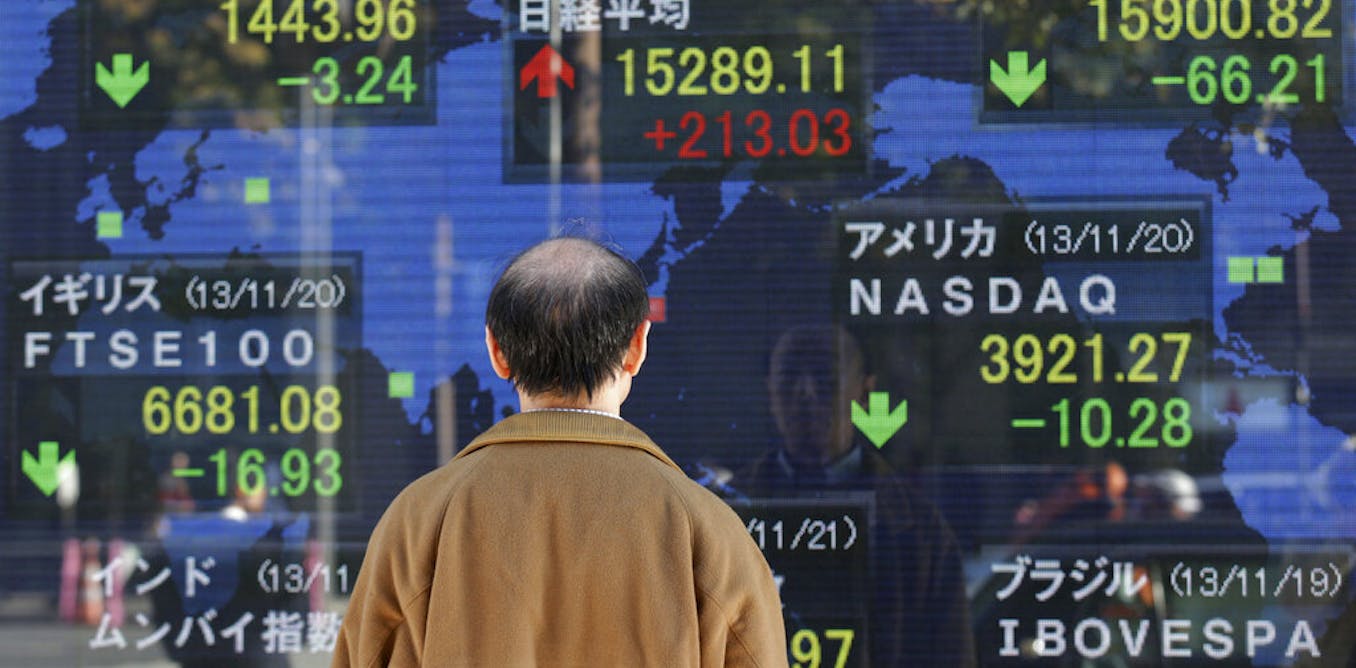
In today’s interconnected world, national economies are increasingly synchronized, reacting collectively to global economic trends. This marks a shift from earlier in the 21st century when economic disruptions were more likely to be influenced by neighboring countries.
Our study, detailed in a recent paper in Economic Letters, analyzed economic correlation using GDP data from 70 nations over six decades. Collaborating with Yoonseon Han and David Lindequist, we discovered that geographical proximity is now less significant in determining the interconnectedness of countries.
We specifically examined how countries’ business cycles — the phases of economic growth and recession — align. For instance, how does a production surge in Germany impact U.S. income levels?
Our research focused on the evolving relationship between distance and economic correlation over time.
From 1960 to 1999, economies were more influenced by nearby nations. The U.S., for example, felt the economic pulse of Canada and Mexico more keenly than that of the UK or South Korea. This aligns with longstanding economic theories suggesting that countries tend to trade more with their neighbors, with trade volume being a key indicator of synchronized business cycles.
However, post-2000, this correlation weakened. Over the last two decades, there has been no significant statistical link between a country’s geographic distance and the alignment of economic movements, known as economic covariance.
Why this is significant
In the late 1990s and early 2000s, economists including Frances Cairncross and Thomas Friedman proposed that technologies like the internet and containerization had diminished the importance of distance, paving the way for a more globalized future. They foresaw these technologies not only revolutionizing production methods — such as global supply chains — but also transforming work and lifestyle.
While these theories faced skepticism from trade analysts, and not all predictions were realized, such as the persistent link between distance and trade flows, they hinted at a shift. For instance, the U.S. continues to trade most with Canada and Mexico. Additionally, urban housing prices still reflect the high value of location.
Yet, our research suggests that parts of the globalized economy theory may be unfolding, as countries become more vulnerable to global shocks rather than localized ones.
The COVID-19 pandemic starkly demonstrated this interconnectedness, with global supply chain disruptions leading to a worldwide price increase. Consequently, U.S. economic policy has increasingly addressed vulnerabilities to foreign shocks, with terms like “supply chain resilience” gaining traction under the Biden administration. Learn more.
Unanswered questions
Our findings indicate that globalized business cycles and economic shocks have intensified in recent decades. Major economic incidents from 1960-2000, such as the 1980s savings and loan crisis or the 1997 Asian currency crisis, were largely localized. In contrast, significant events like the 2008 financial crisis had widespread global effects.
It remains uncertain if this trend will continue, leading to an era where global economies move in unison, or if a shift toward economic nationalism might re-localize economic dynamics and shocks.
The Research Brief offers a concise overview of intriguing academic research.