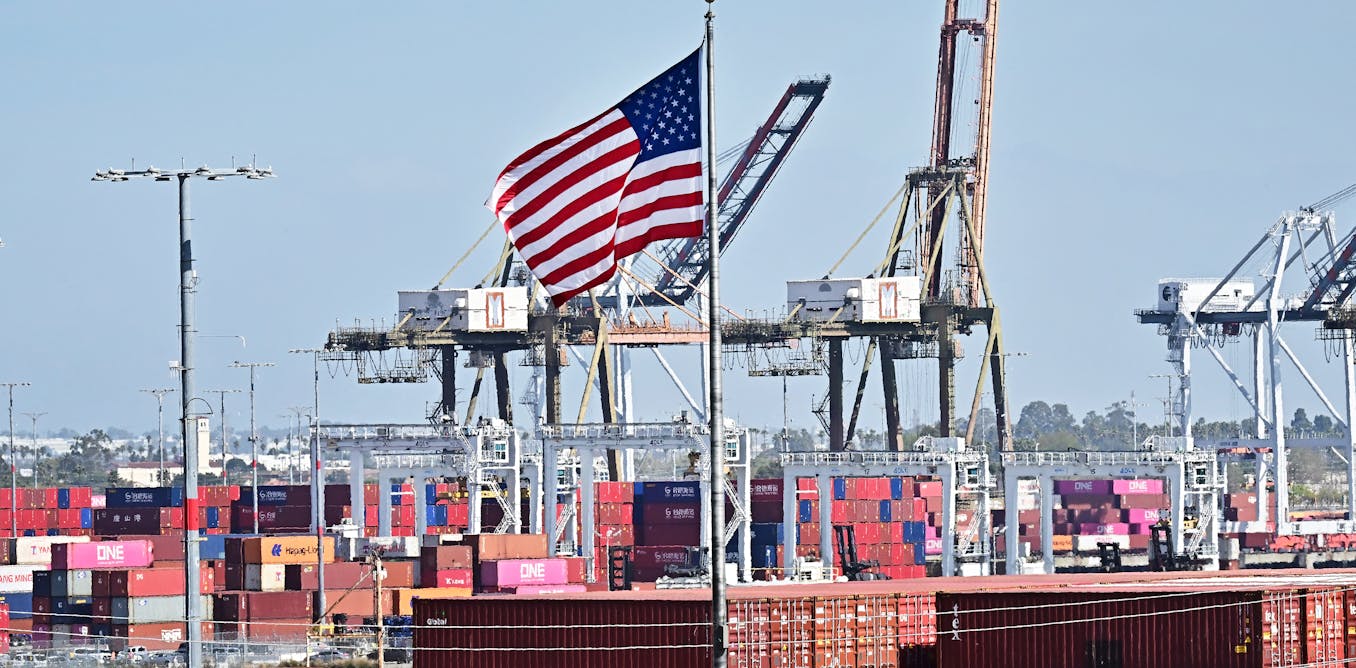
The legality of former President Donald Trump’s global tariffs is under scrutiny as the U.S. Supreme Court deliberates on a pivotal case. This case could reshape the landscape of U.S. economic policy, where tariffs have become a significant tool impacting everyday costs on items like groceries, automobiles, and holiday gifts, as well as broader economic indicators like unemployment and inflation.
As an economist engaged in trade policy research, I frequently encounter questions regarding the essence and effects of tariffs. This article aims to clarify these aspects and the rationale behind government-imposed tariffs.
Understanding Tariffs and Their Financial Impact
Tariffs function as import taxes intended primarily to shield local industries from foreign competition. When U.S. businesses import products, they receive a tariff invoice from U.S. Customs and Border Protection, which must be settled before the goods can be admitted into the country.
These added costs typically lead importers to increase their prices to offset the tariffs. While some importers may initially absorb these costs to remain competitive, this approach is often unsustainable, particularly for companies with slim profit margins. Over time, as detailed in economic studies, the likelihood of passing these costs to consumers rises.
Importers might also request that foreign suppliers reduce their prices to share the tariff burden, but suppliers are generally disinclined to do so if they can find other markets that offer better prices. Research on the 2025 tariffs implemented by Trump indicates that U.S. importers and consumers have shouldered most of the financial impact, with importers initially bearing up to 80% of the costs, under the assumption that these tariffs might be temporary. If the Supreme Court upholds Trump’s tariffs, the financial strain on consumers is expected to intensify.
Although tariffs target only imports, they indirectly cause domestic product prices to rise by increasing demand for local alternatives. This dynamic enables domestic producers to raise their prices as well.
Tariffs Through History
The U.S. Constitution grants Congress the authority to levy taxes and tariffs. Historically, tariffs were a primary source of federal revenue, especially post-Civil War, when they protected burgeoning manufacturing sectors. However, the 1913 introduction of the income tax shifted this focus.
The Smoot-Hawley Tariff Act of 1930 was the last significant U.S. tariff legislation, imposing an average tariff rate of 20% by 1933. These tariffs led to retaliatory actions and global trade conflicts during the Great Depression. The post-World War II era saw the U.S. spearheading the General Agreement on Tariffs and Trade (GATT), promoting tariff reductions to stabilize and grow the global economy. This resulted in a decrease in global average tariff rates from about 40% in 1947 to 3.5% in 2024, with the U.S. average dropping to 2.5% and 60% of imports entering duty-free.
While Congress holds tariff authority, it can delegate emergency powers to the president within constitutional limits. The current Supreme Court case examines Trump’s application of the International Emergency Economic Powers Act (IEEPA) to unilaterally modify U.S. tariff rates. The debate centers on whether Trump exceeded his constitutional authority under this act, which does not explicitly mention tariffs.
Evaluating the Merits and Drawbacks of Tariffs
The broader question is whether tariffs represent sound policy. The negative consequences of the Great Depression’s tariff wars have led to a widespread consensus supporting free trade and lower tariffs. Economists and political scientists generally support this perspective, although developing nations continue to use tariffs to protect emerging industries.
Trump reintroduced tariffs as both a protectionist mechanism and a potential revenue source for the U.S. government, even proposing that they might replace income taxes, an idea challenged by most economists.
Trump’s tariffs aim to benefit domestic industries by increasing import costs, thereby shifting demand to local products. The strategy hinges on investment in protected sectors to enhance efficiency and employment. However, critics highlight trade-offs, such as higher consumer prices and market inefficiency, where resources flow into less efficient production sectors. U.S. tariffs have also invited foreign retaliation, impacting American exporters adversely through retaliatory measures.
Moreover, the unpredictable nature of Trump’s tariff policies—marked by frequent changes and uncertainties—hampers investment in protected sectors. Uncertainty, as one study notes, has dampened U.S. investment by 4.4% in 2025.
Another significant cost is the breach of global trade agreements and GATT rules, undermining the U.S.’s reliability as a trading partner. The U.S., once a champion of a stable trade system, is now seen as a less dependable partner, prompting other nations to seek new trade alliances elsewhere.
Looking ahead, Trump has indicated plans to deploy alternative emergency tariff measures if the Supreme Court invalidates his IEEPA tariffs. Unless Congress intervenes, an assertive U.S. tariff policy seems poised to persist, making public understanding of tariffs—who bears their costs and their broader economic impact—more essential than ever.