The recent U.S. military operation resulting in the capture of Venezuelan President Nicolás Maduro on Jan. 3, 2026, has sparked a conversation about the motivations behind American foreign policy in the region. The Trump administration has notably prioritized access to Venezuela’s oil resources over traditional diplomatic goals like combating drug trafficking or enhancing regional stability.
In his initial press briefing post-operation, President Donald Trump emphasized the significance of oil companies, suggesting that oil revenues could subsidize any further U.S. involvement in Venezuela.
The discussion continued on “Fox & Friends,” where Trump remarked, “We have the greatest oil companies in the world,” and added, “the biggest, the greatest, and we’re gonna be very much involved in it.”
A noted historian of U.S.-Latin American relations expressed surprise at the administration’s transparency regarding oil’s influence on its Venezuelan policy. Traditionally, U.S. interventions in Latin America, as detailed in a 2026 book on the subject, have been covert, with economic motives often concealed.
A Historical Perspective on Economic Influence
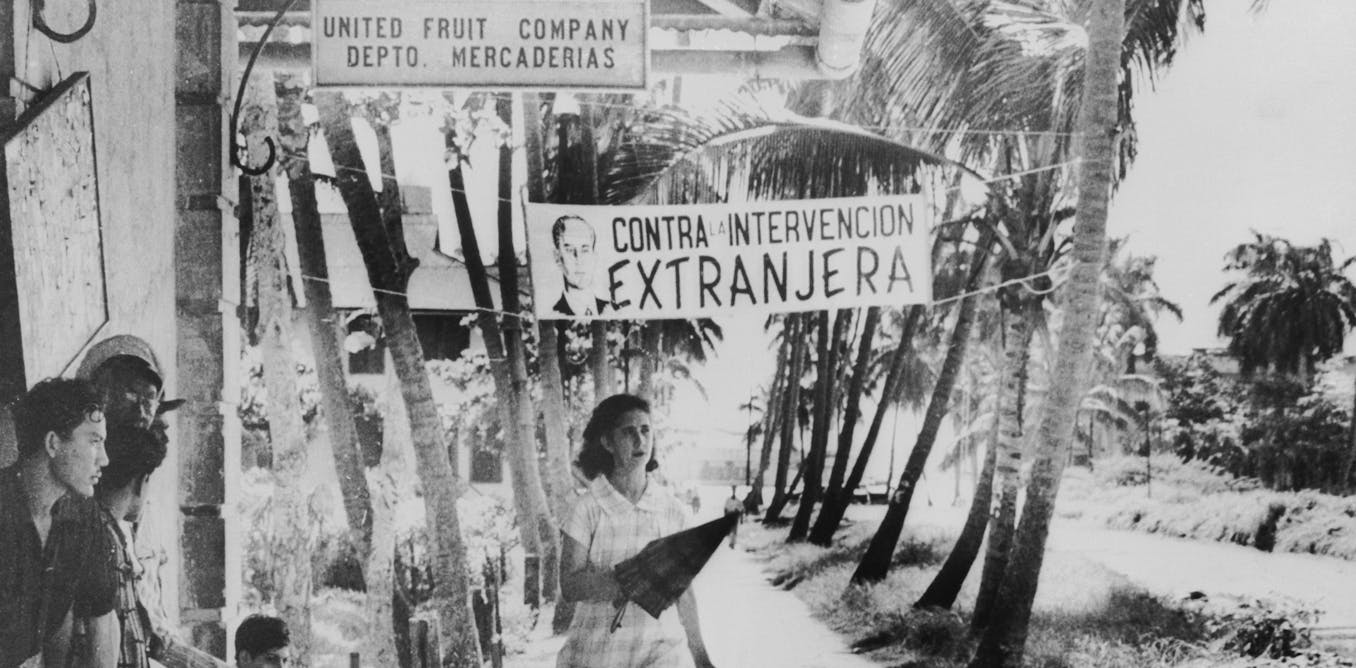
In the mid-20th century, Guatemala was a key supplier of bananas to the U.S., a status it holds to this day. The United Fruit Company, a major player in this trade, controlled vast tracts of land in the country. This was made possible by deals with previous regimes, but at the expense of local farmworkers who endured unstable wages and harsh working conditions, often facing layoffs and wage cuts.
Known locally as the “pulpo” or octopus, United Fruit wielded extensive influence over Central American politics, economies, and daily life, as illustrated by the Colombian government’s violent suppression of a 1928 strike, an event immortalized in Gabriel García Márquez’s novel “One Hundred Years of Solitude.”
The Rise and Fall of Guatemala’s Democracy
In 1944, a coalition overthrew Guatemala’s dictatorship, inspired by anti-fascist ideals post-World War II. Democratically elected leaders like Juan José Arévalo and Jacobo Árbenz sought to democratize and reform the economy, introducing labor laws and land reforms to empower the Indigenous and impoverished majority.
However, United Fruit denounced these reforms, alleging communist influence, and lobbied the U.S. government for intervention. Despite initial reluctance, the company enlisted high-profile lobbyists to frame the reforms as a threat to capitalism, resulting in U.S. congressional denunciations and eventually leading to a CIA-backed coup in 1954.
The Role of Propaganda and Lobbying
United Fruit’s campaign against Guatemala also involved extensive propaganda efforts, including a film titled “Why the Kremlin Hates Bananas,” which bolstered U.S. media narratives about communist threats.
The subsequent U.S.-engineered coup replaced Guatemala’s government with a pro-American regime, marking the end of its democratic experiment and ushering in decades of military rule, characterized by repression and human rights abuses.
Long-term Consequences
The aftermath of the coup, which was officially justified through an antitrust suit against United Fruit to divert attention from its role, resulted in the company’s eventual decline. Meanwhile, Guatemala’s societal and political landscape was irreparably altered, with ongoing repercussions that continue to affect the region today.