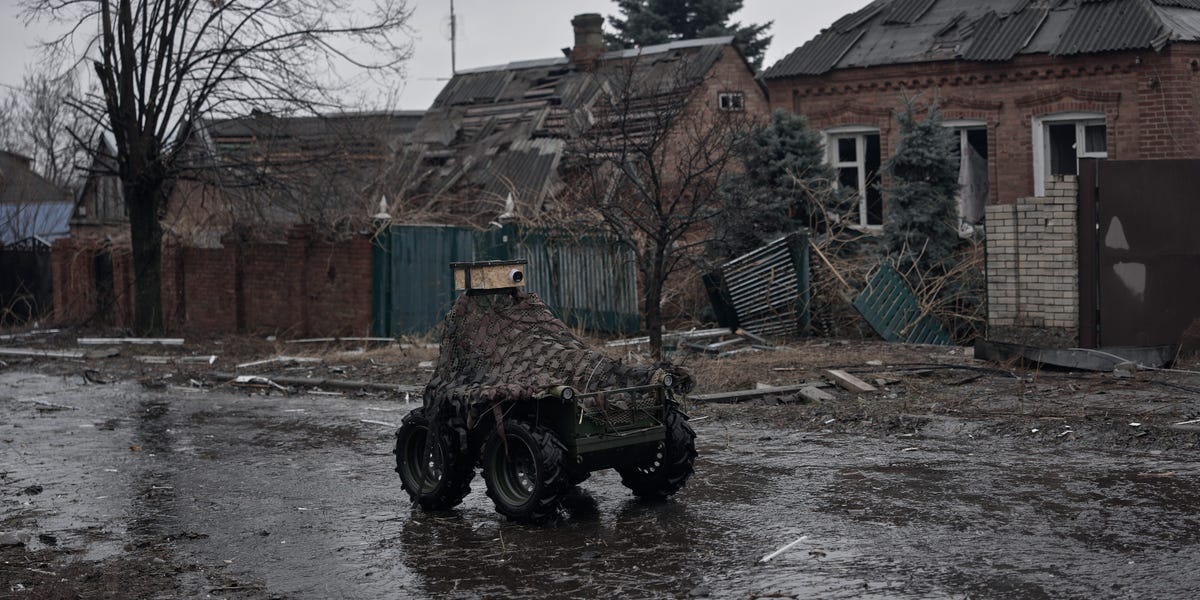
Earlier this year, a newly introduced tax on electric vehicles unexpectedly impacted Ukraine’s defense capabilities, reducing its ability to acquire essential ground drones for the frontline. This setback was highlighted by the CEO of a prominent defense trade association.
According to Ihor Fedirko, CEO of the Ukrainian Council for Defense Industry, the 20% value-added tax (VAT) introduced in January may have cost Ukraine’s military the opportunity to purchase an additional 5,000 uncrewed ground vehicles in the first six months of 2026. “We know that our government is procuring 25,000 in the first half of this year. If they could procure 20% more, that’s 5,000,” Fedirko explained to Business Insider. “For our armed forces, that’s a lot.”
The implementation of the tax caused significant disruption in the local ground drone industry and military, stalling contracts and pushing some manufacturers to the brink of closure. Ukrainian lawmakers are now working to repeal the tax, which they argue has crippled an essential wartime industry that Kyiv seeks to expand rapidly.
Nina Yuzhanina, a member of Ukraine’s European Solidarity party, stated last week that the EV tax “almost ceased” the supply of ground drones to the military. In response, she and 44 other parliamentarians proposed a bill on May 19 to address the issue by reclassifying uncrewed ground vehicles as a separate category, thus exempting them from the 20% VAT.
Although the bill is scheduled for discussion over the coming weeks, Fedirko predicts it will take approximately two months for the changes to fully impact production if passed promptly. This development coincides with the announcement from Ukraine’s defense ministry of their plan to procure 50,000 ground drones by the year’s end. Ukrainian UGVs range in price from $5,000 to $100,000 depending on the system type and equipment.
Fedirko emphasized the financial impact of the tax exemption, stating, “The exemption would save more than eight to 10 billion hryvnias, which is about $200 million. For us, it’s a huge number.”
How Ukraine began taxing its own war production
The VAT on ground drones is an anomaly within Ukraine’s wartime tax policies. Under martial law, most of the country’s defense industries are exempt from such taxes. However, the VAT on electric vehicles and ground drones, a consumption tax collected at various stages of the supply chain, ultimately affects Ukraine’s military.
Ground drone manufacturers had previously been exempt from EV duties since 2018, but this exemption ended on January 1. This change forced military procurers to adjust their budgets to accommodate the 20% tax, creating confusion since defense equipment is typically VAT exempt. The result was a three-month period without state contracts, a critical revenue source for manufacturers.
“Three months without procurement, that’s crazy. It’s impossible to live without it,” Fedirko remarked.
Production chaos while at war
In April, the Ukrainian defense ministry acknowledged the procurement bottleneck and announced efforts to “unblock” contracts and expedite deliveries. Yet, during this period, many firms struggled financially. The 20% budget reduction posed a severe threat to companies already in need of funding.
The new VAT also introduced weeks of bureaucratic delays, requiring firms to involve state tax services and meticulously document procurement processes. Some companies had to reduce capacity significantly, with layoffs or a reduction in engineering staff.
To cope, some manufacturers attempted to reclassify their drones as tanks or armored vehicles, while others sold their UGVs to volunteer organizations like ComeBackAlive, which supports military units on an as-needed basis. Tencore, known for its TerMIT drone, relied on these volunteer organizations when state contracts were unavailable for five months.
“For UGV manufacturers, the VAT issue was not an accounting detail,” Tencore stated to Business Insider. The company collaborates with the Ukrainian Robotics Force association, which is part of Fedirko’s UCDI.
A fix six months in the making
The delay in addressing the tax issue arose because military ground drones were so novel that lawmakers struggled to define them, according to Fedirko. The European Union’s commodity rules, upon which Ukraine’s classifications are based, also lack clear definitions for these uncrewed systems.
Although procurement resumed in the spring, the months of delay have already deprived frontline troops of necessary equipment, as noted by manufacturers like Tencore. “For Ukraine, six months feels like infinity,” Fedirko commented.
While the defense ministry declined to comment on the parliamentary bill, it reported that Ukraine’s UGV industry now comprises over 280 companies offering 550 different types of drones. As the conflict enters its fifth year, Ukrainian forces increasingly depend on these platforms for logistics, evacuations, and assaults on Russian positions.
President Volodymyr Zelenskyy highlighted the significance of ground drones in April, noting their use in over 22,000 missions during the first quarter of 2026.