The shouting, the sweat, the distant stares—some films capture the boot camp chaos, while others miss the mark.
Many service members have tales of enduring boot camp—the sand, the blisters, the sleepless nights, and the infamous recruit who couldn’t help but laugh during inspection. Hollywood has long sought to encapsulate the chaos of boot camp training, but only a select few films truly capture what real drill instructors encounter each cycle. By consulting actual Marine DIs, Army drill sergeants, Navy instructors, and veterans who still flinch at the sound of a whistle, we evaluated iconic training scenes for accuracy and emotional impact. Let’s delve into these portrayals.
Full Metal Jacket (1987) — Parris Island, U.S. Marine Corps
R. Lee Ermey doesn’t portray a drill instructor—he was one. The late retired Marine Corps gunnery sergeant improvised much of his dialogue, setting a benchmark for realism. His precision, movement, and volume control align with Marine customs. Kubrick’s extended, uncut scenes magnify the inspection tension, while Ermey’s posture and articulation transform chaos into a well-orchestrated routine.
The Old Gunny Sergeant on YouTube aptly remarked:
“He uh lee Army was just hired in as a technical advisor because he was a former drill instructor, he was a Marine… when asked to do a scene… he gave his performance… and Stanley liked it so much that he said oh you’re you’re the guy you are the Drone instructor you’re the star of the show.”
Realism Score: ★★★★★ (10/10)
Why It Works: The precise posture, diction, and chaos control are textbook examples. It resonates because it’s authentic.
An Officer and a Gentleman (1982) — Aviation Officer Candidate School
The late Louis Gossett Jr. delivered an Oscar-winning portrayal as a DI, earning respect from real instructors. The film captures the physical grind—wind sprints, inspection stress, and attrition—and frames leadership through pressure. As Gunnery Sgt. Emil Foley, Gossett challenges candidates, warns of potential failures, and specifically targets Mayo’s character. The “I got nowhere else to go!” scene marks a turning point from bravado to growth, followed by teamwork, resilience, and mutual respect.
Realism Score: 8/10
Why It Works: It illustrates both the harsh training environment and the transformative process.
Jarhead (2005) — Marine Corps Training, 1990s
Based on Anthony Swofford’s memoir, Jarhead avoids typical boot camp clichés, focusing instead on monotony, repetition, and psychological pressure. Drill instructors use rhythm, distance, and manipulation as tools, reflecting the slow grind many Marines experience.
Former Marine Jameson Travels noted on YouTube: “This is about right—the badgering, the constant questions. One note: we didn’t have DIs with facial hair… I never saw a DI wear one.” On the ubiquitous “Jody”: “He’s everywhere in boot camp lore… I think I broke up with my girlfriend six times in my head because of Jody.”
Realism Score: 7/10
Why It Works: It captures mental attrition more than physical exertion.
G.I. Jane (1997) — Navy SEAL Training
While dramatized, many instructors believe Ridley Scott accurately portrays the emotional challenges of elite selection. The intense physical training—drown-proofing, surf torture, log PT—is realistic, and the portrayal of peer pressure and team loyalty largely holds true.
Former Naval Academy graduate and Navy SEAL Jake Sweig remarked: “G.I. Jane was a ripper. One thing it got right was the absolute chaos of SEAL training.” However, he criticized a specific fight scene for being unrealistic, but the larger depiction of willpower remains accurate.
Realism Score: 6/10
Why It Works: Focuses on the enduring test of willpower rather than gender politics.
Stripes (1981) — Army Basic Training, Comedy Division
Marine infantryman James Laporta notes that the film accurately depicts some drill basics: marching from the left foot; precise spacing; and the importance of drill sergeants. Although the comedic elements (e.g., laughing recruits) would likely result in disciplinary action, the foundational elements of real drill are present.
When Harold Ramis leads “Do Wah Diddy Diddy,” Laporta points out that cadence belongs to the drill sergeant, not the recruits. Despite this, the film effectively portrays teamwork built under stress. The final cadence run, although a parody, captures team spirit better than many serious films.
Realism Score: 3/10 for tactics, 10/10 for morale
Why It Works: Humor serves as a coping mechanism for the demanding training.
Heartbreak Ridge (1986) — Marine Recon Indoctrination
As former Army historian Gordon Rottman explains, the film started as an Army Rangers story about Grenada but was adapted for the Marines after the Army objected. This historical shift leads to some inaccuracies. On screen, Marine Force Recon is depicted handling key Grenada missions, but in reality, these were primarily Ranger operations.
The film’s composite approach leaves viewers thinking Marines led the operation, which is mostly the reverse of the actual events.
Realism Score: 5/10 tactics, 2/10 history
Why It Works: Portrays leadership and training effectively, but not as a factual account.
Renaissance Man (1994) — Army Basic at Fort McClellan
The film is not widely praised for its military accuracy, but it effectively captures themes of honor, duty, and growth. Critics found the military environment unconvincing, portraying a softer version of the armed forces. The focus is on the transformative power of education and human connection rather than realistic boot camp procedures.
While some service members appreciate the film’s themes, they acknowledge the focus on education over realism.
Realism Score: 3/10
Why It Works: It emphasizes inspirational themes over strict accuracy.
Cadence (1990) — Correctional Training Unit
While formal reviews are limited, veterans and longtime observers commend the film for depicting Army life well. Set in a mid-’60s West Germany stockade, it captures the daily routine and institutional pace that wears individuals down. Private Franklin Bean, played by Charlie Sheen, enters an all-Black barracks under Sergeant Otis McKinney (Martin Sheen), and the film highlights racial tension and camaraderie.
Often considered underrated, Cadence stands out by focusing on confinement and the military justice system, rather than combat. Service viewers appreciate its authenticity in portraying mundane military life.
Realism Score: 7/10
Why It Works: Accurately depicts stockade life and unit dynamics, while addressing themes of race and authority.
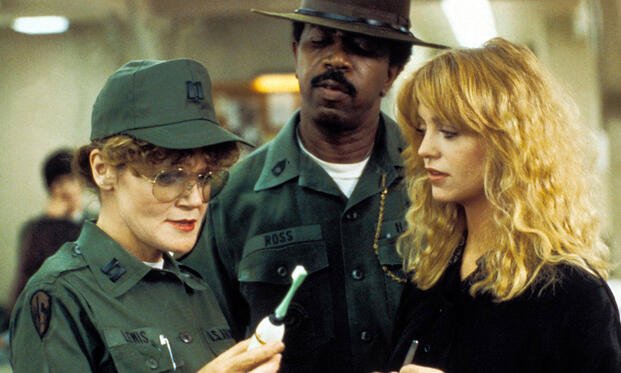
Private Benjamin (1980) — Army Basic Training, Women’s Corps
Released during a time when service comedies gained popularity post-Vietnam, Private Benjamin updated the classic boot camp trope for a female audience. Critics noted its humor and cast, although the film’s depictions of women and leadership have not aged well. Despite this, the camaraderie developed under stress remains relatable.
The film reflects a transitional period for the military, focusing on esprit de corps rather than procedural accuracy.
Realism Score: 4/10
Why It Works: Utilizes comedy to convey camaraderie, despite dated cultural portrayals.
Major Payne (1995) — ROTC-Style Discipline, Exaggerated but Familiar
While not a “military classic,” this family comedy, starring Damon Wayans as Maj. Benson Winifred Payne, delivers valuable lessons. The plot involves instilling discipline in a cadet unit for a drill competition. Beneath the humor are lessons on career transitions, mental toughness, incremental improvement, and teamwork.
Though the film leans on comedy, it effectively conveys leadership lessons, framing JROTC as a suitable setting for its themes.
Realism Score: 4/10 for tactics, 8/10 for leadership lessons
Why It Works: Uses comedy to teach discipline and resilience, emphasizing teamwork and confidence.
What Real DIs Say About Hollywood Boot Camps
- “The yelling’s not random.” It’s calculated — tempo, volume, and timing serve a purpose.
- “Recruits aren’t broken. They’re re-wired.” The goal is confidence, not cruelty.
- “No movie ever nails the smell — or how sand gets everywhere.”
Transformation is the key. Cadence calls, 3 a.m. corrections, and “impossible” tasks exist to build automatic responses under stress. The best films — even comedies — get that boot camp isn’t about pain. It’s about change.
Final Formation
Great boot camp scenes don’t just show yelling — they show teaching through friction. That’s why Ermey’s voice still echoes: the sound of chaos organized into discipline, the moment you learn pressure is a teacher, not a punishment.