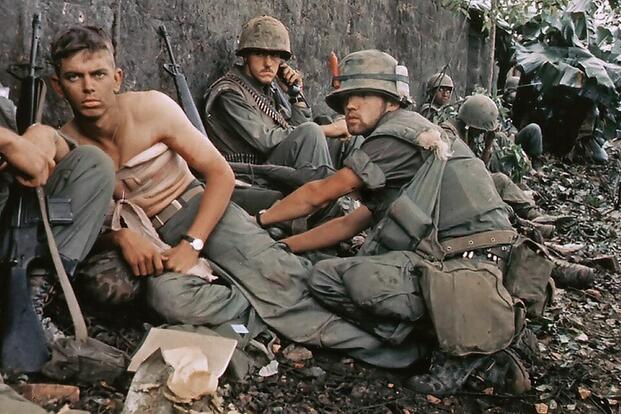
In the dense fog of the Vietnam War, few battles stand as starkly etched in memory as the Battle of Hue. This monthlong confrontation marked a turning point in the conflict, with harrowing stories of bravery and unexpected encounters defining its legacy.
The First Shots Fired
On January 31, 1968, Charles McMahon, a 19-year-old Marine from Massachusetts, found himself thrust into the fierce combat of Hue City. As he searched a backyard, a North Vietnamese Army (NVA) soldier emerged from the bushes, his rifle slung and his head down. Startled, McMahon instinctively opened fire, marking his first direct kill in the battle.
“He looked up, turned and ran, and I pulled the trigger,” McMahon remembered. “To this day I can see the look on his face … It was the first time a guy was right in front of me and I got him.”
Origins and Training
McMahon’s journey to Vietnam began in Cambridge, Massachusetts, where he grew up surrounded by wartime stories from his family. Encouraged by nuns at his school to enlist rather than be drafted, McMahon joined the Marine Corps at 17, following the footsteps of his father, a Guadalcanal veteran.
At Parris Island, McMahon was the smallest recruit, earning the role of “house mouse” for drill instructors. He then trained at Camp Geiger and joined Delta Company, 1st Battalion, 6th Marines at Camp Lejeune, under the guidance of Vietnam veterans.
Into the Heart of Vietnam
Arriving in Vietnam in November 1967, McMahon was immediately immersed in the realities of war. Initially offered a position in Force Recon, he opted to join Hotel Company, 2nd Battalion, 5th Marines at An Hoa Combat Base. As he adapted to the rhythms of patrols and road sweeps, McMahon experienced his first firefight, understanding the personal nature of combat.
Encountering the Enemy
As tensions rose in late 1967, McMahon’s patrols discovered signs of a significant NVA presence. The Marines prepared for confrontation, with McMahon eager to prove himself. His friend, Bob Meadows, teased him about not yet engaging with the NVA, asking, “Hey, when are you gonna get some?”
The Battle of Hue Begins
On the morning of January 31, 1968, McMahon’s squad was tasked with securing a convoy near Hue. Along the way, they picked up Catherine Leroy, a renowned French combat photographer, who warned them of the NVA’s hold on the city. Despite initial disbelief, the Marines soon encountered the grim reality as they approached Hue.
Upon reaching the city, the convoy was met with empty streets and ominous smoke columns, signaling the unfolding battle. Barricades halted their progress, and Leroy was captured by NVA forces shortly after crossing into Hue.
A City in Flames
The urban warfare that ensued was relentless. McMahon and his squad faced fierce resistance as they fought to reclaim Hue, with every street and building posing a potential threat. They cleared houses room by room, often encountering civilians or NVA soldiers.
One afternoon, McMahon kicked open a door to find a family huddled on the floor. The father made the sign of the cross, and McMahon reassured them, “The NVA were taking people and killing them. These people were just glad to see us.”
The Tide Turns
As the battle raged, McMahon’s unit received critical support from the Ontos vehicles, which used their recoilless rifles to break through NVA strongpoints. The Marines adapted tactics, using smoke and CS gas to dislodge enemy forces. Slowly, they pushed through the city, street by street.
By late February, the NVA had retreated from the southern half of Hue, and the battle’s end was in sight. The Marines’ perseverance and tactical ingenuity had paid off, culminating in the lowering of the NVA flag from the Citadel on February 24.
The Aftermath
Reflecting on the battle, McMahon acknowledged the heavy toll it took. Approximately 150 Marines were killed, with over 800 wounded, while the NVA suffered around 5,000 casualties. Despite the losses, McMahon took pride in their accomplishment, noting, “We fought the good fight.”
Years later, McMahon returned to Vietnam, finding a country that had moved on. Through conversations with former enemy soldiers, he realized, “These people had moved on and were now at peace. In my head, it was finally over.”
Life Beyond the Corps
After his discharge, McMahon pursued aviation studies and a career with Conrail and Amtrak, eventually retiring as senior director of engineering. He maintained connections with fellow Marines and cherished their shared history, often reflecting on the battle that defined his youth.