France Leads NATO Transformation with Innovative Command Structure
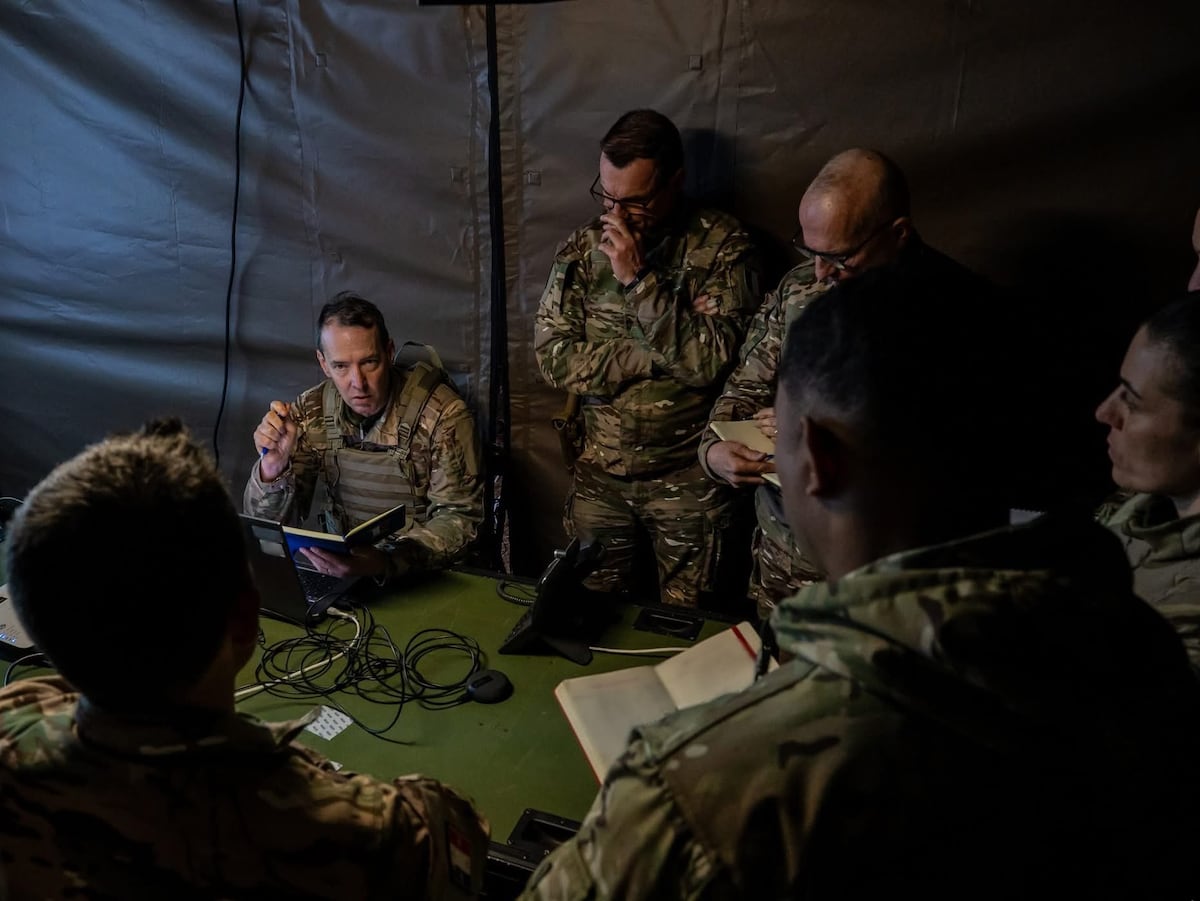
In a quiet meadow of western France, Gen. Benoît Desmeulles orchestrates a cutting-edge military exercise, Orion 26, aimed at reimagining NATO’s command strategies. The exercise, situated in a makeshift office nestled between armored personnel carriers, showcases France’s commitment to spearheading a new era of mobile command operations.
Orion 26 serves as a critical testing ground for France, where Gen. Desmeulles, from his temporary command post dubbed “CP1,” manages a force of 120,000 troops. This exercise marks a significant shift in military strategy, striving to validate France’s capability to lead a corps-level European force in scenarios of intense conflict, especially as the U.S. encourages NATO allies to assume greater defense responsibilities. The French 1st Army Corps, in this simulation, commands divisional units from Poland, Britain, Italy, and Spain.
Unlike traditional fixed command posts, Desmeulles is experimenting with a mobile forward command center positioned 80 to 100 kilometers from the conflict zone. This approach, a departure from the typical NATO setup, aims to enhance decision-making speed through an optimized observe-orient-decide-act (OODA) process. “We’ve strengthened the military aspect,” Desmeulles remarked, emphasizing the strategic advantage of being closer to the action.
The forward command post, designed for swift deployment, relies on a blend of satellite, radio, and mobile networks for connectivity. This setup allows for rapid relocation, providing a distinct edge over traditional stationary command centers. The operation is supported by a secondary command node further back, focusing on logistics and support, while the main data-heavy headquarters remains stationed in the historic Lille citadel.
Ukraine’s recent conflicts have influenced this strategic shift, but Desmeulles also draws lessons from the Gulf Wars and World War II. “We mustn’t lose sight of the fact that one day we might be engaged in something completely different,” he noted, highlighting the importance of adaptability.
This innovative approach is not without its challenges. According to Capt. Charles of the 41st Signal Regiment, fitting armored vehicles with necessary equipment remains a hurdle, though the deployment process is swift. The regiment’s forward command post setup, complete with decoy emissions, exemplifies new tactical considerations for survivability, emphasizing electronic warfare and anti-drone tactics.
The broader vision for Orion 26 is to integrate NATO’s command networks into the field, a first for the alliance. As Desmeulles explained, past deployments involved fixed, city-like command compounds, a stark contrast to the mobile, adaptable operations now being tested. “The threat was different. Now, we’re preparing to fight a different battle, so the tools evolve,” he stated.
Despite these advancements, challenges such as electromagnetic emissions and decoy effectiveness remain. During the exercise, opposing forces identified the forward post through emissions tracking and drone reconnaissance, although subsequent efforts were thwarted by decoy tactics.
France’s role in spearheading these changes positions it as a leader in NATO’s transformation of land forces, a move gaining attention from other alliance members. Desmeulles asserts that this initiative reflects France’s readiness to deploy its army corps independently, although firepower remains an area for improvement. “Whatever happens, France has an army corps ready for deployment,” he affirmed, underscoring the strategic importance of these innovations.