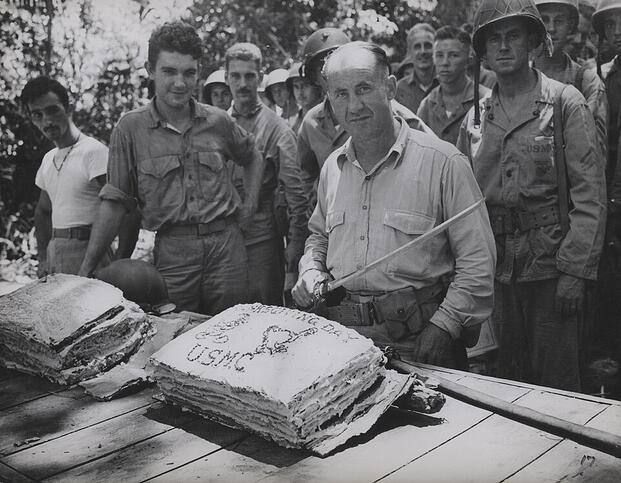
Every year on November 10, Marines around the globe partake in a unique tradition that involves slicing birthday cakes with Mameluke swords, reciting an age-old order, and ceremoniously passing a piece of cake from the oldest Marine to the youngest. These cherished customs, however, have origins that trace back to a time when the Marine Corps’ very survival was in jeopardy.
The Challenge of Preservation in the 1920s
In 1920, Major General John A. Lejeune took command of the Marine Corps during a precarious period. Despite gaining national acclaim for their valor at Belleau Wood, the Corps faced existential threats due to post-World War I disarmament pressures. The Washington Naval Treaty discussions threatened significant budget reductions, prompting debates in Congress about the necessity of a separate amphibious force. The Army and Navy appeared sufficient for America’s defense needs, leading to suggestions that the Marines were redundant.
Lejeune realized the Corps needed a robust identity beyond combat prowess to withstand political and fiscal challenges. In response, he sought to establish enduring traditions that would fortify the Marine Corps’ cultural and historical significance.
Crafting a New Legacy
By 1921, under the guidance of Major Edwin McClellan and a small team, the Marines began to acknowledge their founding on July 11, 1798. Yet, these acknowledgments were often subdued. McClellan proposed shifting the official Marine Corps birthday to November 10, 1775, commemorating the Second Continental Congress’s authorization of two Marine battalions. This suggestion was paired with a proposal for an annual celebration to highlight the Corps’ storied history and service.
Lejeune embraced this idea, issuing Marine Corps Order No. 47 on November 1, 1921, directing that a special birthday message be delivered to every command annually. The order celebrated the founding of the Marines and highlighted the legacy of those who had served.
Traditions Take Root
The inaugural Birthday Ball in 1925 marked the beginning of a grand tradition. Held in Philadelphia, it featured dignitaries, a military parade, and a ceremony at Tun Tavern’s original site. Over time, the cake-cutting ceremony emerged, with the first documented instance at Marine Barracks Washington in 1937, where the cake was cut with a Mameluke sword—a nod to Lieutenant Presley O’Bannon’s historic assault on Derna, Tripoli, in 1805.
By 1952, Commandant Lemuel C. Shepherd Jr. formalized the cake-cutting tradition across the Corps, which was integrated into the Marine Corps Drill Manual by 1956. The modern ceremony includes the passing of cake slices from the oldest to the youngest Marine, symbolizing the continuity of the Corps.
A Symbol of Endurance
Lejeune’s strategic implementation of Order No. 47 came at a time when the Marine Corps’ future was uncertain due to budgetary constraints. By instituting a formal birthday celebration, he created a tradition that strengthened the Corps’ identity and public visibility. These celebrations enhanced the public perception of the Marines as an indispensable military branch, ensuring its survival through challenging times.
The Marine Corps’ traditions have adapted to various circumstances, with celebrations held even in combat zones using ration cakes. The Marines’ Hymn, officially recognized in 1929, became an integral part of these events, further rooting the Corps in American culture.
Continued Celebration and Legacy
As the Marine Corps celebrates its 250th birthday in 2025, the traditions established by Lejeune remain pivotal. The annual celebrations, including motivational runs and historical displays, continue to reinforce the Corps’ unique identity. Lejeune’s foresight in building these traditions has ensured that the Marine Corps is not only a powerful military force but also a cherished national institution.
Today, Marine Corps birthday celebrations are widely recognized, celebrated by Marines, alumni groups, veterans, and the public. Lejeune’s legacy lives on through these enduring traditions, highlighting the Marine Corps as an irreplaceable part of America’s history and future.