The recent leadership change at Marine Aviation Logistics Squadron 36 (MALS-36) at Camp Foster, Okinawa, has sparked significant attention within military circles. The transition underscores the stringent expectations the Marine Corps holds for its commanders, emphasizing a zero-tolerance policy for any leadership that does not meet its high standards.
On November 26, Maj. Gen. Marcus B. Annibale announced that Lt. Col. Calischaran G. James was relieved from his position as the commanding officer of MALS-36. The official statement cited a “loss of trust and confidence in his ability to command,” a phrase commonly used in the military to indicate a significant breach of leadership standards. Lt. Col. Ryan T. Iden has temporarily assumed command until a permanent replacement is appointed.
Understanding the ‘Loss of Trust and Confidence’
The term “loss of trust and confidence” is a standard expression across military services, signaling that an officer is no longer deemed fit to lead. This language was similarly used when Maj. Gen. Stephen Neary was relieved in 2020, illustrating a consistent approach to leadership accountability within the Marine Corps.
While the specifics of such decisions are typically not disclosed to protect ongoing investigations, the phrase implies a failure to meet the ethical, moral, or professional standards expected of Marine leaders. It does not necessarily indicate criminal behavior but rather a determination that the individual can no longer fulfill their leadership duties effectively.
The Role of Leadership Doctrine
Marine Corps leadership doctrine, as outlined in the manual “Leading Marines”, emphasizes the sacred responsibility of command, which is viewed as a moral and professional relationship rather than merely a position. This doctrine highlights the critical role of leadership in maintaining morale, discipline, and courage among Marines.
The expectation is clear: commanders must lead by example, embodying the core values of honor, courage, and commitment. Failure to uphold these standards can result in removal from command, even without a charge under the Uniform Code of Military Justice (UCMJ).
The Impact of ‘Soft Relief’ Policies
Former Commandant Gen. David Berger addressed the practice of “soft reliefs” in a 2020 white letter, urging Marine leaders to ensure accountability through proper documentation and fitness reports. He emphasized that maintaining high standards is crucial for an elite organization like the Marine Corps.
This perspective is vital in understanding the recent decision regarding MALS-36. By holding commanders accountable, the Marine Corps aims to uphold its values and ensure that its units operate under trusted leadership.
Significance for MALS-36
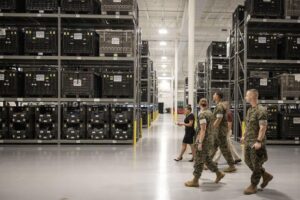
Aviation logistics units such as MALS-36 are crucial, managing maintenance, supplies, and readiness for aircraft operations. A leadership failure in these units can quickly impact safety and operational effectiveness, necessitating swift action to maintain trust and performance.
The appointment of Lt. Col. Iden as interim commander ensures continuity and stability while the Marine Corps addresses the leadership transition. This move reflects a broader pattern in which the Marine Corps uses relief-for-cause as a decisive tool to enforce leadership standards, especially in high-stakes environments like the Indo-Pacific.