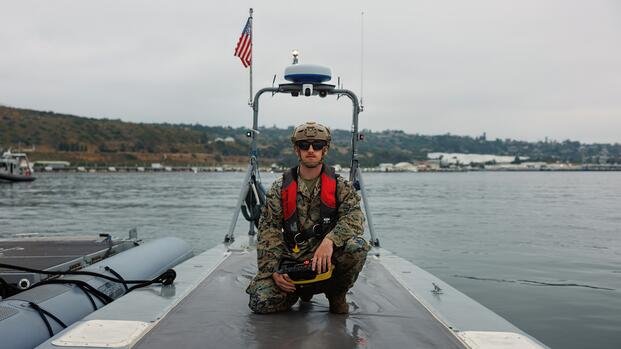
In a strategic pivot, the Marine Corps is focusing on leveraging dispersed operations across the Pacific’s island chains to address potential threats from China. Central to this strategy are small teams stationed on remote outposts, equipped with long-range missiles and sensors. However, the challenge remains in maintaining supply lines to these forward positions in hostile conditions. Blue Water Autonomy proposes a solution with its innovative autonomous ships, designed to deliver the necessary supplies without risking human lives to enemy threats.
Blue Water Autonomy’s co-founder and chief strategy officer, Austin Gray, highlights the relevance of their Liberty Class vessels to the Marine Corps’ new operational strategy. According to Gray, “These ships are built for the exact kind of persistent presence the Marines require in the first island chain,” as reported by Military.com.
They operate independently for months, carry heavy payloads, and scale in numbers that traditional manned fleets cannot match.
Marine Corps Force Design Focuses on Agility and Distribution
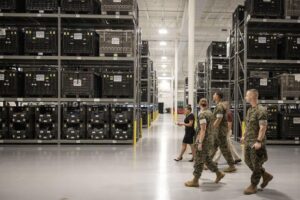
Over the past six years, the Marine Corps has undergone significant restructuring under the Force Design initiative. This involved phasing out older heavy equipment like tanks and short-range artillery, establishing Marine Littoral Regiments, reorganizing aviation and logistics units, and reducing the number of Marines by approximately 12,000. The overarching aim is to create a leaner, more lethal force that is better integrated with naval operations in high-threat coastal areas.
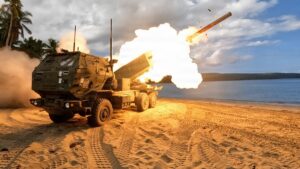
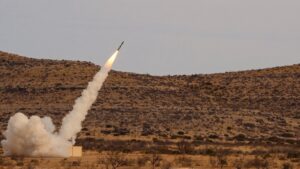
The concept of Expeditionary Advanced Base Operations (EABO) is central to this vision. It involves small Marine teams establishing temporary bases on islands or atolls to conduct sea denial using anti-ship missiles, gather intelligence, and support fleet operations. These forces operate within the adversary’s weapon engagement zone, relying on mobility, concealment, and a minimal operational footprint for survivability.
Logistics is a critical component of this strategy. Former Commandant of the Marine Corps, General David Berger, once emphasized the importance of logistics by stating:
As I have said numerous times … logistics is the pacing function.
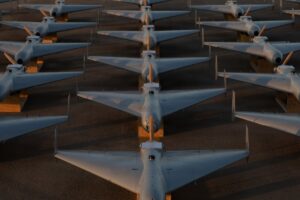
Given the vast distances, limited port infrastructure, and the threat of long-range strikes, traditional resupply methods are vulnerable. Unmanned surface vessels offer a potential solution by providing persistent, expendable platforms that can transport fuel, ammunition, food, and water directly to forward positions while keeping manned ships at a safer distance.
For a deeper dive into ongoing modernization efforts within the Marine Corps, refer to the October 2025 update on Force Design changes.
Liberty Class Designed for Scale and Endurance
In February 2026, Blue Water Autonomy introduced the Liberty Class, a 187-foot steel-hulled autonomous ship developed with Dutch shipbuilder Damen. While it is based on a proven patrol vessel design, the Liberty Class replaces traditional crew spaces with modular payload bays, advanced autonomy systems, and robust power generation capabilities for extended operations.
The ship boasts a range of over 10,000 nautical miles, speeds exceeding 25 knots, and a payload capacity of approximately 150 tons, enough to accommodate four 40-foot shipping containers or a combination of missiles, sensors, and fuel bladders. It is designed for two to three months of operations without human maintenance, utilizing Level 4 autonomy for navigation and collision avoidance even in challenging sea conditions.
Gray, a former Navy intelligence officer with experience on carriers, emphasized the ship’s open-ocean capabilities. He noted in an interview with Military.com that Blue Water’s design is not confined to calm coastal waters. The axe-bow hull and commercial-grade systems enable the vessels to traverse large water bodies and remain operational in littoral regions where Marine support is needed.
Construction of the first hull is set to commence this month at a U.S. shipyard, with delivery expected by late 2026. Blue Water plans to ramp up production to 10-20 vessels annually, offering an affordable solution to bolster fleet numbers.
Autonomous Resupply Transforms EABO Sustainment
In a potential Pacific conflict, Marine units stationed on remote islands might require resupply every few days or weeks. Traditional manned logistics ships face missile threats and necessitate escorts. The Liberty Class vessels, with their autonomous capabilities, can change this dynamic by traveling from rear-area hubs, approaching EABO sites under the cover of darkness or adverse weather, and offloading supplies at small piers, even in austere locations.
The Liberty Class’s modular loading capabilities provide a significant advantage over older platforms. While one configuration might transport fuel bladders and ammunition, another could deliver spare parts, medical supplies, or even small unmanned aerial vehicles. Without a crew onboard, commanders can take greater risks, dispatching multiple vessels on parallel routes to complicate enemy targeting efforts.
Gray emphasized the operational tempo advantage, highlighting that Marines on EABO bases cannot afford delays due to weather or escort availability. The ships operate continuously, even in Sea State 7 conditions (up to 30-foot waves), ensuring a steady supply flow that transforms temporary outposts into sustained threats for adversaries.
The use of unmanned logistics vessels could significantly reduce the burden on amphibious ships in distributed scenarios, freeing them for more critical missions.
ISR and Potential Fires Extension Add Layers
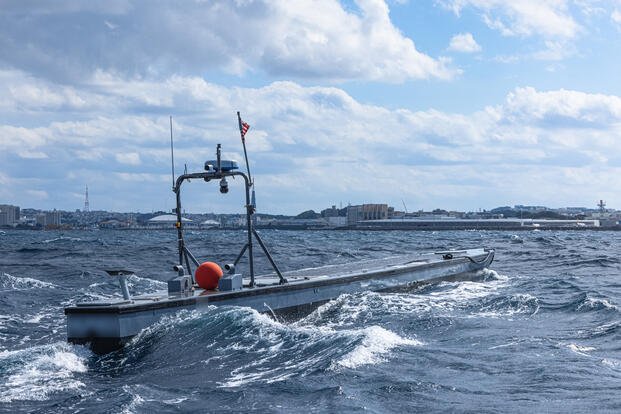
In addition to carrying cargo, Liberty Class ships can be equipped with advanced sensor suites for continuous intelligence, surveillance, and reconnaissance. This enhances the situational awareness of Marine littoral regiments, extending their reach beyond line-of-sight from shore bases. Data links facilitate the relay of information to Marine command nodes or Navy destroyers further offshore.
Future versions could include vertical launch cells for missiles, transforming the vessels into mobile, cost-effective strike platforms. Even without weapons, they can act as decoys or communication relays, complicating enemy targeting processes.
This multi-role capability aligns with the Marine Corps’ objective of all-domain integration. A single Liberty Class mission could simultaneously deliver 100 tons of 155mm rounds to one location while providing real-time targeting data to Marines stationed elsewhere.
Mass Production Revitalizes Shipbuilding Edge
Blue Water’s approach addresses a broader strategic challenge. The U.S. shipbuilding industrial base has been in decline for years, making it difficult for the Navy to expand fleet numbers in response to China’s rapid growth. By employing commercial shipyard techniques, modular construction, and software-driven autonomy, Liberty Class vessels offer significantly lower costs, approximately one-tenth the price of a traditional frigate for comparable mission days at sea.
Gray emphasized the economic impact:
Every hull that Blue Water delivers creates jobs in American yards and reduces reliance on foreign supply chains
Moreover, it provides a critical warfighting capability: the numbers needed for distributed operations across vast oceanic expanses.
Path Ahead for Navy-Marine Team
As the Marine Corps continues to refine its Force Design through exercises in regions like the Philippines and Japan, Blue Water Autonomy positions its vessels as strategic partners. The Liberty Class does not aim to replace Marines or sailors; instead, it enhances their operational reach and resilience.
Ultimately, success in the Pacific will depend on maintaining a presence where it is most needed. Unmanned fleets capable of covering large distances, delivering essential cargo, and operating in hazardous areas provide the joint force with a critical advantage. Gray and his team are developing the tools; it’s now up to the military services to integrate them into proven maritime concepts.
The first Liberty Class prototypes are set to undergo testing later this year. If they meet expectations, the Marine Corps’ expeditionary bases may soon be supported by a silent, autonomous fleet operating just beyond the horizon.