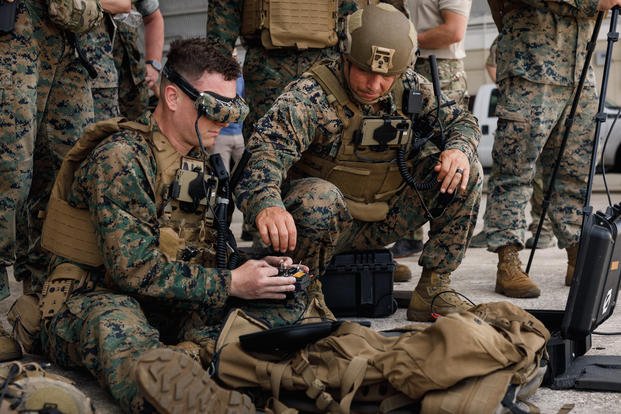
The advent of drone technology has revolutionized military operations, and the U.S. Marine Corps is at the forefront of this transformation. With the establishment of the Marine Corps Attack Drone Team (MCADT) in January 2025, the Corps is embracing the capabilities of attack drones to enhance combat effectiveness and precision.
Launch and Objectives
Stationed at Marine Corps Base Quantico in Virginia, the MCADT operates under the Weapons Training Battalion and collaborates closely with the Marine Corps Warfighting Laboratory. The unit’s objectives are to develop comprehensive training for First Person View (FPV) drones, influence new technology requirements, and participate in competitive events to refine operational tactics. An upcoming event is the U.S. National Drone Association’s Military Drone Crucible Championship in Central Florida, where they will engage in simulated combat scenarios alongside units like the Army’s 75th Ranger Regiment.
According to the Marine Corps, the MCADT’s primary tasks are:
- Developing sophisticated FPV drone training programs for Marines.
- Advising on service-level technical specifications for rapid FPV technology deployment.
- Enhancing combat effectiveness through competitive training exercises.
Transformative Technology
Drones have become critical assets on modern battlefields, enabling small units to identify and engage targets from a distance without immediate risk. In regions like Eastern Europe, FPV drones have demonstrated their effectiveness against both vehicles and fortifications. Major Alejandro Tavizon, the MCADT’s officer in charge, emphasized the importance of adapting to these advancements: “Today’s battlefield is changing rapidly, and we must adapt just as quickly.”
The Marine Corps is actively modernizing its capabilities, as evidenced by the recent training exercises conducted by the 4th Marine Regiment in Okinawa, Japan. These exercises involved untethered small unmanned aerial systems (sUAS) and autonomous ground vehicles, showcasing the potential to reduce risk to personnel. Senior Chief Hospital Corpsman David Long remarked on the benefits: “This takes a huge load off the humans.”

The Broader Impact
FPV drones are a cost-effective alternative to traditional weaponry, offering similar capabilities at a fraction of the price. With a range of up to 12 miles, these drones expand the operational reach of Marines at a cost below $5,000. The Marine Corps is also preparing to counter adversary drone threats by offering specialized courses on defense strategies.
Efforts are underway to extend drone training beyond specialists, aiming to equip more Marines with piloting skills. This initiative aligns with the Corps’ strategic objective to remain agile in contested areas, such as the Pacific, where drones can provide logistical and intelligence support. Despite challenges like capability gaps and the need for rapid deployment, the MCADT is at the cutting edge of unmanned warfare, leveraging industry partnerships and experimental initiatives.
For additional information, visit the Marine Corps’ official announcement or explore details on recent Okinawa training.