The Marine Corps is taking bold steps to ensure its forces are ready for future conflicts with an update to its Force Design 2030 strategy. This plan outlines how the Corps intends to remain agile, deadly, and adaptable amidst modern warfare’s evolving landscape.
Understanding Force Design 2030
Force Design 2030 is a comprehensive blueprint for the Marine Corps’ modernization efforts. It’s designed to maintain the Corps’ edge over adversaries deploying advanced technologies like drones, long-range missiles, and cyber warfare. The strategy emphasizes speed, lethality, and evasiveness, particularly in strategic regions such as the Pacific islands, and focuses on new equipment, innovative unit structures, and integrated operations with the Navy and joint forces.
Recent Developments in Force Design
The update offers insights into progress made since the previous year, highlighting real-world applications, unit restructuring, and new weapon systems. Notably, the Marines have tested new operational tactics across various exercises. During BALIKATAN 25, the I MEF engaged in island-based operations using NMESIS to neutralize naval threats, MADIS to counter drones, and G/ATOR radar for threat detection, in collaboration with Japanese and Philippine forces. Other exercises, such as TALISMAN SABRE and RESOLUTE DRAGON, refined precision strikes and defense strategies with allies.
Unit structures have been adjusted with the establishment of two Marine Littoral Regiments (MLRs) within III MEF. The 3d MLR became fully operational in 2023, with the 12th expected to follow by 2026. These regiments are tailored for island warfare, equipped with advanced sensors and missiles. Marine Expeditionary Units (MEUs) now carry similar high-tech gear as MLRs, and infantry battalions have added a Fires and Recon company, enhancing their capabilities with drones and rockets. The Marine Corps has also initiated a new Attack Drone Team to further hone these skills.
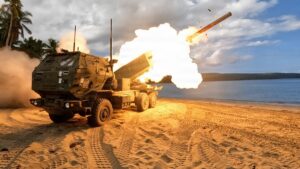
New weaponry and systems are being introduced. The NMESIS anti-ship missiles are being scaled up, and HIMARS batteries are fully operational. G/ATOR radar deployment is on track, and new precision munitions are expected by 2026. F-35 squadrons are expanding, and MQ-9A drones are actively conducting reconnaissance missions. Furthermore, 3D printing capabilities are enabling on-site manufacturing of parts, enhancing operational flexibility.
Air defense capabilities are improving with the introduction of the Medium-Range Intercept Capability (MRIC) against cruise missiles, MADIS systems on vehicles, and portable anti-drone kits to counter threats.
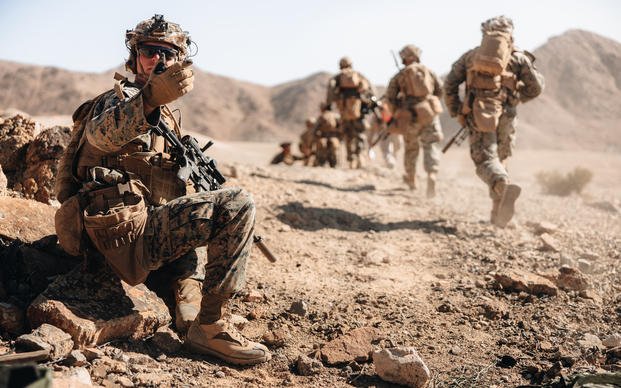
The Marine Corps is updating its doctrines, with Expeditionary Advanced Base Operations (EABO) and Stand-in Forces concepts becoming official. Base infrastructure, including barracks and defenses, is being modernized, while recruitment and retention are at record levels. Training now incorporates AI, drones, and joint operations.
The Marine Corps’ Vision for the Future
Looking ahead, the Marine Corps is focused on enhancing mobility, weaponry, joint networks, logistics, and continuous learning.
Improving maneuverability involves maintaining a fleet of at least 31 amphibious ships, developing new landing crafts, and deploying advanced ground vehicles such as the Advanced Recon Vehicle and Amphibious Combat Vehicle. Aviation strategies aim to decentralize operations with aircraft like the KC-130, CH-53, and MV-22.
Lethality enhancements include adapting NMESIS and HIMARS for challenging environments, developing new rocket launchers, and integrating drone teams for target acquisition. The F-35 will collaborate with unmanned wingmen like the XQ-58, expanding long-range strike capabilities.
Joint kill webs are being optimized to accelerate sensor-to-shooter processes with advanced command systems, AI-enhanced MQ-9 drones, and flexible targeting tools for aviation assets.
Logistics remain a focal point, with a focus on sustaining operations in contested environments by expanding prepositioned supplies in strategic locations and utilizing autonomous systems like the ALPV and Tactical Resupply UAS drones.
Education and ongoing learning are key to maintaining Marine Corps effectiveness. The Force Design update emphasizes that learning “shapes the force,” with lessons from exercises directly influencing operational changes and priorities.
The Significance of Force Design
Force Design 2030 is crucial for the Marine Corps’ ability to counter emerging threats, particularly from nations like the People’s Republic of China. These changes facilitate smaller, faster units capable of identifying and neutralizing threats without relying on extensive supply chains. For Marines, this means access to advanced tools, smarter training, and a force structured to win future conflicts. As global attention focuses on the Pacific, the Marine Corps is ensuring its readiness to meet any challenge.