Poland’s Major Defense Procurement Boost with $16.5 Billion Deal
In a significant move to bolster its military capabilities, Poland has signed contracts worth approximately 60 billion zloty ($16.5 billion) for the procurement of various defense assets. This expansive acquisition includes infantry fighting vehicles, self-propelled howitzers, military vehicles, and wheeled mortars, all sourced from local defense enterprises.
The funding for these purchases is supported by the European Union’s Security Action for Europe (SAFE) low-cost loan program. However, this decision has sparked political debate within Poland. At a recent signing event on May 30, Deputy Prime Minister and Defense Minister Władysław Kosiniak-Kamysz criticized President Karol Nawrocki for his resistance to the Brussels loan mechanism.
Nawrocki has expressed concerns that the SAFE program could allow Brussels undue control over funding. Despite this opposition, Poland’s centrist government has proceeded with the loan via executive action. “The terms are twice as favorable as the first contracts signed in [South] Korea,” Kosiniak-Kamysz remarked, defending the decision by comparing it to previous weapon deals made by a former administration.
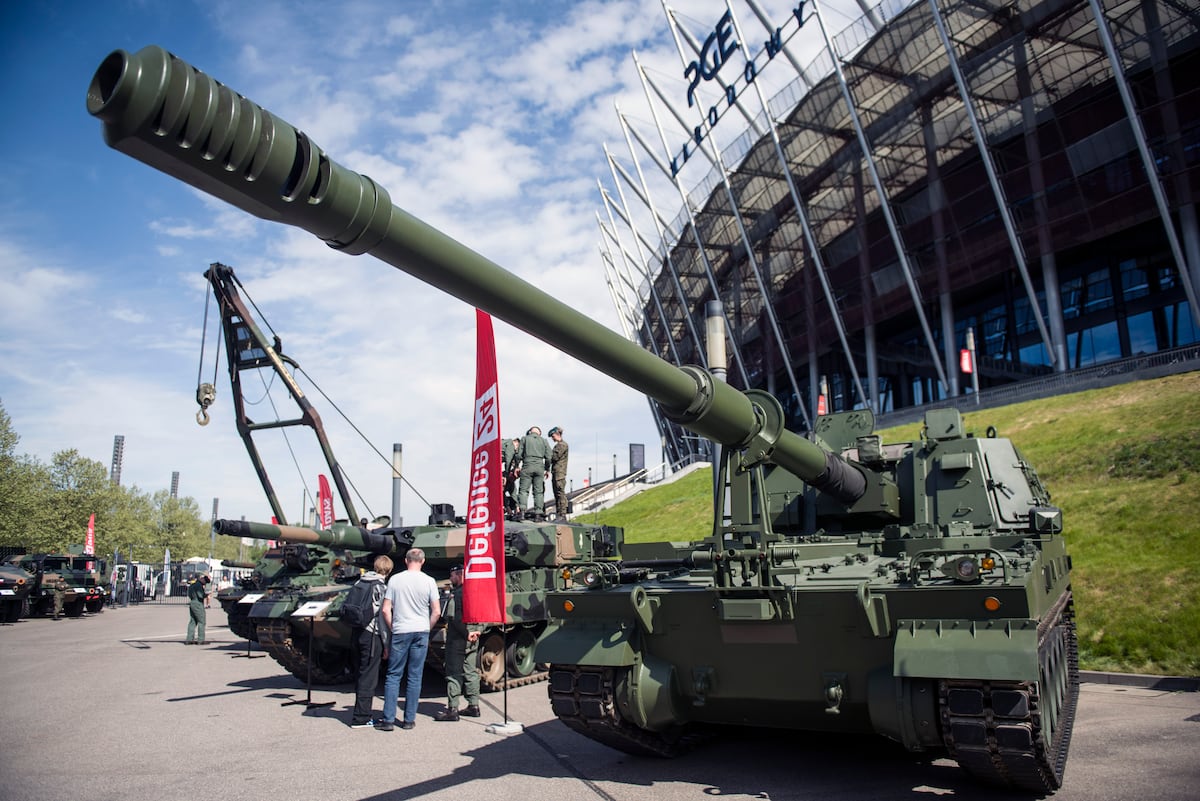
The latest contracts encompass 146 Borsuk tracked infantry fighting vehicles, 96 Krab 155mm self-propelled howitzers, 1,000 support vehicles for the Homar-K rocket launcher system, and 64 Rak 120mm self-propelled wheeled mortars. Managed by the state-run defense conglomerate PGZ, the contracts were finalized at Huta Stalowa Wola, a PGZ subsidiary known for producing land force equipment.
Beyond meeting the nation’s defense needs, these contracts aim to enhance Poland’s manufacturing capabilities for export. “We have to build up the strength and potential not only for producing for our own needs, but also for exports,” said Kosiniak-Kamysz.
Through the SAFE scheme, Poland has access to €43.7 billion ($50.9 billion) for defense acquisitions, potentially making it the largest recipient of the program. However, this has raised concerns among political figures like Mariusz Błaszczak, a former defense minister and member of the opposition Law and Justice party. He warned of potential EU interference in military procurement and a possible shift away from U.S. suppliers towards European ones.
Kosiniak-Kamysz reassured that Poland remains committed to its alliances. “While there is SAFE, other deals do not disappear. We have deals with the United States for more than 200 billion zloty,” he stated.
Further expanding its defense infrastructure, Poland also signed a contract exceeding 13.5 billion zloty for the production of “several hundred thousand” 155mm artillery rounds. This move is part of an effort to augment ammunition reserves and reinforce domestic production capabilities, drawing lessons from the conflict in Ukraine. Every shell is to be produced locally, using Polish resources, as emphasized by Arkadiusz Bąk, PGZ’s vice president.
In a strategic collaboration, PGZ has partnered with the U.K.’s BAE Systems to enhance artillery ammunition production.