The Battle of Chosin Reservoir during the Korean War is a tale of survival against overwhelming odds. In late November 1950, Mao Zedong deployed 120,000 Chinese soldiers to encircle and eliminate the 1st Marine Division near North Korea’s Chosin Reservoir. Despite the harsh conditions and numerical superiority of the Chinese forces, the story of how UN forces managed to escape remains a remarkable episode in military history.
The Chinese Offensive
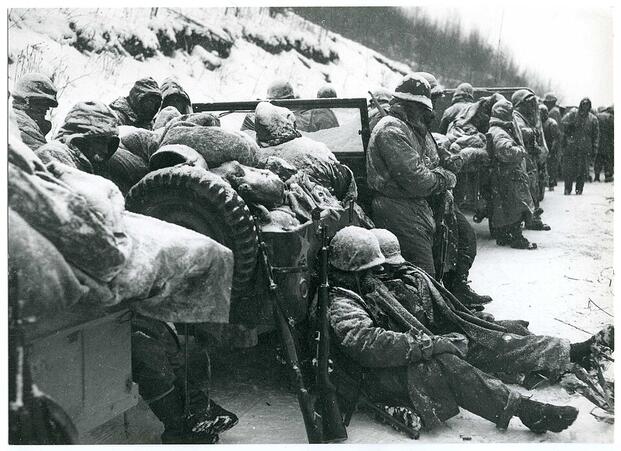
As UN troops advanced deep into North Korea, whispers of Chinese troop presence circulated, but were largely ignored by commanders like Douglas MacArthur. On November 27, 1950, temperatures dropped to 36 degrees below zero, and the Chinese launched a surprise attack on UN positions around the Chosin Reservoir. Maj. Gen. Oliver P. Smith, leading the 1st Marine Division, had anticipated potential Chinese intervention and had established supply depots, which proved crucial for their survival.
Fox Hill: A Stand Against the Odds
Fox Company, led by Capt. William Barber, held a strategic hilltop with only 220 Marines against the Chinese 59th Division’s 10,000 troops. Pfc. Hector Cafferata, in a memorable act of bravery, fought in his socks in the freezing cold after losing his boots. Despite severe wounds, he continued fighting alongside Kenneth Benson, who reloaded rifles while temporarily blinded. Barber, wounded as well, directed the defense from a stretcher, maintaining morale for five days. Both received the Medal of Honor for their heroism.
The Army’s Forgotten Battle
On the reservoir’s eastern side, Regimental Combat Team 31 faced a dire situation. Surrounded by Chinese forces, the team, led by Col. Allan MacLean and later Lt. Col. Don Carlos Faith Jr., held their ground despite severe casualties. The Army’s sacrifice, often overshadowed, played a critical role in preventing the Chinese from cutting off Marine retreat routes. Only 385 of the original 2,500 soldiers reached safety, but they had effectively neutralized two Chinese divisions in the process.
British Commandos in Hell Fire Valley
Task Force Drysdale, under Lt. Col. Douglas Drysdale, included British Royal Marines and aimed to open a withdrawal route for the 1st Marine Division. Despite heavy Chinese resistance in Hell Fire Valley, the task force managed to bolster the defenses at Hagaru-ri, contributing significantly to the UN forces’ eventual breakout.
The Breakout and Aftermath
On December 1, the 1st Marine Division began their strategic withdrawal. With air support from Marine and Navy fighter-bombers and the assistance of engineers, they navigated through destroyed bridges and Chinese roadblocks to reach Hungnam by December 11. The evacuation saved over 100,000 military personnel and civilians. The Chinese, although achieving a strategic victory by forcing the UN retreat, suffered massive losses, which stalled further advances into South Korea.
The courage displayed at Chosin Reservoir, by American Marines, Army soldiers, British commandos, and South Korean troops, is a testament to their resilience and tenacity in the face of overwhelming odds.