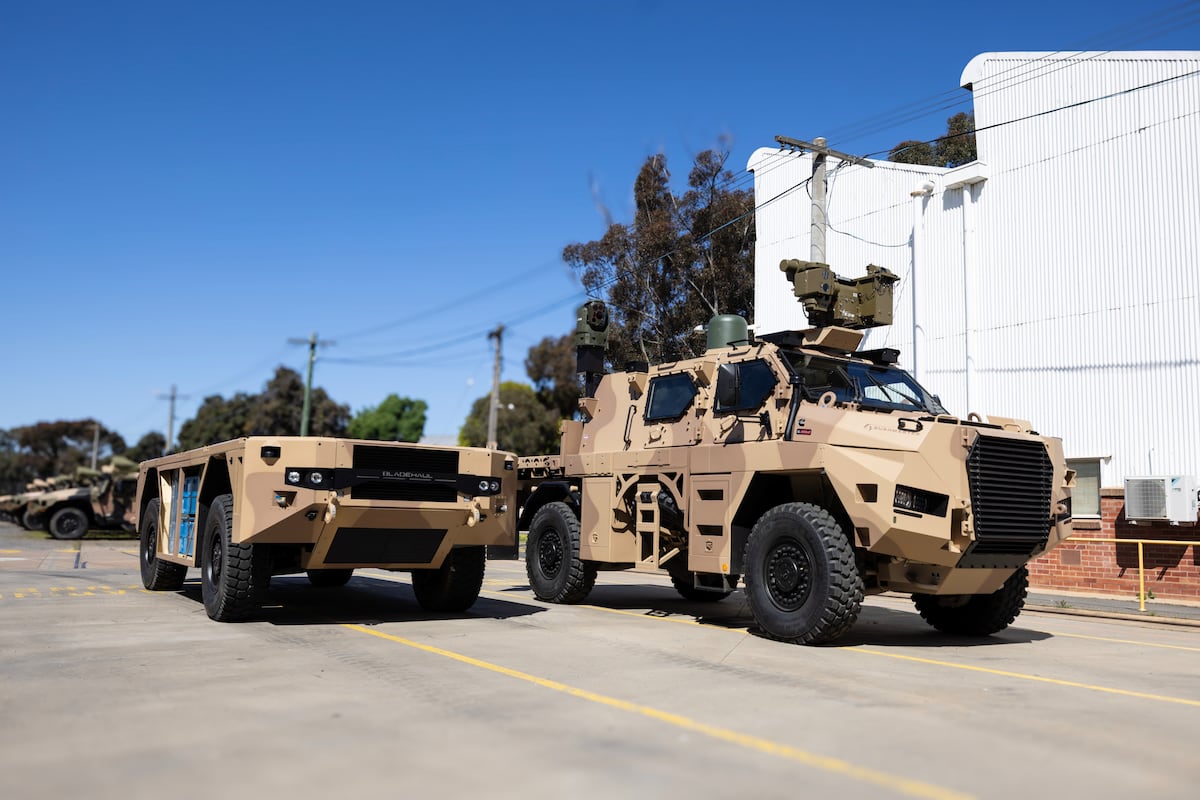
Revolutionizing Military Logistics: The BladeHaul UGV Unveiled
Envision a military vehicle capable of transporting a 20-foot container seamlessly across the battlefield while simultaneously offering the power to operate complex equipment like radar systems or missile launchers. Thales Australia has introduced such a groundbreaking innovation.
On October 6, during the Land Forces 2026 event in Perth, Western Australia, Thales Australia introduced the BladeHaul, an extra-large, heavy-duty unmanned ground vehicle (UGV). This new development leverages the robust chassis and driveline of the widely-used Bushmaster 4×4 protected mobility vehicle, a staple of the Australian Army.
As described by its creators, the BladeHaul is designed to surpass all current and anticipated models in payload capacity and operational versatility. Official specifications highlight a payload capacity exceeding 10 tons and a driving range matching the Bushmaster’s impressive 600-plus kilometers. Notably, the mechanical components of the Bushmaster have been replaced with an advanced hybrid energy and battery storage system, developed in collaboration with 3ME Technology.
3ME Technology, known for its expertise in the mining industry and for pioneering a hybrid Bushmaster, has equipped the BladeHaul with a 660V power system providing 110kWh of energy. Justin Bain, CEO of 3ME Technology, remarked, “Working with Thales Australia brings together the best of Australian innovation, combining 3ME Technology’s systems engineering and platform development capabilities with the Bushmaster’s proven performance and established manufacturing base. Together we’re delivering an entirely new XL-UGV at a time when demand for contested logistics and remote power solutions for littoral environments is present and growing.”
Thales Australia envisions multiple applications for the BladeHaul, including acting as a cargo transporter in contested logistics areas, serving as a mobile power source, and functioning as a platform for sensors and weapon systems. Potential uses include deploying coastal anti-ship missiles, counter-drone operations, air surveillance, munitions reloading, and mine detection tasks, with options for a mine plow or rollers.
Innovative uses suggested by the manufacturer include carrying containerized missile systems, launching drone swarms, or powering field hospitals and command posts. The BladeHaul boasts a 1MW power output, sufficient to supply energy to 1,000 homes, making it a versatile tool for military operations.
Despite its capabilities, the BladeHaul is still in development. Work began 18 months ago, with significant progress in the last six months, but the vehicle is yet to feature a fully operational autonomy system. Thales Australia has partnered with Deakin University to create an autonomy suite, building on the technology used in the smaller Guardian Angel UGV. This system will enable remote, fully autonomous, or follow-me operation modes.
Thales emphasized the innovation behind the BladeHaul by stating: “By integrating advanced autonomy that enables human-machine teaming, hybrid technology, heavy payload capacity and power generation within a single platform, Thales Australia and 3ME Technology are delivering a next-generation solution that enhances operational readiness and supports Australia’s commitment to sovereign defense innovation.”
Although initially aimed at the Australian Army, the BladeHaul’s potential extends to any land force. Its design does not include a V-shaped hull for blast protection, given the absence of a human crew, but ballistic shielding can be added based on mission requirements.
There is also interest in developing a UGV capable of transporting a 40-foot container. As Bain noted, “If there’s sufficient demand, we may look at that.”