Boeing’s T-7A Red Hawk Advances to Production Phase Amidst Challenges
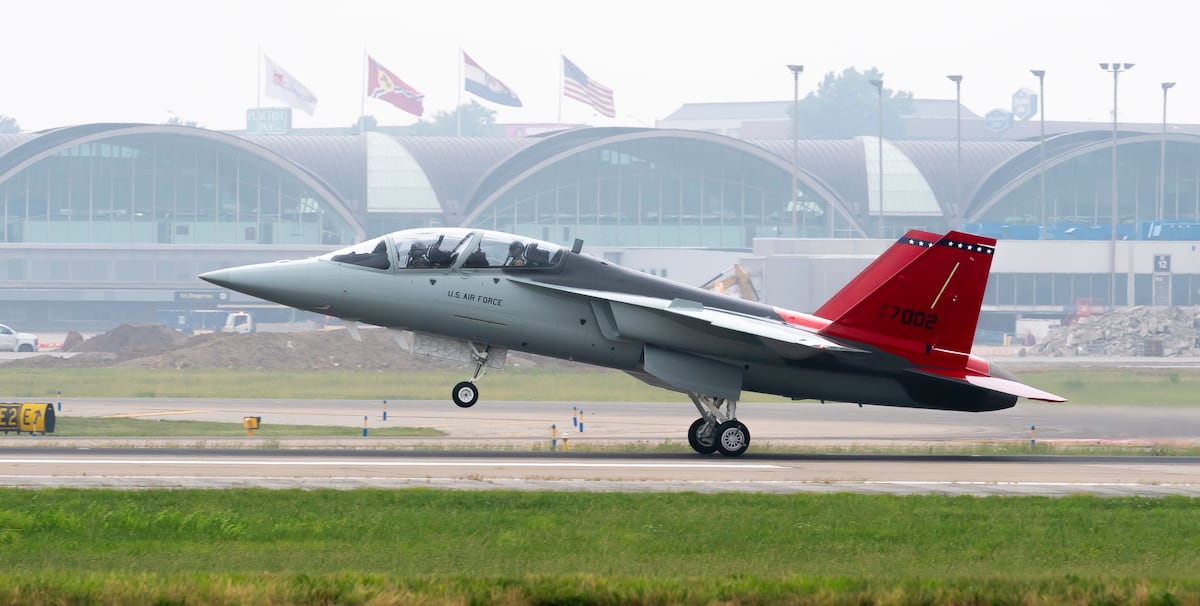
The U.S. Air Force has taken a significant step towards modernizing its training fleet with the approval of the low-rate initial production of Boeing’s T-7A Red Hawk advanced trainer aircraft. This move marks an important milestone in replacing the aging T-38 Talon, which has served the Air Force for over six decades.
On April 23, the Air Force authorized a $219 million contract to procure the first batch of 14 T-7A aircraft, along with necessary spares, support equipment, and training supplies. The service aims to achieve initial operational capability by 2027. This decision was made after the aircraft successfully passed Milestone C, a crucial juncture in the defense acquisition process that transitions a program from development to production.
William Bailey, fulfilling the duties of the assistant secretary of the Air Force for acquisition, technology, and logistics, commented on this achievement: “Reaching Milestone C is a testament to the dedicated government and industry teams who have worked diligently to overcome complex technical hurdles. The T-7A is a pivotal program for the future of our combat air forces.”
The Air Education and Training Command (AETC) emphasizes the importance of this transition. Brig. Gen. Matthew Leard, AETC’s director of plans, programs, requirements, and international affairs, stated, “Our mission is to train the next generation of combat aviators, and the T-7A Red Hawk is the tool we need to do it. Replacing our 60-plus-year-old T-38s is a top priority. The T-7A’s advanced systems will give our students a far more realistic training environment, ensuring they are prepared for the cockpits of the future.”
For Boeing, this production approval comes after overcoming multiple challenges, including ejection seat deficiencies and flight control software issues. The company has also dealt with significant financial losses, with Flight Global reporting that losses have exceeded $1.8 billion. Nevertheless, Boeing remains optimistic. Andy Adams, vice president and program manager for Boeing T-7 programs, expressed, “Boeing is honored to work with our U.S. Air Force partner in achieving this historic milestone in the T-7A Red Hawk’s journey. Getting this pathfinding digitally designed, built and tested advanced trainer into the hands of Air Force instructors and students remains our focus, and Milestone C positions us to start low-rate initial production this year.”
Despite the green light for production, the Air Force is approaching the rollout with caution. Approval for each of the first three low-rate production lots will be given separately, allowing for adjustments based on testing outcomes before moving on to subsequent batches.
The comprehensive program plans to deliver 351 T-7A aircraft and 46 ground-based training simulators distributed across five AETC bases. Boeing, in collaboration with Saab of Sweden, which manufactures the aircraft’s aft fuselage, secured the initial $9.2 billion contract in September 2018.
The T-7A Red Hawk pays homage to the legendary Tuskegee Airmen of World War II, known for their distinctive red-tailed fighter planes. The aircraft first landed at Joint Base San Antonio-Randolph on December 5, 2025, and is set to be integrated into the 99th Flying Training Squadron, a unit directly linked to the original Tuskegee squadron.