New U.S. Army Multi-Domain Task Force Activated at Fort Carson
A significant step in the U.S. Army’s strategic evolution was marked with the activation of a new multi-domain task force at Fort Carson, Colorado. This task force is part of a broader initiative to adapt to the complex global military landscape.
Named the 4th Multi-Domain Task Force, this unit is dedicated to enhancing long-range precision fires within the Indo-Pacific theater. Its primary mission, as stated by the Army, is to “deny, disrupt and disaggregate adversary capabilities” while bolstering the effectiveness of joint force operations.
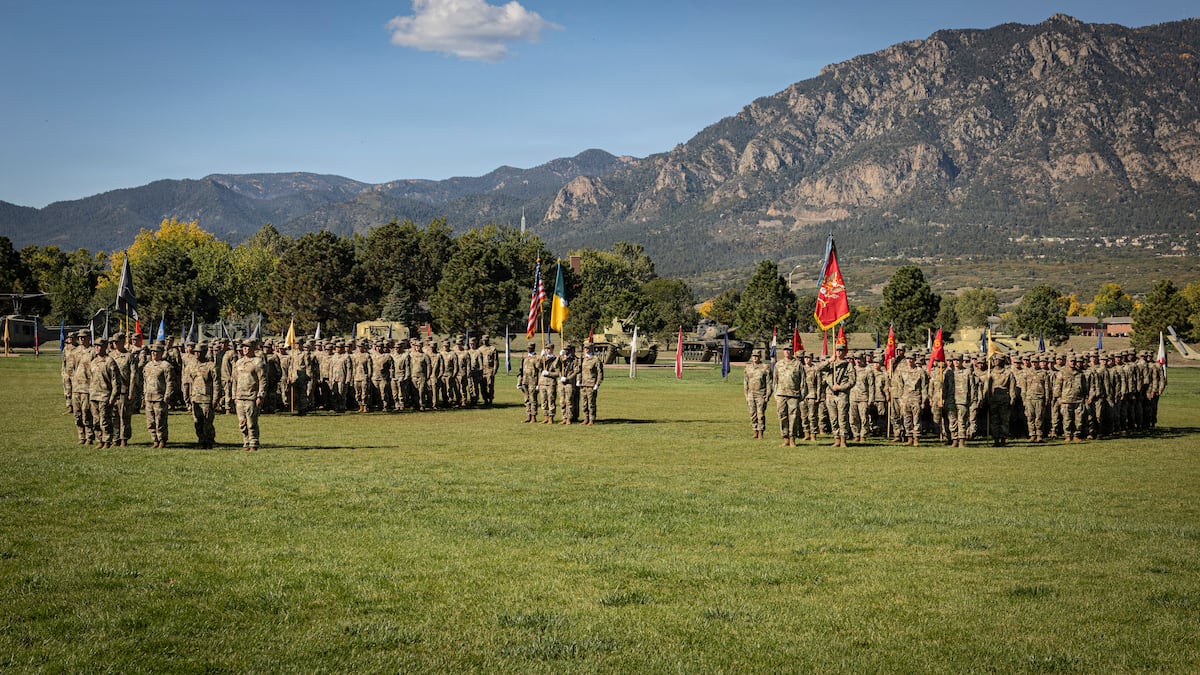
The newly formed task force comprises four battalions and is set to expand to a total strength of 2,100 soldiers. During the activation ceremony, Col. Hugh W.A. Jones took command, having previously led the 2nd Stryker Brigade, 4th Infantry Division. His leadership was instrumental when the brigade was deployed to the U.S.-Mexico border last year. “While we build this formation to deter aggression and preserve peace, if war comes, we must be prepared to fight and win,” Jones emphasized during the ceremony. “We owe those in harm’s way every advantage we can give them, while leaving our enemy nowhere to run and nowhere to hide.” (source)
The task force reports to the 7th Infantry Division, headquartered at Joint Base Lewis-McChord in Washington. This division was recently integrated with the 1st Multi-Domain Task Force, forming the 7th Infantry Division (Multi-Domain Command-Pacific). This new command structure is tasked with integrating various operational domains, including maneuver, fires, air defense, cyber, space, and more, in support of joint operations across the Pacific.
Maj. Gen. Bernard Harrington, commanding officer of the 7th Infantry Division, attended the activation ceremony. Addressing the soldiers, he stated, “You are driving the change our nation demands today, to meet the changing character of war, to prevent conflict, and to maintain a free and open Pacific alongside our allies and partners.” (source)
This activation is a component of the Army’s broader transformation strategy, which aims to counter near-peer adversaries by establishing five multi-domain task forces by 2028, as outlined in a Congressional Research Service report. The Army has already activated the 2nd Multi-Domain Task Force in Germany in 2021 and a third in Hawaii in 2022. Plans are underway to establish another at Fort Bragg, North Carolina.
These units are designed to operate across all military domains, providing a versatile set of options for combatant commanders. “As we build this formation, we must never forget that technology earns its value in the hands of well-trained and disciplined soldiers,” Jones remarked. “A soldier who solves a difficult problem here may make the difference for an American fighting far beyond the horizon.” (source)