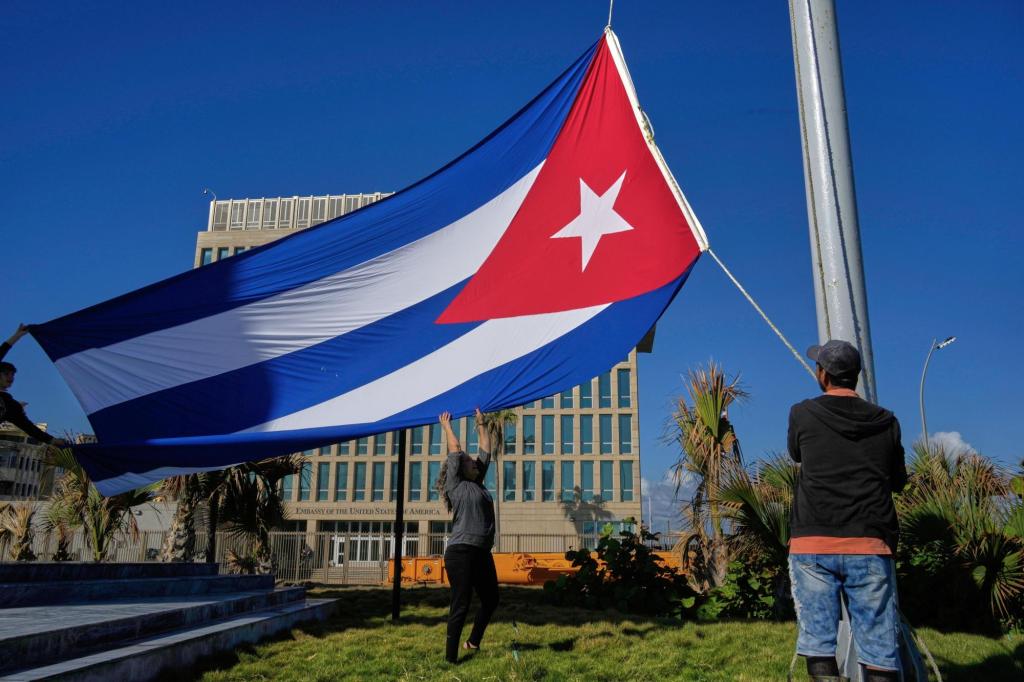
Flags Lowered in Cuba as Tensions Rise Following U.S. Actions in Venezuela
In the early hours of Monday, Cuba witnessed a somber display of mourning as the nation’s flags were lowered to half-mast. This act was in response to the recent U.S. military strike in Venezuela, a close ally of Cuba, which resulted in the deaths of 32 Cuban security personnel. The incident has prompted widespread concern among Cuban citizens regarding the implications of Venezuelan President Nicolás Maduro’s capture for their nation’s future.
The alliance between Cuba and Venezuela has been notably strong, with Cuban soldiers often serving as bodyguards for the Venezuelan president. Venezuela’s oil exports have been crucial in sustaining Cuba’s struggling economy for many years. However, Cuban authorities have so far provided limited information on the casualties from the attack.
The U.S. government, particularly under the Trump administration, has indicated that the removal of Maduro could also impact Cuba significantly. President Trump stated, “It’s going down. It’s going down for the count,” referring to the potential economic fallout for Cuba.
Cuba, home to an approximate population of 10 million, has wielded considerable influence over Venezuela, a nation rich in oil and with a population three times larger. Despite this influence, Cuba has faced persistent challenges such as power outages and food shortages. The recent events have left Cubans like 75-year-old Berta Luz Sierra Molina in despair, as she expressed, “I can’t talk. I have no words,” while others, like 63-year-old Regina Méndez, declared their readiness to fight if necessary.
Jorge Piñón, an energy expert at the University of Texas at Austin, highlighted Venezuela’s crucial role as it had been supplying Cuba with 35,000 barrels of oil daily, about 25% of Cuba’s needs. He raised a critical query: “Is the U.S. going to allow Venezuela to continue supplying Cuba with oil?”
Mexico, previously a provider of 22,000 barrels daily to Cuba, reduced its supply following a visit from U.S. Secretary of State Marco Rubio. Piñón noted, “I don’t see Mexico jumping in right now. The U.S. government would go bonkers.”
Ricardo Torres, an economist at American University, discussed the potential impact of losing Venezuelan oil, stating, “Blackouts have been significant, and that is with Venezuela still sending some oil. Imagine a future now in the short term losing that. It’s a catastrophe.”
With limited options, Cuba might look to Russia, which currently supplies around 2 million barrels of oil annually. Piñón pondered Russia’s willingness to increase support, “Russia has the capability to fill the gap. Do they have the political commitment, or the political desire to do so? I don’t know.”
Torres suggested that Cuba should pivot towards economic reforms, such as opening up to the private sector, which might encourage assistance from countries like China. “Do they have an alternative? I don’t think they do,” he remarked.
Additional reporting by Milexsy Durán in Havana and Isabel DeBre in Buenos Aires.
For more coverage on Latin America and the Caribbean, visit AP’s dedicated hub.
This article includes a correction regarding Marco Rubio’s visit to Mexico, initially reported as occurring in August, now confirmed to have taken place in early September.